First Steps: Setting Up Your Island
Welcome, aspiring industrialist, to the world of Anno 1800! The initial moments of your empire-building journey are critical. A strong foundation will ensure your city thrives, while missteps can lead to early bankruptcy and frustration. This comprehensive guide will walk you through everything from selecting your starting island to attracting your first citizens and establishing a robust early economy.
Choosing Your Starting Island: The Foundation of Your Empire
Your very first decision in Anno 1800 is arguably one of the most important: selecting your starting island. While you can eventually expand to other islands, your main island will be the heart of your operations for a long time. Don't rush this choice!
Key Island Selection Criteria:
- Fertilities: This is paramount. Look for an island with at least 3-4 different fertilities. Essential early game fertilities include:
- Potatoes: Crucial for Schnapps, a basic need for your first population tier (Farmers).
- Grain: Needed for Bread (Farmer/Worker need) and Beer (Worker need).
- Hops: Required for Beer.
- Pigs: For Sausages (Worker need).
- Wool: For Work Clothes (Farmer need).
Strategy Tip: While you won't find all of these on one island, prioritize Potatoes, Grain, and at least one of Hops/Pigs/Wool. The more, the better.
- Raw Materials:
- Wood: Abundant forests are a must. You'll be consuming a lot of wood in the early game.
- Clay: Essential for Brick production, which is needed for many advanced buildings. Ensure your island has at least one clay deposit.
- Iron: While not immediately critical, an iron deposit on your main island is a huge long-term advantage for steel production.
- Coastline and Harbors: A long, relatively flat coastline provides more space for warehouses, trade routes, and future harbor expansions. Avoid islands with too many narrow inlets or steep cliffs along the coast.
- Building Space: Look for large, flat areas for efficient city planning. While you can clear trees, mountains are permanent obstacles.
Common Pitfall: Don't pick an island solely because it looks pretty. Functionality and resource abundance are far more important in the long run.
The First Minutes: Establishing Your Foothold (Step-by-Step)
Once your island is chosen, the game begins! Follow these steps precisely to get your economy rolling and attract your first citizens.
Step 1: Place Your Warehouse
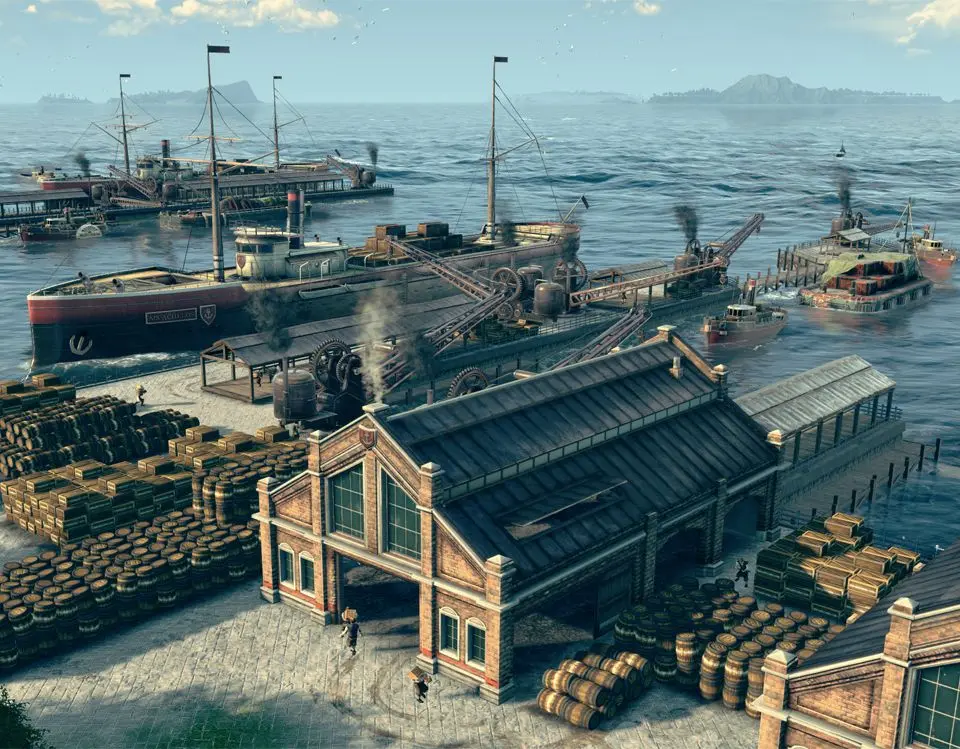
- Location: Immediately place your Warehouse (found in the "Logistics" tab of the build menu) on the coast. Aim for a central location that allows easy access to both land-based resources (forests, mines) and future trade routes. Leave some space around it for future harbor expansions.
- Purpose: The Warehouse is your island's central hub for all goods. It's where resources are stored, loaded onto ships, and distributed to your population.
Step 2: Secure Wood Production
- Lumberjack's Hut: Build a Lumberjack's Hut (under "Production > Raw Materials") deep within a forest. Ensure its green influence area covers as many trees as possible.
- Sawmill: Directly adjacent to your Lumberjack's Hut, place a Sawmill (under "Production > Raw Materials"). This converts raw wood into valuable wood planks, which are the building blocks for almost everything else.
- Roads: Connect both buildings to your Warehouse with a Road (under "Logistics"). Roads are essential for transporting goods efficiently.
- Initial Goal: Accumulate at least 50-100 wood planks quickly.
Step 3: Attract Your First Population - Farmers
- Farmer Residences: Build 3-5 Farmer Residences (under "Residences") near your Warehouse and connected by roads. These are your first citizens!
- Population Needs: As soon as Farmers move in, their needs will appear in the top-left corner of your UI. Initially, they'll demand:
- Fish: A basic food source.
- Work Clothes: Essential for their comfort and productivity.
- Schnapps: A simple alcoholic beverage.
- Income: Your Farmers will start paying taxes, providing your first trickle of income. Keep an eye on the green coin icon in the top left – this is your current balance.
Step 4: Fulfill Basic Needs - Fish & Work Clothes
- Fishery: Build a Fishery (under "Production > Food") directly on the coast, ensuring its influence area covers a good fishing spot (indicated by darker blue water). Connect it to your Warehouse with a road.
- Sheep Farm & Sheep Wool Weavery:
- First, build a Sheep Farm (under "Production > Farming") on fertile land that supports sheep (check the fertility overlay, accessed via the button next to the minimap).
- Next, build a Sheep Wool Weavery (under "Production > Industrial") nearby. This converts wool into Work Clothes.
- Connect both to your Warehouse with roads.
- Monitor Needs: Keep an eye on the population needs bar. Green means the need is met, yellow means it's partially met, and red means it's unmet. Aim for all green!
Step 5: Produce Schnapps
- Potato Farm: Build a Potato Farm (under "Production > Farming") on land with Potato fertility. Ensure its fields are placed efficiently within its influence area.
- Schnapps Distillery: Place a Schnapps Distillery (under "Production > Industrial") near your Potato Farm. This converts potatoes into Schnapps.
- Roads: Connect both to your Warehouse.
Understanding the Early Game UI
The Anno 1800 UI can seem daunting at first, but a few key elements are crucial for early success:
- Top-Left Corner:
- Population Icons: Shows your current population for each tier (Farmers, Workers, Artisans, etc.). Click on them to see their specific needs and happiness.
- Coin Icon: Your current balance and your real-time income/expense per minute. Aim for a positive income!
- Influence Icon: (Later game) Shows your current influence points, used for various bonuses and expansions.
- Top-Right Corner:
- Mini-Map: Shows your island and surrounding waters. Click the small icons next to it to toggle overlays like fertility, pollution, and attractiveness.
- Notifications: Important messages about your city, quests, or events.
- Bottom-Right Corner:
- Build Menu: Your primary tool for constructing buildings. Organized into logical tabs (Residences, Production, Logistics, etc.).
- Quick Actions: Buttons for pausing the game, fast-forwarding, or accessing the world map.
- Warehouse (Selected): When you click on your Warehouse, a detailed panel appears showing all goods stored, their current stock, and production/consumption rates. This is vital for managing your economy.
Early Game Strategy Tips & Common Pitfalls
- Roads are King: Always connect your production buildings to your Warehouse. Unconnected buildings won't transport goods.
- Overproduction vs. Underproduction: In the early game, it's better to slightly overproduce basic goods (Fish, Work Clothes, Schnapps) than to underproduce. A small surplus keeps your population happy and prevents shortages.
- Expand Residences Gradually: Don't build too many Farmer Residences at once. Only build more as your income allows and as you can consistently meet their needs. Rapid expansion without supporting infrastructure leads to bankruptcy.
- Monitor Income: Always keep an eye on your income. If it dips into the red, pause construction and identify the issue. Often, it's due to unmet needs causing your population to pay less tax.
- Quests: Pay attention to the early game quests given by NPCs. They often guide you through essential early steps and provide valuable rewards or income boosts.
- Save Frequently: Anno 1800 can be unforgiving. Save your game regularly, especially before making large investments or risky decisions.
By following these initial steps and understanding the core mechanics, you'll be well on your way to transforming your humble settlement into a bustling industrial metropolis. Good luck, and may your coffers overflow!