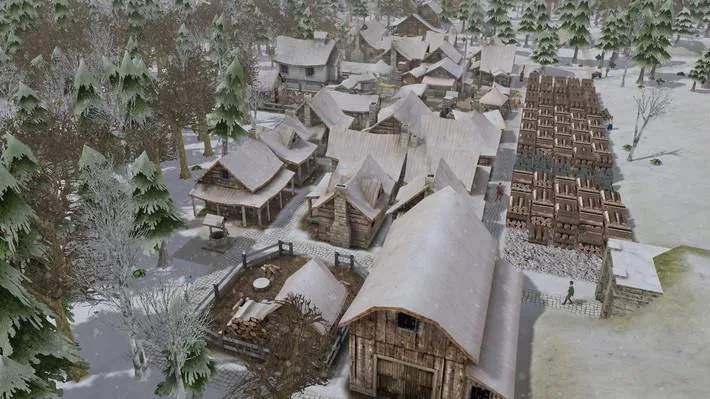
Starting Conditions & Map Generation
The foundation of any successful Banished settlement lies in its initial setup. Understanding the various starting conditions and how map generation impacts your early game strategy is crucial for long-term survival and prosperity. This section will guide you through making informed choices that set your banished citizens up for success.
Choosing Your Starting Conditions
When you begin a new game, you're presented with several options that significantly alter the difficulty and resources available. These choices are permanent for that save file, so consider them carefully.
- Starting Resources: This dictates the initial inventory your villagers arrive with.
- Easy: Provides a generous supply of food, firewood, tools, and building materials. This is highly recommended for new players to familiarize themselves with game mechanics without immediate resource pressure. You'll start with a good buffer of logs, stone, iron, and various food types.
- Medium: Offers a moderate amount of starting resources. You'll have enough to get started, but will need to prioritize resource gathering much sooner than on Easy.
- Hard: Presents a significant challenge with very limited starting resources. Expect to immediately focus on survival, as food and firewood will be scarce. This mode is for experienced players seeking a true test of their Banished skills.
- Starting Population: This determines the number of adult villagers and children that begin with you.
- Easy: You'll have a larger initial population, providing more immediate labor for various tasks. This can accelerate your early development but also increases immediate resource consumption.
- Medium: A balanced starting population, requiring careful management of labor and resources.
- Hard: A very small starting population, making every villager's contribution critical. Growth will be slow, and losing even one villager can be devastating.
- Climate: This impacts the length and severity of seasons, particularly winter.
- Mild: Shorter, less severe winters. Food and firewood demands are lower, and growing seasons are longer. Ideal for learning the game.
- Moderate: Standard seasonal cycles. Winters are noticeable and require preparation.
- Harsh: Long, brutal winters that demand significant stockpiles of food and firewood. Crop yields are reduced due to shorter growing seasons. This setting significantly increases the difficulty.
Understanding Map Generation
The map you play on is procedurally generated, offering unique challenges and opportunities with each new game. While you can't directly sculpt the terrain, you can influence its characteristics.
- Map Size:
- Small: A compact map with resources often closer together. Can feel cramped for larger settlements but simplifies logistics.
- Medium: A balanced map size, offering a good mix of space and resource distribution.
- Large: Expansive maps with abundant resources, but also greater distances between points of interest. Logistics become a more significant challenge, requiring more roads and efficient planning.
- Terrain Type: This dictates the overall landscape and resource availability.
- Valleys: Characterized by flatter, open areas, often with rivers running through them. Good for farming and building large, contiguous settlements. Stone and iron deposits might be less concentrated.
- Mountains: Features rugged, uneven terrain with many hills and cliffs. While challenging for construction, mountains often contain rich deposits of stone and iron. Finding large, flat areas for farms can be difficult.
- Lakes: Maps dominated by large bodies of water. Excellent for fishing and trade via the Trading Post, but can limit arable land and make pathfinding more complex.
- Seed: This is a numerical value that determines the exact layout of the map.
- You can enter a specific seed to regenerate a map you've played before or one shared by another player. This is useful for practicing specific strategies or comparing different approaches on the same terrain.
- Leaving the seed blank will generate a random map each time, providing endless replayability.
Strategic Map Selection & Early Game Walkthrough
Your choices in map generation directly impact your initial strategy. Here's a step-by-step guide to making the most of your starting conditions:
- Prioritize Food Production: Regardless of your starting conditions, food is paramount.
- Easy/Medium Start: Immediately construct a Gatherer's Hut and assign 2-3 workers. Gatherers are highly efficient early-game food producers, especially if placed in a dense forest.
- Hard Start: Your initial food supply will be minimal. Focus on a Gatherer's Hut first, then quickly follow with a Fishing Dock if a suitable water source is nearby. Every morsel counts.
- Secure Firewood & Shelter: Winter is a constant threat.
- Build a Woodcutter and assign at least one worker. Firewood is essential for heating homes.
- Construct Houses for your villagers. Each house requires 4 logs and 2 stone. Ensure you have enough housing for your initial population to prevent unhappiness and reduced productivity.
- Resource Gathering Infrastructure:
- Place a Storage Barn near your initial settlement to store food and other goods.
- Build a Stockpile for logs, stone, and iron. Clear initial trees and rocks around your starting point to gather these vital resources.
- Consider a Forester's Lodge early on to ensure a sustainable supply of logs, especially if you're on a smaller map or anticipate rapid expansion.
- Tool Production (Medium/Hard):
- On harder difficulties, your starting tools will deplete quickly. Plan to build a Blacksmith as soon as you have a steady supply of iron and logs. Tools are crucial for worker efficiency.
- Exploration & Planning:
- Use your initial laborers to clear small areas of trees and rocks to reveal the surrounding terrain. Look for good spots for future farms, mines, and quarries.
- Identify potential bottlenecks, such as limited flat land or distant resource nodes, and plan your expansion accordingly.
By carefully considering your starting conditions and making strategic early-game decisions based on your generated map, you can lay a strong foundation for a thriving Banished settlement, even in the harshest of environments.