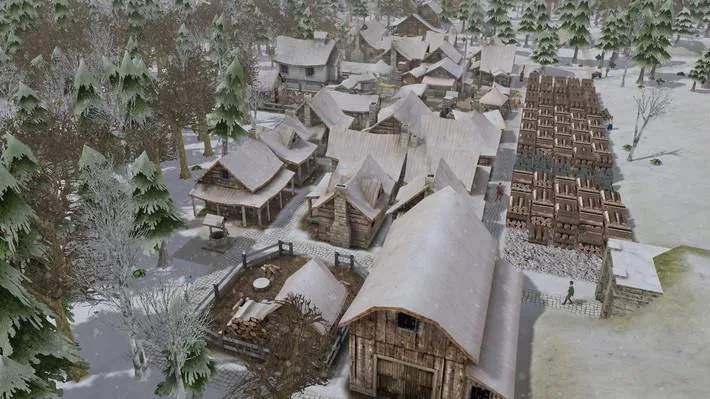
Food & Provisions
In Banished, food is the absolute cornerstone of your settlement's survival and prosperity. Without a consistent, varied, and abundant food supply, your citizens will starve, fall ill, and ultimately perish, leading to the swift collapse of your burgeoning town. Understanding the intricacies of food production, storage, and consumption is paramount for any successful chieftain.
The Importance of a Diverse Diet
While any food will prevent starvation, a diverse diet is crucial for maintaining citizen health, happiness, and overall productivity. A population consuming several food types is less prone to illness and generally more content. Aim to provide at least three different food sources consistently. A varied diet also helps mitigate the impact of a single crop failure or animal population decline, offering a resilient buffer against disaster.
Food Production Buildings & Strategies
There are five primary ways to produce food in Banished, each with its own advantages, disadvantages, and seasonal considerations. Balancing these sources is key to a resilient food economy, ensuring year-round supply and dietary diversity.
1. Gathering Hut
- Description: A basic structure where Gatherers collect wild berries, mushrooms, onions, and roots from surrounding forests. This is often one of the first food production buildings you'll construct.
- Pros:
- Year-round production, though output significantly decreases in winter.
- Requires no specific fertile land, only mature forest.
- Provides a good variety of plant-based foods, contributing to dietary diversity.
- Excellent and reliable early-game food source.
- Doesn't require tools for workers.
- Cons:
- Output is directly dependent on forest density; clear-cutting nearby trees will reduce yield.
- Can be less efficient per worker than specialized farms in the late game, but offers consistent baseline production.
- Limited by the availability of wild edibles, which can be depleted if too many huts are placed in one area without forest management.
- Strategy: Place Gatherer Huts deep within mature forests, away from areas you plan to clear for farms or housing. Ideally, surround them with a 5x5 or larger block of untouched forest. Assign 2-3 workers per hut for optimal early-game production. Combine with a Forester Lodge (set to "Plant Only" initially, then "Cut and Plant" once trees mature) and a Hunter's Lodge for a self-sustaining forest-based food and resource hub. This creates a highly efficient "forest cluster" that provides food, logs, and hides.
2. Hunter's Lodge
- Description: Hunters track and kill deer, bears, and other wild animals, providing meat and hides. They patrol a circular area around the lodge.
- Pros:
- Year-round production, though animal activity can fluctuate.
- Provides protein (meat), which is vital for a balanced diet.
- Offers a valuable secondary resource (hides for leather, which can be processed into coats at a Tailor).
- Deer populations regenerate over time, ensuring a renewable resource.
- Does not compete for fertile land.
- Cons:
- Output can be inconsistent, as it relies on animal spawns and hunter success rates.
- Requires mature forests for animal habitat; clear-cutting reduces animal populations.
- Bears can sometimes injure or kill hunters, requiring a Hospital or Herbalist to treat.
- Hunters require tools (bows/axes) to work efficiently; lack of tools severely reduces output.
- Strategy: Similar to Gatherer Huts, place Hunter's Lodges in dense forests, ideally within the same forest cluster as a Gatherer Hut and Forester Lodge. This maximizes the efficiency of the forest area. A good ratio is one Hunter's Lodge for every 2-3 Gatherer Huts in a forested area, especially if combined with a Forester. Ensure your hunters have access to tools by either building a Blacksmith or trading for them. Avoid placing too many Hunter's Lodges in one area, as they can overhunt and deplete local animal populations.
3. Fishing Dock
- Description: Fishermen cast nets or use lines to catch fish from lakes or rivers. They work from a dock structure built directly over water.
- Pros:
- Year-round production, largely unaffected by seasonal changes.
- Provides a consistent source of protein, adding crucial dietary variety.
- Does not compete for valuable forest land or fertile soil, making it ideal for settlements with limited land resources.
- Fish populations are generally robust and regenerate, though overfishing in a small area can occur.
- Cons:
- Requires direct access to a suitable body of water (lakes, wide rivers). Not all map types have abundant water sources.
- Output can be affected by the size and depth of the water body; larger, deeper bodies of water generally yield more fish.
- Can be less efficient per worker than fully optimized farms in ideal conditions, but offers stability.
- Fishermen require tools (fishing poles/nets) to work efficiently.
- Strategy: Build Fishing Docks along the edges of large lakes or wide, slow-moving rivers. Avoid placing them too close together, as they can deplete local fish populations within their operational radius. A good rule of thumb is to leave significant space (e.g., 10-15 tiles) between docks to allow fish to regenerate. Assign 2-4 workers per dock, depending on the water body's size and your food needs. Ensure a Blacksmith is producing tools or that you are trading for them, as tool availability directly impacts fishing efficiency. Placing a Storage Barn nearby will reduce travel time for fishermen, increasing their effective output.
4. Farm
- Description: Farmers cultivate crops on fertile land, providing grains (wheat, corn, squash) and vegetables (cabbage, beans, potatoes). Farms are a cornerstone of large-scale food production.
- Pros:
- Extremely high yield per worker in ideal conditions, making them the most efficient food source by volume.
- Provides a massive amount of food once established and properly managed.
- Can be specialized for specific crops, allowing for targeted dietary needs or trade goods.
- Crops like beans and squash contribute significantly to dietary diversity.
- Cons:
- Seasonal: Only produces during spring, summer, and autumn. Requires careful planning to ensure a sufficient winter food supply from stored harvests.
- Requires large, flat areas of fertile land, which can be limited on some maps.
- Vulnerable to pests and blights, which can devastate an entire harvest if not managed.
- Requires significant labor during planting (spring) and harvesting (autumn) seasons.
- Farmers require tools (hoes/scythes) to work efficiently.
- Strategy:
- Location: Identify large, flat areas of fertile land early on. Use the "Terrain" overlay (hotkey 'T') to highlight fertile soil. Aim for areas with 80%+ fertility for optimal yields.
- Size & Workers: The optimal farm size is often debated, but a 15x15 plot is a highly efficient size for 2 farmers. This allows them to plant and harvest the entire field within the seasonal windows. For smaller populations, a 10x10 farm can be managed by 1 farmer, though it will be less productive per square tile. For very large farms (e.g., 20x20), you'll need 3-4 workers. During planting (early spring) and harvesting (late autumn), temporarily assign extra laborers to farms to ensure all crops are collected before winter or before they spoil (though food doesn't spoil in storage, unharvested crops can be lost to winter). This temporary labor surge is critical for maximizing yields.
- Crop Selection:
- Wheat/Corn: High yield, good for staples. Wheat can be milled into flour at a Windmill (from mods) or traded. Corn is a robust alternative. These are excellent for raw food volume.
- Potatoes/Cabbage: Good all-around vegetables with decent yields and contribute to dietary variety. Potatoes are particularly calorie-dense.
- Squash/Beans: Excellent for dietary variety and often have good yields. Beans are particularly good as they mature relatively quickly, making them a safer bet if you're short on time for harvesting. They also help improve soil fertility over time, especially if rotated.
- Crop Rotation: While Banished doesn't explicitly model soil depletion in the same way some other games do, rotating crops can still be a good strategy for role-playing or if using certain mods. More practically, rotating crops ensures you have a diverse food output.
- Blight Management: If a blight occurs, immediately assign all available laborers to the affected farm to clear it. This is done by clicking on the blighted farm and selecting the "Clear Blight" option. This prevents the blight from spreading to adjacent farms and minimizes crop loss. Blight can severely reduce a harvest, so swift action is key.
- Storage: Build a Storage Barn directly adjacent to farms to minimize travel time for farmers, maximizing their time spent working the fields. This is crucial for ensuring harvests are brought in quickly.
- Tool Availability: Ensure a consistent supply of tools (hoes and scythes) for your farmers. A lack of tools will drastically reduce their efficiency and, consequently, your food output. Prioritize tool production at your Blacksmith or trade for them if necessary.
- Winter Planning: Farms produce zero food in winter. Ensure you have enough stored food from your autumn harvest to last until the next spring harvest. Over-reliance on farms without sufficient storage is a common pitfall for new players.
5. Orchard
- Description: Orchards grow fruit trees (apples, peaches, cherries, plums). These provide a different type of plant-based food and contribute significantly to dietary diversity.
- Pros:
- Provides a different type of plant-based food (fruit), enhancing dietary variety.
- High yield per worker once mature, often comparable to farms.
- Trees are long-lived once planted and require less year-to-year management than annual crops.
- Less susceptible to immediate seasonal failures compared to annual crops, though blights can be devastating.
- Cons:
- Seasonal: Only produces during summer and autumn. Like farms, requires storage for winter.
- Slow to Mature: Trees take several years (typically 3-5 years) to reach full production. This requires significant early investment without immediate returns.
- Requires fertile land, similar to farms.
- Vulnerable to blight, which can destroy entire sections of an orchard.
- Orchard workers require tools (pruning shears/axes) to work efficiently.
- Strategy:
- Early Investment: Plant orchards early in the game, even if you don't immediately need the food, as they take time to mature. The sooner you plant, the sooner they'll start producing. Consider planting them in your first 5-10 years to ensure a mature food source for later expansion.
- Size & Workers: A 15x15 orchard is a good size for 1-2 workers. One worker can manage a 15x15 orchard effectively once it's mature, but two workers will ensure a faster harvest. Similar to farms, you may need to temporarily assign extra laborers during harvest season, especially for larger orchards, to bring in all the fruit before winter.
- Blight Management: If blight occurs, assign extra workers to clear it quickly to prevent spread and loss of trees. Blight can be more devastating in orchards due to the long maturity time of trees; losing a mature orchard means losing years of investment.
- Storage: Like farms, place a Storage Barn directly adjacent to orchards to minimize travel time for workers during harvest, maximizing their time spent picking fruit.
- Tool Availability: Orchard workers require tools (often generic tools or specific pruning shears in some mods). Ensure your Blacksmith is producing enough or that you are trading for them.
- Crop Choice: All fruit types provide similar benefits, so choose based on availability or personal preference. Apples are a common starting choice.