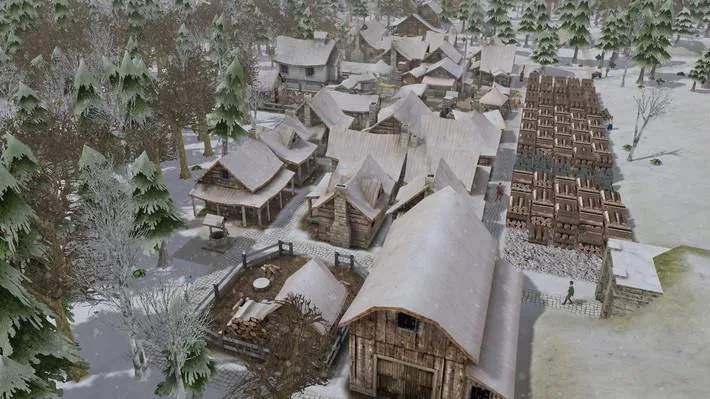
Resource Storage & Logistics
Efficient resource management is the bedrock of a thriving Banished settlement. Without proper storage and logistical planning, your villagers will spend valuable time hauling goods, leading to bottlenecks, wasted labor, and ultimately, starvation or freezing. This section will guide you through optimizing your resource flow from collection to consumption.
Early Game Storage: The Crucial First Steps
In the initial stages of your settlement, every resource counts. Prioritize basic storage immediately after establishing your first few homes.
- Stockpile: This is your most fundamental storage. Place it strategically near your initial gatherers (e.g., Gatherer's Hut, Hunter's Lodge) and your starting Town Center. Ensure it's large enough to hold a decent quantity of Logs, Stone, Iron, and Food. Remember, a full Stockpile means resources are left on the ground, exposed to decay or simply unavailable for use.
- Storage Barn: Crucial for perishable goods, especially food. Build your first Storage Barn near your initial food production (e.g., Fishing Dock, Gatherer's Hut) and your housing clusters. This minimizes travel time for villagers fetching food and prevents spoilage.
- Wood Cutter & Forester: Place a Wood Cutter and Forester's Lodge in close proximity to a dense forest. Designate a "Cut Only" zone around the Wood Cutter and a "Plant & Cut" zone for the Forester. Ensure a Stockpile is nearby for the raw Logs.
Mid-Game Expansion: Specialization and Distribution
As your population grows and your production diversifies, you'll need more specialized storage and a robust distribution network.
Specialized Storage Buildings:
- Storage Barns (Multiple): As your food production expands (Farms, Orchards, Pastures), build multiple Storage Barns. Distribute them strategically throughout your settlement to reduce travel distances for food delivery and consumption. Consider placing one near each major farming district.
- Stockpiles (Multiple): Just like Storage Barns, multiple Stockpiles are essential. Place them near quarries, mines, and logging camps to store raw materials. Also, consider placing smaller Stockpiles near construction sites to ensure materials are readily available.
- Market: The Market is a game-changer for logistics. Build it in a central location within your main residential area. Market workers will automatically collect a diverse range of goods (food, firewood, tools, clothes) from various production buildings and store them in the Market. Villagers then only need to visit the Market for their needs, drastically reducing travel time and improving efficiency. Aim for at least one Market per major residential cluster.
- Trading Post: While primarily for trade, the Trading Post also acts as a significant storage hub for goods you intend to trade or receive. Ensure it's accessible by river for merchant boats. Keep a good stock of high-value trade goods like Ale, Wool Coats, or Iron Tools here.
Logistical Strategies:
- Roads: Invest heavily in roads. Stone Roads significantly increase the movement speed of your laborers, especially those hauling heavy resources. Connect all major production sites, storage facilities, and residential areas with a network of well-maintained roads.
- Laborers: Assign a sufficient number of laborers. These unassigned workers are crucial for moving resources between buildings and Stockpiles/Barns. A shortage of laborers will lead to resources piling up at production sites and not reaching their intended destinations. Monitor your "Idle Laborers" count closely.
- Resource Limits: Utilize the resource limits feature in your production buildings (e.g., "Keep 1000 Food" in a Storage Barn). This prevents overfilling one storage building while others remain empty, promoting a more balanced distribution.
- Forester & Wood Cutter Placement: When expanding, consider placing new Forester's Lodges and Wood Cutters in areas that are becoming deforested, or near new residential zones to provide a local source of Logs and Firewood.
Advanced Logistics: Optimizing for Scale
Once your town is flourishing, fine-tuning your logistics becomes paramount to continued growth and stability.
- Strategic Building Placement: Always consider the flow of resources when placing new buildings. For example, place a Blacksmith near an Iron Mine and a Stockpile to minimize the travel distance for raw iron and finished tools. Similarly, place a Tailor near a Pasture (for wool) or a Hunter's Lodge (for leather).
- Multiple Markets: For very large settlements, a single Market may not be sufficient. Consider building additional Markets in new residential districts to ensure all citizens have easy access to supplies.
- Prioritize Hauling: In times of crisis (e.g., impending winter with low food), temporarily reassign some workers to be laborers to prioritize hauling critical resources like food and firewood to storage.
- Avoid Bottlenecks: Regularly check your production buildings for full storage. If a building's output storage is consistently full, it means resources aren't being moved efficiently. This could indicate a lack of laborers, insufficient storage capacity nearby, or poor road infrastructure. Address these issues promptly.
By diligently planning your storage and optimizing your logistical chains, you can ensure your Banished citizens remain well-fed, warm, and productive, allowing your settlement to flourish for generations.