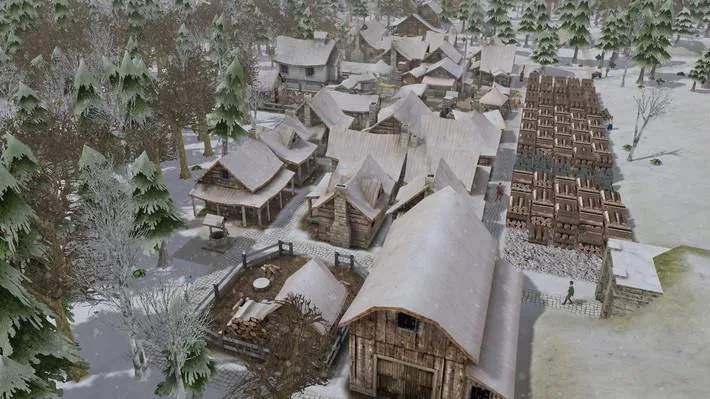
Early Expansion & Diversification: Building a Sustainable Future
With your initial settlement stabilized and basic needs met, the next critical phase in Banished is to strategically expand and diversify your economy. This involves securing varied food sources, planning efficient housing layouts, and establishing essential infrastructure to support a growing population. Neglecting these steps can lead to resource bottlenecks, starvation, or a decline in citizen happiness and productivity.
I. Food Source Diversification: Beyond the Hunter's Lodge
Relying solely on a single food source, such as a Hunter's Lodge or Gatherer's Hut, is a recipe for disaster. Seasonal changes, resource depletion, or unexpected events can quickly decimate your food supply. Diversification is key to long-term survival.
- Fishing Docks:
- Placement: Construct Fishing Docks along the banks of rivers or lakes. Optimal placement is where the dock's influence circle (visible when placing the building) covers a large body of water, ideally with deep sections. Avoid placing them too close to other resource-gathering buildings like Gatherer's Huts, as they can sometimes share the same resource pool.
- Benefits: Provides a consistent food source year-round, less susceptible to seasonal changes than farms.
- Labor: Each dock requires 1-4 fishermen. Start with 2-3 and adjust based on output and available labor.
- Consideration: Fish populations can deplete over time in a small area; consider building multiple docks spread out or rotating workers if you notice declining yields.
- Farms:
- Placement: Farms require large, contiguous areas of flat, fertile land.
- Optimal Size: For early game, start with smaller plots like 8x8 or 10x10. These sizes are manageable for 1-2 farmers and allow for quick adjustments. As your population grows and labor becomes more abundant, you can scale up to 15x15 or even 12x20 plots, which are highly efficient for 2-3 farmers.
- Proximity: Ideally, place farms relatively close to your housing clusters to minimize travel time for farmers, but prioritize fertile land. Avoid placing them directly adjacent to forests you intend to harvest, as tree removal can impact soil quality.
- Water Access: While not strictly required for farm operation, having a well nearby can be beneficial for farmers in case of a fire, though this is a secondary concern to fertile land.
- Crop Selection:
- Early Game: Prioritize high-yield crops like Corn or Wheat for staple food. Potatoes are also a good option, offering good yield and a relatively short growing season. Aim for a mix to prevent monoculture risks.
- Mid-Game: Introduce Beans or Squash. While their raw food yield might be slightly lower than corn or wheat, they contribute to dietary diversity, which can improve citizen health and happiness, reducing instances of illness.
- Late Game & Advanced Strategy: Consider specialized crops. Cabbage offers good yield and can be harvested multiple times in a season if managed carefully. Pumpkins have a high yield but a longer growing season. For maximum efficiency and resilience, aim to have at least 3-4 different crop types spread across your farms. This mitigates the risk of a single crop failure due to blight or unexpected weather patterns. Remember to rotate crops annually (e.g., Corn one year, Beans the next) to maintain soil fertility and prevent pest buildup, though this is not explicitly simulated as a mechanic, it's good practice for role-playing and strategic thinking.
- Labor: Farms are labor-intensive, especially during planting and harvesting seasons. Ensure you have sufficient unassigned laborers or dedicated farmers. A good rule of thumb is 1 farmer per 100-150 squares of farm plot.
- Seasonal Nature: Farms only produce during warmer months. Plan your food storage accordingly to last through winter. Over-producing in summer is crucial.
- Placement: Farms require large, contiguous areas of flat, fertile land.
- Orchards:
- Placement: Similar to farms, orchards require flat, fertile land.
- Optimal Size: Start with 8x8 or 10x10 plots. These are efficient for 1-2 orchardists. Larger orchards (e.g., 12x12 to 15x15) can be managed by 2-3 workers.
- Proximity: Like farms, place them reasonably close to housing.
- Tree Selection:
- Early Game: Apple or Peach trees are good starting choices. Apples tend to have a slightly higher yield.
- Long-Term Investment: Orchards take several years (typically 3-5) to reach full production, but once mature, they provide a consistent, high-value food source for many decades. They are less labor-intensive than farms once established, primarily requiring workers for harvesting.
- Yield & Maintenance: Mature orchards can produce significant amounts of fruit. They are also less susceptible to immediate crop failures than annual farms, offering a stable food backbone.
- Labor: Orchards require less active labor than farms once established, primarily for harvesting. One orchardist can manage a surprisingly large area once trees are mature.
- Placement: Similar to farms, orchards require flat, fertile land.
II. Strategic Housing & Service Placement
As your population grows, haphazard housing construction will lead to inefficiencies and unhappy citizens. Thoughtful planning is crucial.
- Housing Clusters:
- Optimal Cluster Size: Instead of spreading houses thinly, build them in compact clusters of 8-12 houses. This maximizes the efficiency of nearby services.
- Roads: Connect these clusters with well-maintained dirt roads to reduce travel time. Upgrading to stone roads later significantly boosts travel speed.
- Future Expansion: Leave space between clusters for future expansion or the placement of larger buildings like Markets.
- Integrating Services:
- Wells: Place a Well at the center or edge of each housing cluster. One well can effectively serve approximately 10-15 houses. This provides immediate access to water for citizens and is critical for fire suppression.
- Markets: Once your population reaches around 50-75 citizens, construct your first Market.
- Placement: Place the Market centrally to serve 2-3 housing clusters. Its large influence radius (visible during placement) should ideally cover the majority of your residential area.
- Benefits: Markets significantly reduce citizen travel time for acquiring food, tools, and clothing, as vendors bring goods directly to the market. This frees up citizens to work more efficiently. This also centralizes goods, making it easier to track overall resource levels.
- Labor: Each Market requires 1-4 vendors. Start with 2 and add more as your population and resource diversity grow.
- Storage Barns & Stockpiles: Ensure each housing cluster has a nearby Storage Barn for food and goods, and a Stockpile for raw materials (wood, stone, iron). This minimizes travel time for workers depositing resources. A good ratio is one Storage Barn per 15-20 houses, and Stockpiles as needed near resource extraction points or processing buildings.
III. Education and Tool Production
Investing in education and maintaining a steady tool supply are foundational for a productive and advanced society.
- School:
- Timing: Build your first School once your population reaches around 20-30 adults and you have a stable food supply. Prioritize this before your first generation of children becomes adults.
- Benefits: Educated workers are significantly more efficient in all professions (e.g., farmers, miners, foresters, blacksmiths). They also live longer and are less prone to illness. An educated worker produces roughly 20-30% more resources than an uneducated one.
- Labor: Requires 1 teacher.
- Placement: Place the school centrally within your main housing area to minimize travel time for children.
- Blacksmith:
- Timing: A Blacksmith becomes essential once you have a stable supply of Iron Ore (from a Mine or trading post) and Wood (for fuel). This usually occurs after your initial expansion, around the time you start building your first mine or quarry. Aim to have one operational before your initial stock of tools runs out.
- Benefits: Produces crucial Tools. Tools are consumed by almost every profession, and a lack of tools drastically reduces worker efficiency and output. Running out of tools can cripple your economy.
- Labor: Requires 1-2 blacksmiths.
- Materials: Requires Iron Ore and Logs.
- Alternative: In the very early game, if iron is scarce, you can trade for tools at a Trading Post. However, self-sufficiency is always the long-term goal.
- Tool Types: Blacksmiths can produce Stone Tools (less efficient, uses stone and wood) or Iron Tools (more efficient, uses iron and wood). Prioritize Iron Tools as soon as resources allow, as their durability means less frequent replacement and higher worker output.
IV. Raw Material Diversification: Beyond Woodcutting
As your settlement grows, your demand for raw materials will expand beyond just wood. Diversifying your raw material acquisition is critical for advanced construction and tool production.
- Quarries:
- Timing: Construct your first Quarry once you have a stable food supply and a population of at least 30-40 adults, as they are labor-intensive.
- Placement: Quarries must be built on rocky terrain. Look for large, dark grey rock formations on the map. They have a large footprint, so plan accordingly.
- Benefits: Provides a steady supply of Stone, essential for building advanced structures like Stone Houses, Markets, Trading Posts, and upgrading roads. Stone structures are more durable and resistant to fire.
- Labor: Each Quarry can employ 1-8 workers. Start with 4-6 workers to ensure a good output.
- Consideration: Quarries are a finite resource. Once depleted, they leave a large, unusable pit. Plan their placement carefully, perhaps on the outskirts of your main settlement.
- Mines:
- Timing: A Mine is a mid-game building, typically constructed after your first Quarry, once you have a consistent supply of food and tools, and a population of 50+ adults.
- Placement: Mines must be built on mountainous or hilly terrain, often indicated by darker, more rugged ground. Like Quarries, they have a significant footprint.
- Benefits: Provides Iron Ore and occasionally Coal. Iron Ore is vital for producing Iron Tools at the Blacksmith. Coal can be used as fuel in homes and some industrial buildings, reducing reliance on firewood.
- Labor: Each Mine can employ 1-8 workers. Start with 4-6 workers.
- Consideration: Similar to Quarries, Mines are finite resources and will eventually deplete, leaving a large, unusable hole. They are also prone to collapse if not maintained, though this is not a direct game mechanic, it adds to the thematic challenge.
- Safety: Mines can be dangerous. Ensure your miners are well-fed and housed nearby to minimize travel time and maximize productivity.
- Forestry & Woodcutters:
- Forestry: While you start with a Woodcutter, establishing a dedicated Forester is crucial for sustainable wood production.
- Placement: Place Foresters in large, undeveloped forest areas. Their influence circle shows where they will plant new trees and harvest mature ones.
- Benefits: Foresters ensure a renewable supply of Logs and Firewood. They plant new trees, allowing for long-term resource management.
- Labor: Each Forester can employ 1-4 workers. Assign 2-3 to plant and 1-2 to cut for a balanced approach.
- Strategy: Set the Forester to 'Plant Only' for a few years to establish a dense forest, then switch to 'Cut & Plant' or 'Cut Only' as needed.
- Woodcutter: Place Woodcutters near your Forester's Lodge or Storage Barns to process logs into firewood efficiently. Firewood is your primary heating source and a valuable trade good.
- Forestry: While you start with a Woodcutter, establishing a dedicated Forester is crucial for sustainable wood production.
By carefully planning your expansion, diversifying your resources, and investing in infrastructure and education, you will lay a robust foundation for a thriving and resilient Banished settlement.