The Gothic Line: Breaching Fortress Italy
The Gothic Line represents the final, most formidable defensive barrier in the Italian Campaign. Stretching across the Apennine Mountains from the Tyrrhenian to the Adriatic Sea, this German stronghold is a testament to meticulous engineering and brutal determination. Unlike the Gustav Line, which relied heavily on natural terrain, the Gothic Line integrates a complex network of concrete bunkers, artillery emplacements, machine gun nests, minefields, and anti-tank ditches. Expect a protracted and costly engagement if you approach it without a comprehensive strategy.
By this stage of the campaign, your companies should be highly veteran and equipped with the most advanced upgrades. This is not the time for half-measures. Success hinges on precise combined arms assaults, leveraging every available asset to crack this seemingly impenetrable defense.
Understanding the Enemy: Common Gothic Line Defenses
Before committing your forces, it's crucial to understand the types of fortifications you'll encounter. The Germans have had ample time to prepare, and their defenses are layered and mutually supporting.
- Concrete Bunkers & Pillboxes: These are the backbone of the Gothic Line, often housing heavy machine guns (MG42s) or anti-tank guns (PaK 40s). They offer extreme resistance to small arms fire and require specialized anti-fortification tactics.
- Artillery Emplacements: Expect numerous 10.5 cm leFH 18 howitzers and 8.8 cm Flak 36 guns, often dug into reinforced positions, providing devastating indirect fire support and anti-tank capabilities.
- Machine Gun Nests: Beyond the bunkers, numerous MG42 teams will be positioned in well-concealed, mutually supporting positions, creating deadly kill zones.
- Minefields & Barbed Wire: Extensive minefields (Teller mines, S-mines) and barbed wire entanglements will funnel your troops into pre-sighted kill zones, slowing your advance and inflicting casualties.
- Anti-Tank Ditches & Dragon's Teeth: These engineered obstacles are designed to halt armored advances, forcing your tanks into vulnerable positions or requiring dedicated engineering support to breach.
- Concealed Infantry Positions: German Grenadiers and Panzergrenadiers will be dug in, often in camouflaged foxholes or trenches, ready to ambush advancing infantry.
Breaching the Line: Step-by-Step Tactical Recommendations
Successfully breaching the Gothic Line requires a multi-pronged approach, focusing on softening defenses, creating breakthroughs, and exploiting vulnerabilities. Here’s a step-by-step guide:
Phase 1: Reconnaissance & Softening Up
- Extensive Reconnaissance: Before any major assault, use reconnaissance aircraft (e.g., P-47 Thunderbolt recon runs) or scout units (e.g., US Rangers with recon ability, British Commandos with Pathfinder ability) to identify key enemy strongpoints, artillery positions, and potential weak points in the line. Prioritize targets for air strikes and artillery barrages.
- Artillery & Air Superiority: Dedicate your tactical map abilities to softening up the most dangerous threats.
- Target Bunkers & Artillery: Use heavy artillery (e.g., M12 Gun Motor Carriage, British Sexton) or concentrated air strikes (e.g., P-47 Rocket Strafe, Typhoon Rocket Attack) to suppress or destroy concrete bunkers and enemy artillery.
- Suppress MG Nests: Use mortar teams (e.g., M1 Mortar Team, British 3-inch Mortar Team) or light artillery to suppress machine gun nests, allowing your infantry to advance.
- Mine Clearing: Deploy dedicated engineer units (e.g., US Combat Engineers, British Royal Engineers) with mine detectors to clear paths through minefields. This is slow but essential to prevent catastrophic losses.
Phase 2: The Main Assault - Creating a Breakthrough
Once defenses are softened, focus on creating a narrow, decisive breakthrough. This requires a concentrated force.
- Combined Arms Push: Launch your main assault with a balanced force.
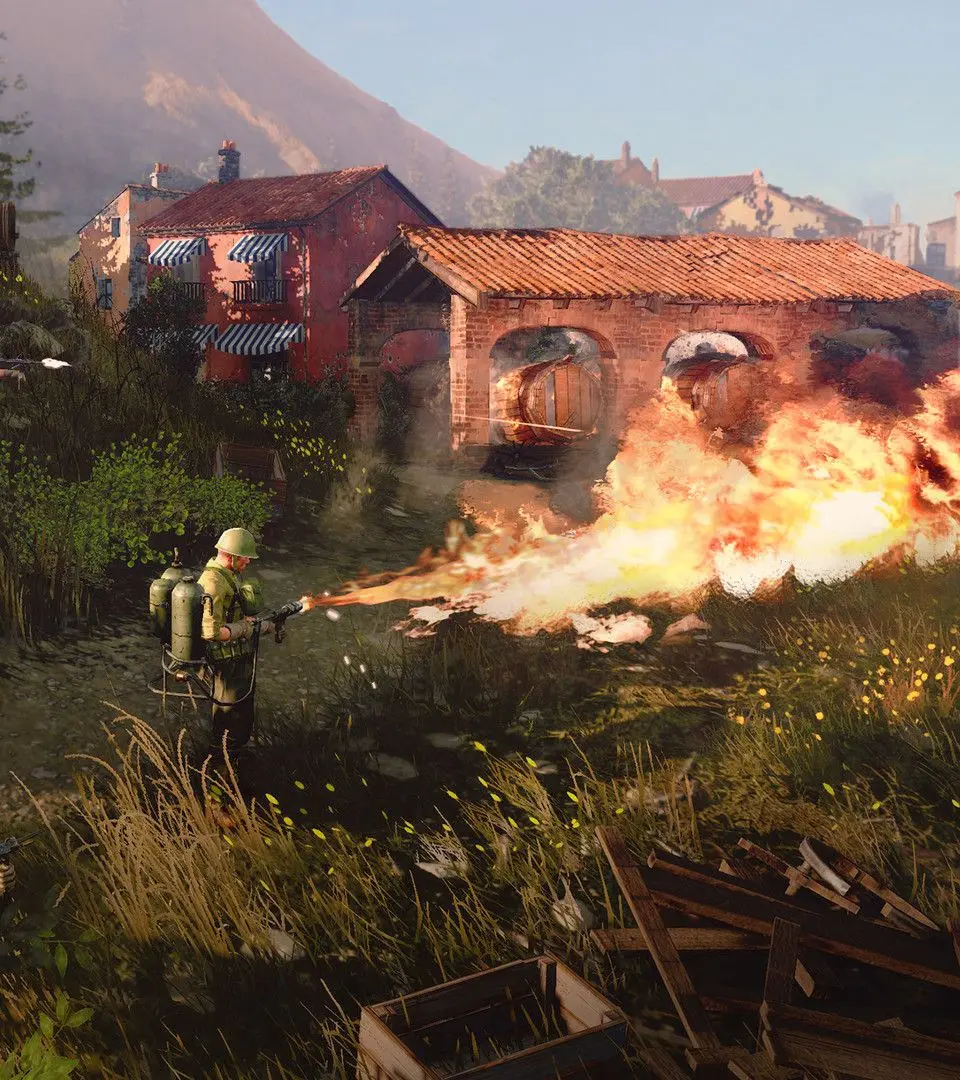
- Heavy Armor (Front): Lead with heavy tanks (e.g., M26 Pershing, Churchill Crocodile flamethrower tank) to absorb fire and breach obstacles. The Churchill Crocodile is particularly effective against bunkers and entrenched infantry with its flamethrower.
- Assault Infantry (Behind Armor): Follow closely with assault-oriented infantry (e.g., US Rangers with Bazookas, British Commandos with PIATs) to clear bunkers and engage enemy infantry at close quarters. Equip them with anti-tank grenades for unexpected armor encounters.
- Engineer Support (Immediate Rear): Keep engineer units close behind your assault infantry to repair damaged tanks, clear remaining obstacles, and lay down smoke screens.
- Smoke Screens: Utilize smoke barrages (from mortars, artillery, or tank smoke launchers) to obscure enemy line of sight, allowing your infantry to close the distance to bunkers and machine gun nests without taking heavy casualties.
- Flanking Maneuvers: If possible, use light, fast units (e.g., M8 Greyhound armored car, Dingo Scout Car) to probe for weak points on the flanks of the main assault. A successful flank can draw enemy fire and create opportunities for encirclement.
Phase 3: Exploitation & Encirclement
Once a breakthrough is achieved, do not hesitate. Exploit it aggressively to prevent the enemy from regrouping.
- Rapid Advance: Push through the breach with mobile units (e.g., M4 Sherman tanks, Cromwell tanks, Half-tracks carrying infantry) to widen the gap and cut off enemy retreat paths.
- Encirclement: Use your mobile forces to encircle enemy pockets that have been bypassed by the main assault. This forces surrenders or allows for their systematic destruction with reduced risk.
- Consolidate & Defend: As you advance, establish forward defensive positions. Bring up anti-tank guns (e.g., M1 57mm Anti-Tank Gun, British 6-pounder Anti-Tank Gun) and machine gun teams to secure your gains against counterattacks.
Specific Unit Compositions & Abilities for Fortified Positions
Certain units and abilities excel at cracking heavily fortified positions:
| Unit/Ability | Faction | Effectiveness vs. Fortifications | Notes |
|---|---|---|---|
| M12 Gun Motor Carriage | US Forces | High (Artillery) | Devastating against bunkers and emplacements. Long range, but vulnerable up close. |
| Churchill Crocodile | British Forces | Very High (Flamethrower Tank) | Exceptional for clearing bunkers and entrenched infantry. Good armor. |
| P-47 Rocket Strafe / Typhoon Rocket Attack | US / British Air Support | High (Air Strike) | Excellent for destroying or heavily damaging bunkers and artillery. Requires air superiority. |
| US Rangers (Bazookas) | US Forces | Medium (Assault Infantry) | Effective against bunkers at close range, especially with veterancy. Good all-around assault unit. |
| British Commandos (PIATs) | British Forces | Medium (Assault Infantry) | Similar to Rangers, PIATs can crack bunkers. Excellent for flanking and close-quarters combat. |
| Combat Engineers / Royal Engineers | US / British Forces | Essential (Support) | Mine clearing, obstacle removal, bunker demolition charges (US), and tank repairs. Absolutely vital. |
| M4 Sherman (W) with Dozer Blade | US Forces | Medium (Obstacle Clearing) | Can clear barbed wire and some light obstacles, creating paths for infantry. |
| M8 Scott / Sexton | US / British Forces | High (Mobile Artillery) | Provides mobile indirect fire support to suppress and destroy enemy positions. |
Common Pitfalls & Missables
- Underestimating Enemy Artillery: German artillery is plentiful and accurate. Failure to suppress or destroy it will lead to heavy casualties during your advance.
- Ignoring Minefields: Rushing into uncleared minefields is a quick way to lose valuable vehicles and infantry. Always use engineers.
- Frontal Assaults Only: Attempting to brute-force through the strongest points of the line without softening them up or attempting flanking maneuvers will be disastrous.
- Lack of Anti-Tank Support: Even if you're focused on bunkers, the Germans will counterattack with tanks. Ensure you have dedicated anti-tank units or abilities ready.
- Forgetting Air Superiority: The Gothic Line is a prime target for air strikes. Don't neglect your air support options.
- Not Consolidating Gains: A breakthrough is only useful if you can hold it. Bring up defensive units and reinforce your positions to prevent counterattacks from collapsing your advance.
The Gothic Line is a grueling challenge, but with careful planning, precise execution, and the right unit compositions, you can break through and secure victory in Italy. Stay vigilant, adapt to the enemy's defenses, and push for the final triumph.