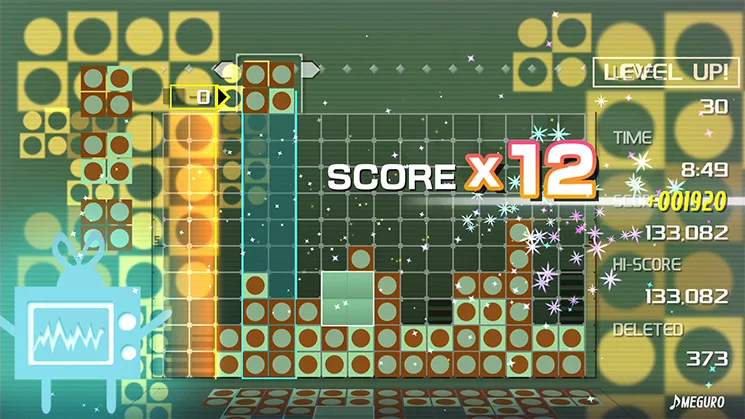
Basic Block Manipulation Techniques
Mastering the art of block manipulation is fundamental to achieving high scores and clearing stages efficiently in Lumines Remastered. Unlike many puzzle games, successful play isn't just about clearing blocks, but about strategically positioning them to create larger, more impactful clear zones. This section will detail the core techniques you'll need to develop.
Understanding Block Types and Movement
Each falling block in Lumines Remastered is a 2x2 square composed of two different colored smaller blocks. These are your primary tools for creating chains and clearing the playfield.
- Rotation: Use the A Button (Switch), X Button (PlayStation), or A Button (Xbox) to rotate the falling block clockwise. This allows you to change the orientation of the two colors within the 2x2 square. For example, if you have a block with two red squares on top and two blue squares on the bottom, rotating it once will place a red square on the top-left, a blue on the top-right, a red on the bottom-left, and a blue on the bottom-right. Experiment with rotations to see how they affect your placement options.
- Horizontal Movement: Use the Left/Right Directional Buttons or Left Analog Stick (all platforms) to move the falling block horizontally across the playfield. This is crucial for positioning blocks precisely where you need them.
- Fast Drop: Pressing Down on the Directional Buttons or Left Analog Stick (all platforms) will cause the current block to drop instantly to the bottom of the playfield or onto the highest stack of blocks below it. While useful for speeding up gameplay, use this with caution as it can lead to misplacements if not timed correctly.
Strategic Placement: Building for the Sweep
The core mechanic of Lumines is clearing 2x2 squares of the same color when the Timeline Sweep passes over them. Your goal is to build these squares, and often, larger chains of them.
- Identify Target Colors: As blocks fall, quickly assess which colors are most prevalent on the board or which colors you need to clear to prevent the stack from reaching the top.
- Create 2x2 Squares: The most basic clear is a 2x2 square of a single color.
- Example: If you have three blue blocks forming an "L" shape, you need to drop a fourth blue block into the empty corner to complete the 2x2 square.
- Actionable Step: When a block falls, immediately look for existing formations on the board that are one block away from forming a 2x2 square. Rotate and move your current block to complete these squares.
- Stacking for Chains: Don't just clear blocks one at a time. Aim to create multiple 2x2 squares that are connected, either horizontally or vertically. When the Timeline Sweep passes, all connected 2x2 squares of the same color will clear simultaneously, leading to higher scores and potentially clearing more of the playfield.
- Strategy: Build vertical columns of a single color. For instance, if you have a column of four blue blocks, and you drop a 2x2 block with two blue blocks on top, you can create two connected 2x2 blue squares.
- Advanced Strategy: Try to build "walls" of a single color. If you have a large vertical section of blue blocks, and you drop a block that completes a 2x2 blue square within that wall, the entire connected section will clear.
- Managing the Playfield: Avoid creating isolated single blocks that cannot be easily incorporated into a 2x2 square. These "orphan" blocks can quickly lead to an unmanageable stack.
- Tip: If you have an orphan block, try to drop a block on top of it that matches its color, or at least one of its colors, to start building a new 2x2 square from that position.
- Avoid: Letting blocks stack too high on one side of the playfield. This creates an uneven surface that is harder to work with and increases the risk of reaching the top.
Utilizing the Timeline Sweep
The Timeline Sweep is your ultimate clearing mechanism. Its speed and direction change with each skin (level), so pay attention to its rhythm.
- Timing is Key: Blocks only clear when the Timeline Sweep passes over a completed 2x2 square. This means you can build up multiple clearable squares before the sweep arrives for a massive chain reaction.
- Anticipate the Sweep: Observe the current skin's Timeline Sweep speed. If it's slow, you have more time to build larger chains. If it's fast, you might need to focus on smaller, quicker clears to manage the rising block stack.
- Strategic Delays: Sometimes, it's beneficial to intentionally delay clearing a 2x2 square if you anticipate being able to connect it to a larger group of the same color with the next few falling blocks. This requires good foresight and understanding of block probabilities.
By consistently applying these basic block manipulation techniques, you'll find yourself clearing stages with greater ease and achieving those satisfying, high-scoring chain reactions.