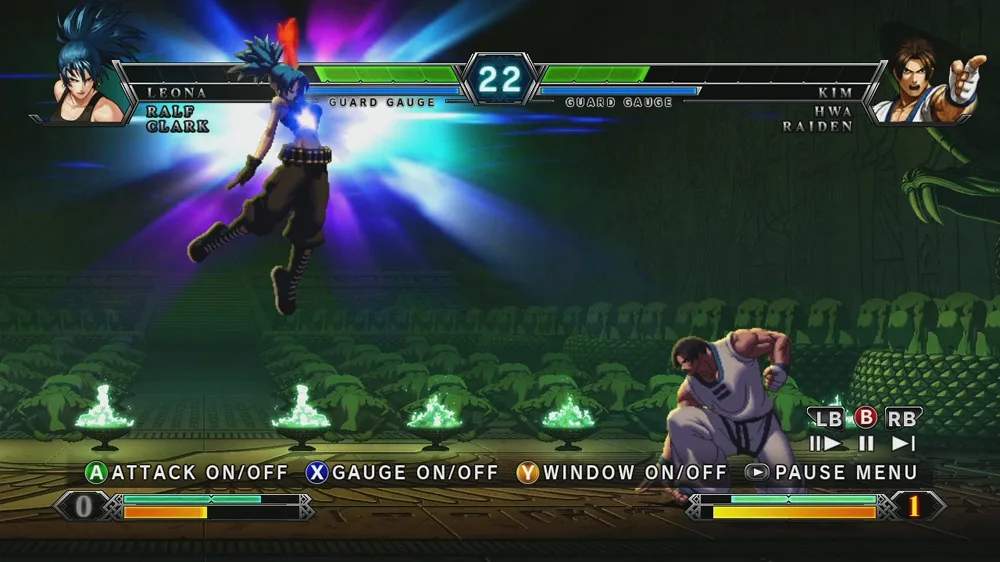
System Mechanics
Mastering the core system mechanics in King of Fighters XIII is crucial for transitioning from a beginner to a formidable fighter. Unlike some other fighting games, KoF XIII demands precise execution and a deep understanding of its unique defensive and offensive options. This section will break down the fundamental systems you need to internalize.
Blocking and Guarding
Blocking in KoF XIII is a fundamental defensive technique that differs from games with a dedicated block button. Instead, your directional input dictates your guard. Successfully blocking an attack will prevent damage, though repeated blocking can lead to Guard Crush.
- Standing Block: To block high or mid-level attacks, simply hold the directional input ⬅ (back) relative to your opponent. Your character will automatically assume a guarding stance if an attack connects while holding back.
- Crouching Block: To block low-level attacks, hold the directional input ↙ (down-back). This is often referred to as "crouch blocking" and is essential for defending against sweeps and other low attacks. Many players find it easier to consistently block by defaulting to crouch block, as it covers both low and most mid-level attacks.
- Guard Crush: Continuously blocking attacks will deplete your Guard Gauge, located below your health bar. Once this gauge is empty, your character will enter a vulnerable "Guard Crush" state, leaving you open to a free combo. Varying your defense with rolls and parries (if applicable to your character) can help prevent Guard Crush.
- Block Stun: When you successfully block an attack, your character will enter a brief "block stun" animation. The duration of block stun varies depending on the strength and type of attack. Understanding block stun is key to knowing when it's safe to counter-attack or continue defending.
Chaining Normals and Combos
Executing effective combos is the backbone of offense in KoF XIII. This often involves "chaining normals," which means linking basic attacks together, and then canceling into special moves or supers.
- Normal Chains: Many characters can link light attacks (LP/LK) into stronger attacks (HP/HK) or other light attacks. For example, a common beginner chain might be ← + LP > LK. The timing for these chains can be strict, requiring practice.
- Special Move Cancels: The true power of combos comes from canceling normal attacks into special moves. This means inputting the special move command immediately after a normal attack connects, before the normal attack animation fully recovers. For instance, Kyo's → + HK can often be canceled into his ↓↘→ + P (100 Shiki: Oniyaki).
- Drive Cancels (DC): Drive Cancels allow you to cancel certain special moves into other special moves, extending combos significantly. This consumes a portion of your Drive Gauge. The timing for Drive Cancels is often precise, requiring you to input the second special move command just as the first special move hits or is about to hit. For example, Kyo's ↓↘→ + HK (75 Shiki: Kai) can be Drive Canceled into his ←↓↙ + K (R.E.D. Kick) for extended juggle opportunities.
- Super Cancels: Similar to Drive Cancels, Super Cancels allow you to cancel a special move directly into a Super Special Move (SSM) or a Neo Max Super Special Move (Neo Max). This consumes Super Meter. The timing is similar to Drive Cancels, requiring a quick input of the Super command after the special move.
Movement and Positioning
Efficient movement is as vital as offensive and defensive techniques. Understanding your character's movement options allows for better spacing, evasion, and pressure.
- Walk: The most basic movement, performed by holding ⬅ (back) or ➡ (forward).
- Dash/Run: Quickly tapping ➡➡ (forward twice) will initiate a dash or run, depending on the character. Dashes are quick bursts, while runs allow for continuous forward movement.
- Backdash: Quickly tapping ⬅⬅ (back twice) performs a quick backdash, providing a brief moment of invincibility for evasion.
- Jumps: Tapping ⬆ (up), ↖ (up-back), or ↗ (up-forward) performs a standard jump.
- Short Hops: Lightly tapping ⬆, ↖, or ↗ will execute a short hop, a quick, low jump useful for overhead attacks and mix-ups.
- Hyper Hops: Quickly tapping ↓ then ⬆, ↖, or ↗ performs a hyper hop, a higher and faster jump than a short hop, useful for closing distances or escaping pressure.
- Rolls: Pressing LP + LK while holding ⬅ (back) or ➡ (forward) performs a dodge roll. Rolls grant brief invincibility and are crucial for evading attacks, passing through projectiles, and repositioning.