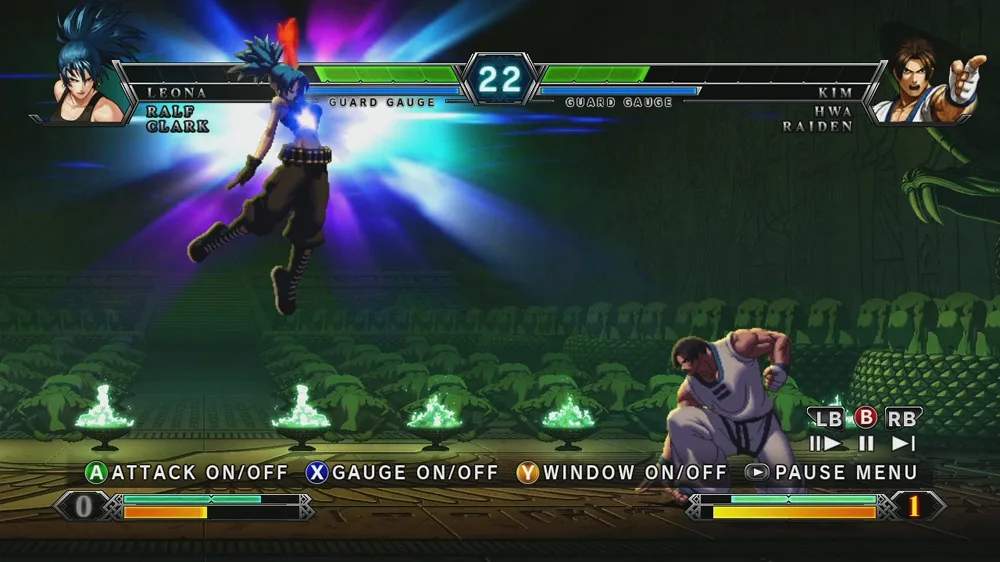
Okizeme (Wake-up Game)
Okizeme, or "wake-up game," is the art of pressuring an opponent as they rise from a knockdown. In KOF XIII, effective okizeme can lead to devastating combos, chip damage, or even a complete reset of the neutral game in your favor. Mastering this aspect of play is crucial for high-level competition.
Understanding Knockdowns and Wake-up Options
When an opponent is knocked down, they have several options for recovery:
- Normal Wake-up: The opponent simply stands up after a short delay. This is the most common and often safest option if you've created enough space.
- Quick Recovery (Roll): By pressing any attack button as they hit the ground, the opponent can perform a quick roll to either the left or right. This can evade immediate pressure but leaves them vulnerable if predicted.
- Delayed Wake-up: Some knockdowns allow for a slightly longer delay before standing, which can throw off timing.
- Wake-up Attacks (Reversals): Certain special moves or DMs have invincibility frames on startup, allowing them to hit through your pressure. These are often referred to as "reversals" and are high-risk, high-reward options.
General Okizeme Strategies
Your goal with okizeme is to cover as many of your opponent's wake-up options as possible, forcing them to guess incorrectly and take damage.
- Knockdown Type Assessment:
- Hard Knockdowns: These leave the opponent on the ground for a longer period, giving you more time to set up. Examples include Iori's qcf+P (Aoi Hana) or Kyo's dp+K (Oniyaki).
- Soft Knockdowns: These are quicker, requiring faster reactions to maintain pressure. Many light attacks that trip fall into this category.
- Positioning:
- Close Range: Ideal for mix-ups, throws, and immediate pressure. Characters like King with her hcf+K (Tornado Kick) or Benimaru with his dp+K (Raijinken) can excel here.
- Mid-Range: Good for setting up projectiles (e.g., Kyo's qcf+P (108 Shiki: Yami Barai)) or advancing attacks that cover rolls.
- Resource Management:
- Power Gauge: Consider if you have enough meter for EX moves, DMs, or Climax Super Special Moves. An EX move on wake-up can be a powerful deterrent or a guaranteed hit.
- Hyper Drive Gauge: If your Hyper Drive Gauge is full, you might consider activating HD Mode for extended combos off a successful wake-up hit.
Specific Okizeme Techniques
1. Meaty Attacks
A "meaty" attack is one that hits the opponent as soon as their invincibility frames from waking up expire. This is a fundamental okizeme technique.
- Execution: Time your attack so that its active frames connect with the opponent's hitbox on their first frame of vulnerability. This often means starting your attack slightly before they fully stand.
- Benefits:
- Beats normal wake-up.
- Can beat quick rolls if the attack has enough active frames or covers the roll distance.
- On block, it often leaves you at an advantage, allowing for continued pressure.
- Example: After a knockdown with K's qcf+P (Ein Trigger), you can often follow up with a well-timed cr.B or st.C as they rise.
2. Cross-ups
A cross-up is an attack that hits the opponent from behind as they wake up, forcing them to block in the opposite direction.
- Execution: Jump over the opponent as they are waking up, timing your jump attack (usually a j.B or j.C) to hit on the opposite side.
- Benefits:
- Forces a difficult block decision (high/low and left/right).
- Can lead to full combos on hit.
- Example: After a knockdown, characters with good jump arcs like Mai or Yuri can often perform a cross-up j.B.
3. Throws and Command Grabs
If your opponent is consistently blocking your meaty attacks, a throw can be a powerful option.
- Execution: Walk up to the opponent as they wake up and execute a normal throw (f/b + C/D) or a command grab (e.g., Clark's hcf+P (Super Argentine Backbreaker)).
- Benefits:
- Unblockable.
- Punishes passive blocking.
- Risks: Vulnerable to wake-up attacks or quick rolls.
4. Empty Jumps and Lows
This is a classic high/low mix-up.
- Execution: Jump over the opponent as if going for a cross-up, but instead of attacking in the air, land and immediately hit with a low attack (e.g., cr.B or cr.D).
- Benefits:
- Catches opponents expecting an aerial block.
- Can lead to combos.
- Risks: Vulnerable to wake-up attacks or anti-airs if the opponent reads the empty jump.
5. Safe Jumps
A safe jump is a jump attack that is timed so that if the opponent performs an invincible wake-up attack, you land and can block before their attack connects.
- Execution: This is character and situation specific, often requiring precise timing and spacing. It usually involves a neutral jump or a short forward jump.
- Benefits:
- Covers both normal wake-up (with a meaty jump-in) and wake-up reversals (by allowing you to block).
- Example: Many characters can achieve a safe jump after a hard knockdown by performing a specific jump-in attack. Experiment in training mode to find these setups for your main characters.
Defending Against Okizeme
As the defender, your goal is to escape pressure or punish predictable okizeme.
- Quick Recovery (Roll): Use this to escape immediate pressure. Be mindful of opponents who predict rolls and use attacks with long active frames or follow-up with another attack.
- Wake-up Attacks (Reversals): If you have meter, an invincible special move or DM can blow through pressure. Be careful, as these are often highly punishable on block or whiff.
- Guard Cancel Roll (Forward/Backward): If you block a meaty attack, you can use a Guard Cancel Roll (f/b + A+B while guarding) to escape pressure at the cost of 1 Power Gauge stock.
- Guard Cancel Strike: If you block a meaty attack, you can use a Guard Cancel Strike (A+C or B+D while guarding) to counter-attack at the cost of 1 Power Gauge stock. This is often a character-specific attack.
- Delayed Wake-up: If available, delaying your wake-up can throw off your opponent's timing, allowing you to escape or punish.
Okizeme is a dynamic and interactive part of KOF XIII. Both the attacker and defender must constantly adapt and read their opponent's tendencies to gain an advantage.