Managing the Playfield
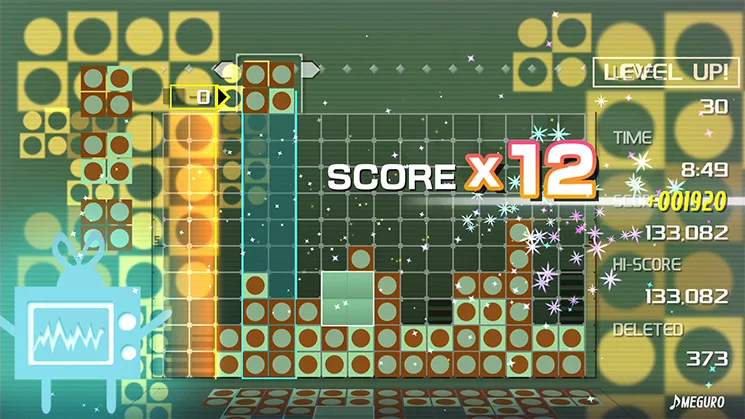
The playfield in Lumines Remastered is your canvas, a 16x10 grid where every block placement and line sweep matters. Effective management is the key to high scores and prolonged gameplay. This section will delve into strategies for controlling the flow of blocks, setting up combos, and avoiding game over.
Understanding Block Placement
Each falling block is a 2x2 square composed of two different colored sub-blocks. Your primary goal is to form 2x2 squares of the same color. When the Timeline sweeps across these completed squares, they are cleared, and you earn points. However, simply clearing blocks isn't enough; strategic placement is crucial for long-term success.
- Initial Placement: At the start of a new skin or when the playfield is relatively clear, focus on building a solid base. Try to keep your blocks low and organized, creating distinct areas for each color.
- Anticipation: Always look at the next block preview (located at the top-right of the screen). This allows you to plan your current block's placement with the next one in mind, setting up potential combos.
- Rotation: Use the block rotation mechanic (typically the 'A' button on Switch, 'X' on PlayStation, or 'B' on Xbox) to orient the 2x2 block in the most advantageous way. Sometimes, rotating a block can prevent a messy pile-up or create an unexpected clearing opportunity.
The Art of Combo Building
Combos are where the real points are in Lumines. A combo occurs when clearing blocks with the Timeline causes other blocks to fall and, in turn, form new 2x2 squares of the same color that are then also cleared by the same Timeline sweep. The longer the chain reaction, the higher your score multiplier.
- Layering Colors: To build combos, you need to strategically layer blocks. Imagine building a structure where a specific color block, when cleared, will cause a cascade of other same-colored blocks to merge and clear.
- Creating "Wells": A common strategy is to create "wells" or depressions in your block formation. Fill these wells with a single color, then place a block of that same color on top to complete a 2x2 square. When cleared, the surrounding blocks will fall into the well, potentially forming new 2x2 squares.
- Staggered Clears: Don't always aim for immediate clears. Sometimes, it's better to leave a completed 2x2 square on the field, waiting for the perfect moment to clear it alongside other blocks for a larger combo. The Timeline will clear all completed 2x2 squares it passes over, regardless of when they were formed.
- Managing the "Garbage" Blocks: Blocks that don't immediately form 2x2 squares are often referred to as "garbage." Don't let these build up indiscriminately. Try to integrate them into future 2x2 squares or use them as temporary foundations for other colors.
Controlling the Timeline
The Timeline is your most important tool for clearing blocks. Its speed and direction are influenced by the current Skin and BPM (Beats Per Minute) of the music. While you can't directly control its speed, you can control how you interact with it.
- Timing is Everything: Pay close attention to the Timeline's position. Placing a block just before it sweeps can lead to immediate clears and prevent blocks from building up too high.
- Clearing Large Areas: When the Timeline is slow, take advantage of the extra time to set up larger clear zones. Conversely, during fast BPM sections, focus on quick, efficient clears to prevent the playfield from becoming overwhelmed.
- Strategic "Holding": Sometimes, it's beneficial to hold a completed 2x2 square until the Timeline is in a position to clear multiple such squares in one pass, maximizing your points and combo potential.
Avoiding Game Over
The game ends when any column of blocks reaches the very top of the playfield. This is your ultimate objective to avoid.
- Maintain a Low Profile: The most fundamental rule is to keep your blocks as low as possible. Prioritize clearing blocks that are nearing the top.
- Even Distribution: Avoid creating tall, isolated columns. Try to keep the overall height of your block formation relatively even across the playfield.
- Targeted Clearing: If a specific column is getting dangerously high, prioritize placing blocks that will clear that column, even if it means sacrificing a potential combo elsewhere.
- The "Panic Clear": In desperate situations, sometimes the best strategy is to quickly form any 2x2 square you can, even if it's small, just to reduce the height of a critical column. Don't be afraid to make a quick, small clear to buy yourself more time.
By mastering these techniques, you'll transform your playfield from a chaotic mess into a controlled environment, paving the way for impressive scores and a truly mesmerizing Lumines experience.