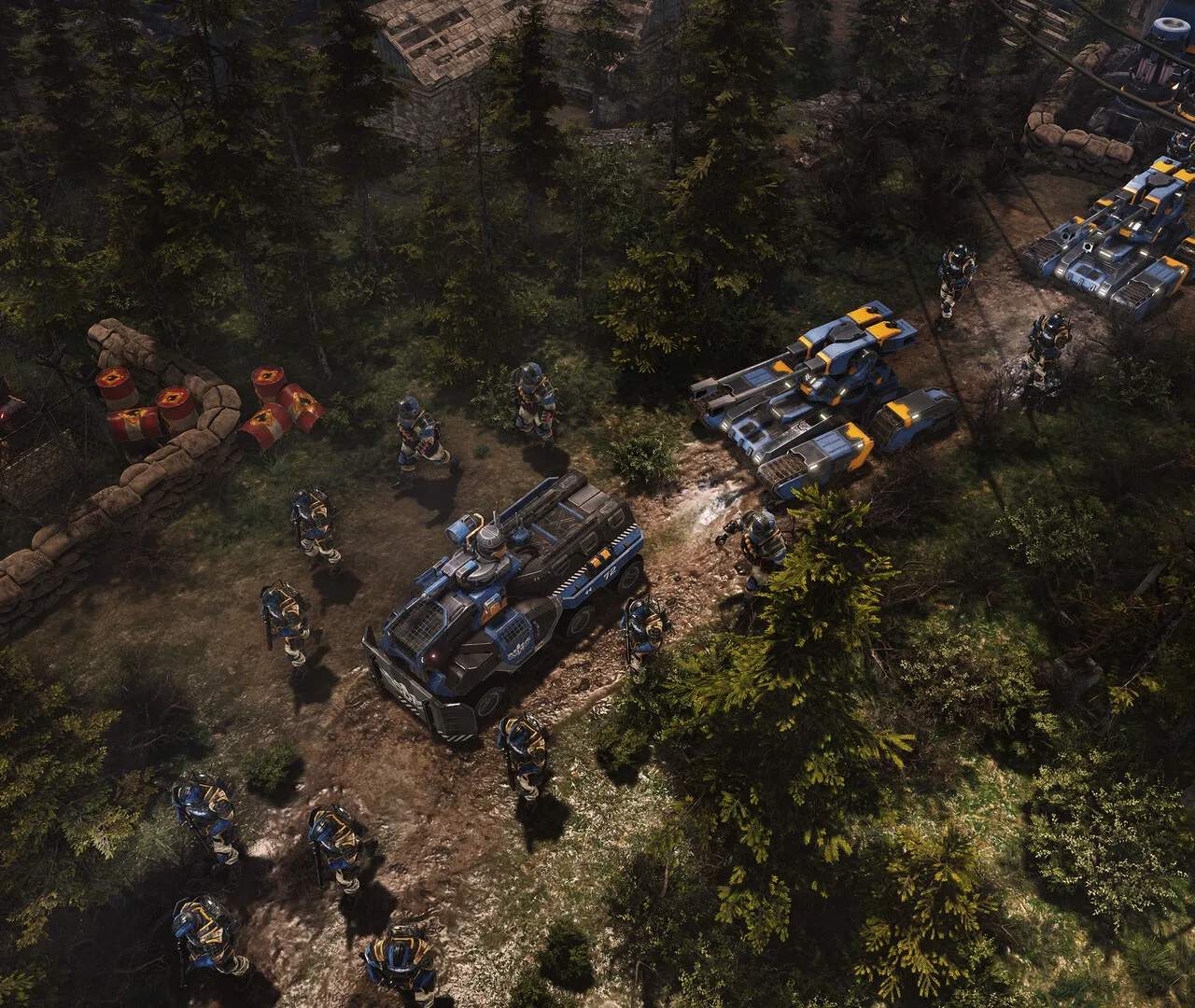
Exploration
Effective exploration in Tempest Rising is paramount for securing vital resources, uncovering strategic advantages, and gaining crucial early intelligence on enemy movements. Mastering the art of scouting allows you to dictate the pace of the game, anticipate threats, and exploit opportunities before your opponent even knows they exist. This section details how to optimize your scouting efforts, identify key map elements, and leverage your units for maximum exploratory efficiency across all game phases.
I. Initial Scouting Phase: Establishing Footholds and Early Intelligence
The opening moments of a match are critical for establishing map control, securing essential resource nodes, and understanding the immediate environment. Your starting units are your primary tools for this vital phase.
-
Designated Scout Units:
- GDF (Global Defense Force): Your primary scout is the Scorpion Buggy. Its exceptional speed and respectable sight range are perfectly suited for rapid reconnaissance. Prioritize using its speed to quickly survey the surrounding area.
- Dynasty: The Hoverbike is your starting scout. Its key advantage lies in its ability to ignore terrain penalties, allowing for swift traversal over rough ground, shallow water, and other obstacles that can slow down ground units. This makes it invaluable for reaching distant points of interest quickly.
-
Prioritizing Key Map Locations:
- Tempest Spikes: These are the lifeblood of your economy. Your absolute first priority is to locate at least two additional Tempest Spike fields beyond your starting position. Mark these locations on your minimap for immediate expansion plans.
- Expansion Points: While scouting, identify defensible locations adjacent to Tempest Spikes. Look for natural choke points, elevated terrain that offers defensive bonuses, or areas that are easily fortified.
- Watchtowers/Observation Posts: These neutral structures are scattered across the map. Capturing them grants a significant, persistent sight radius over a wide area. Securing these early provides invaluable early warning and map awareness.
- Neutral Tech Buildings: Some maps feature neutral structures that, upon capture, can provide temporary buffs (e.g., increased unit production speed), reveal portions of the map, or even grant a small, immediate resource bonus. These are often found in contested mid-map areas and can be high-risk, high-reward objectives.
-
Effective Pathing and Micro-Management:
- Begin by sending your scout unit in a wide, sweeping pattern around your starting base. This "fog of war" clearing helps reveal immediate threats, nearby resource nodes, and potential enemy starting positions.
- Avoid direct, linear paths that might lead straight into unknown enemy territory unless you are actively committed to an aggressive rush strategy. Instead, favor indirect routes that hug the edges of the map or explore around known terrain features.
- Utilize the 'Shift-Click' command to queue multiple movement waypoints. This allows your scout to autonomously explore a series of locations while you focus on essential base building and unit production.
II. Mid-Game Reconnaissance: Deepening Intel and Securing Objectives
As your economy stabilizes and your army begins to take shape, your exploration efforts should evolve to focus on gathering more detailed enemy intelligence and securing advanced strategic positions.
-
Advanced Scout Units:
- GDF: The Vulture Drone, unlocked at the Airfield, provides unparalleled aerial reconnaissance. Its advanced stealth capabilities make it exceptionally difficult for standard enemy defenses to detect, allowing for deep penetration into enemy territory. Use it to identify enemy unit compositions, key production structures (e.g., Vehicle Factories, Airfields), and the status of their resource harvesting operations.
- Dynasty: The Shadow Stalker, unlocked at the Covert Operations Center, is a specialized infantry unit possessing stealth and enhanced sight capabilities. Deploy it to establish hidden forward observation posts, scout enemy flanks before committing to an attack, or to gather intel on enemy base layouts without being detected.
-
Maintaining Map Control and Vision:
- Sensor Towers: Construct these defensive structures at strategic choke points, key intersections, or near contested Tempest Spike fields. Sensor Towers provide continuous vision and, crucially, possess the ability to detect cloaked enemy units, negating a common surprise tactic.
- Patrol Routes: Assign small, fast-moving units (such as additional GDF Scorpion Buggies or Dynasty Hoverbikes) to patrol critical routes between your bases and known or suspected enemy attack vectors. This provides early warning of incoming assaults.
- Forward Operating Bases (FOBs): Consider establishing small, lightly defended FOBs near contested Tempest Spikes or strategic map locations. These serve as forward repair/rearm points for your units and maintain a persistent presence, denying the enemy easy access to these areas.
-
Enemy Base Scouting Strategies:
- Once you have located an enemy base, your objective is to gather intelligence on their technological progression (e.g., are they prioritizing ground or air units? Have they unlocked advanced unit types?), their current army composition, and the efficiency of their resource income.
- Scout for weaknesses in their defenses, such as unguarded flanks, exposed power generators, or areas with less concentrated defensive structures. This information is vital for planning your attacks.
III. Late-Game Intelligence Gathering: Precision Strikes and Counter-Intelligence
In the late stages of a match, exploration shifts from broad discovery to highly targeted intelligence gathering, often serving as a precursor to decisive, large-scale engagements.
-
Targeted Incursions and Sabotage:
- Employ specialized, high-impact units like the GDF's Commando or Dynasty's Assassin for deep infiltration missions. These units often possess unique stealth, demolition, or disruption abilities.
- For example, a GDF Commando can plant C4 charges on enemy power plants, temporarily crippling their production capabilities and forcing them to divert resources to repairs. A Dynasty Assassin can silently eliminate key enemy heroes or support units.
-
Global Vision Abilities:
- Certain factions or advanced research upgrades may unlock powerful global abilities that temporarily reveal large portions of the map or pinpoint specific enemy unit concentrations.
- The GDF Orbital Scan is a prime example, capable of revealing all enemy units and structures within a vast radius for a short duration. This provides invaluable intel for coordinating a major assault, identifying enemy army movements, or confirming the location of their main base.
-
Vigilant Counter-Scouting:
- Be acutely aware that your opponent is also scouting. Deploy your own fast-moving units or strategically place defensive structures with detection capabilities (like Sensor Towers) to intercept and eliminate enemy reconnaissance units.
- A well-placed GDF Missile Turret or Dynasty Plasma Cannon, especially when upgraded with detection, can quickly neutralize enemy air scouts or stealth units attempting to probe your defenses.
By consistently and intelligently applying these exploration and reconnaissance strategies throughout every phase of the game, you will maintain a significant informational advantage over your opponents. This allows you to react proactively to threats, capitalize on fleeting opportunities, and ultimately dictate the flow of battle towards victory.