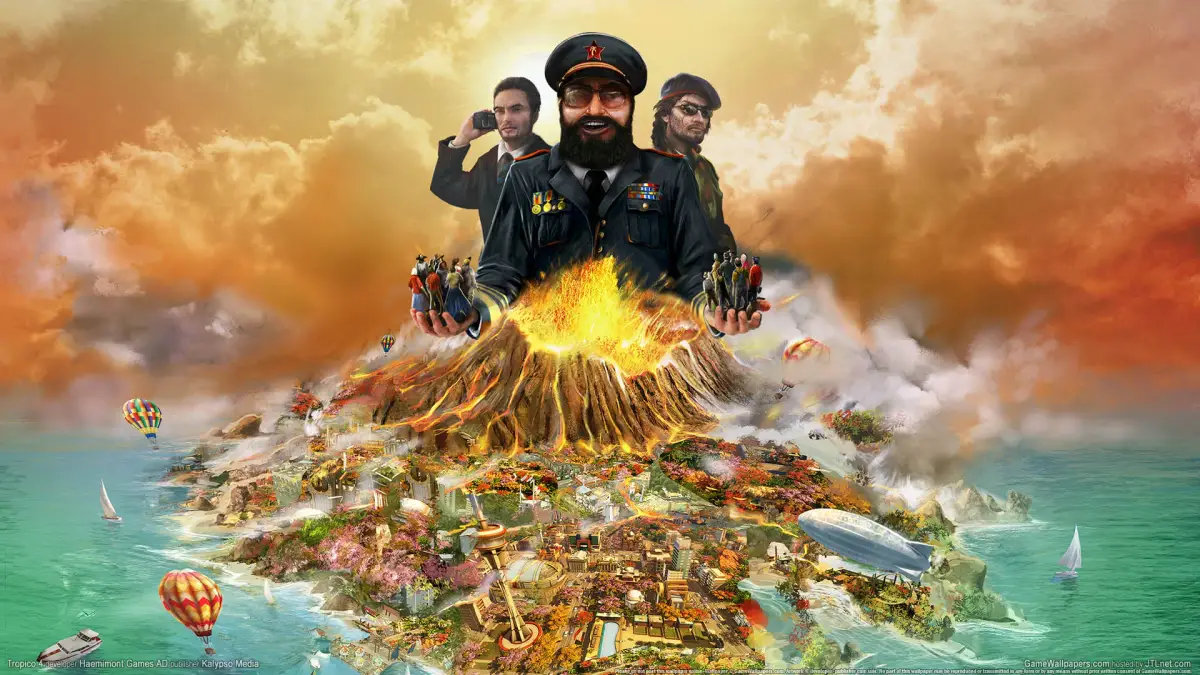
Welcome to Tropico 4, where you step into the shoes of El Presidente, the dictator of a Caribbean island nation. This isn't just about building; it's about balancing the demands of various factions, managing your economy from food production to tourism, and keeping your populace happy enough to avoid a revolution. It's a funny, atmospheric sandbox experience perfect for anyone who enjoys a good city-builder with a dash of political satire.
This guide dives deep into the mechanics of building your island empire. We'll cover everything from optimal build orders for the early, mid, and late game to detailed economic strategies for food, resources, manufacturing, and tourism. You'll also find insights into managing happiness, factions, superpowers, and even your avatar's Swiss bank account, ensuring you can navigate the complexities of ruling Tropico and achieve your goals, whether it's winning elections or simply surviving the inevitable collapse.
Part 1
Dive into Tropico 4 with Part 1 of our comprehensive strategy guide. Learn essential build orders, economic analysis, and tips for a stable island nation.
Hey there! Welcome to Tropico 4. It's a fantastic game, and I'm stoked to help you get started. This guide is all about giving you the lowdown on how to build a thriving island society and a solid economy, whether you're tackling the main scenarios, the Modern Times DLC, or just messing around in sandbox mode. I've poured a ton of hours into this game – completed all the main and DLC scenarios, snagged all 70 achievements, and even managed to keep my population happy with all factions and superpowers at 100%. I've pulled in over $500,000 from a single cargo ship export and made my infrastructure more profitable than the island's total expenses. So, trust me, the strategies I'm sharing here work!
Now, this isn't a step-by-step walkthrough for every single mission. Honestly, most scenarios are pretty straightforward if you've got a decent build order down. The objectives are usually about spending cash or building stuff, and they rarely have tight deadlines. My best advice? Stick to the build order, and you'll knock out those objectives without breaking a sweat.
You won't find endless lists of buildings or stats here – that's what the in-game tooltips and manual are for. When I do list things, it'll be in order of importance or priority. I'm also not going to just copy the game's script; you can experience that yourself! And while I might mention achievements now and then, this guide isn't focused on them. Most achievements are easy to get through normal play or a bit of sandbox grinding.
Let's get straight to it. This section focuses on the build order I find most effective. Get this right, and the rest of the game just falls into place.
Part 2
Master Tropico 4's early and mid-game! Learn how to set up your economy, manage resources, and keep your citizens happy as you build your island nation.
Alright, let's dive into Part 2 of building your Tropico empire! This section is all about getting your island off the ground and navigating those crucial early and mid-game stages. Think of it as laying the foundation for your tropical paradise (or dictatorship, your call!).
[A] Early Game: The Foundation
When you first boot up a new game, you'll usually start with a Palace, a Construction Office, a Teamsters Office, a couple of Garages, and an Industrial Port. You might also get a few farms, ranches, fishing spots, a marketplace, and some housing like Tenements or Shacks. If you start with anything else, be a bit suspicious! Some scenarios throw in fancy buildings early on, but they can be a trap. You'll likely struggle to pay for their upkeep or staff them, making them more of a headache than a help.
Before you start building willy-nilly, do this:
- Tear down unnecessary buildings: Get rid of anything that isn't essential for the early game. You just can't afford the upkeep yet.
- Relocate farms/ranches: If any farms or ranches are smack-dab in the middle of where you want your city center, move 'em to the outskirts. They take up a lot of space and can be polluting. Don't sweat interrupting production; they take a while to get going anyway. It might cost a little now, but it'll pay off later.
Now, let's talk resources. Scan your island and look for these, in order of preference:
- Gold
- Bauxite
- Iron
- Salt
- Cash Crop fertility (Tobacco, Sugar, Coffee)
- Logging
Heads up: Oil isn't an early game resource. You'll need college-educated citizens to tap into that later.
Pick one or two resources based on what's available and how close it is to your port. The closer, the faster you can export! If none of those look good, focus on food exports like cattle, fish, bananas, papayas, pineapples, or corn (in that order).
With your resources in mind, start building:
- Ministry: Build this to hire a Minister of Foreign Affairs. You can even start this process before the building is up; they'll arrive on the next ship.
- Marketplace: Build one if you don't already have it.
- Starting Industry: Set up about 3 buildings for your chosen exports (mines, crops, logging – mix and match!).
- Food Production: Make sure you have at least 2 buildings dedicated to food, separate from your export buildings. Cattle is king here, with corn as a solid second choice.
You'll probably be running low on cash around now. Don't panic; you can go into the red up to -10,000. Foreign aid usually comes in January, which should help keep you afloat until your exports start rolling in.
Once your Foreign Minister arrives:
- USSR Development Aid Edict: Activate this, even if you're broke! It slashes Tenement costs by 50% permanently. Don't wait too long, or your minister might kick the bucket before you can use it.
- Build Tenements: Now's the time to build 1-2 new ones, especially with that discount.
- Build a Church: If you need a priest, you can reassign a couple of your Palace Guards.
- Humanitarian Aid Edict: Activate this. It gives you free medical care and food for 5 years, taking the pressure off building a Clinic and giving your food industry a chance to catch up.
- Build a High School: This marks your transition to the next stage.
[B] Mid Game: Stabilizing and Expanding
So, you've got a High School – welcome to the Mid Game! Your main goals now are to stabilize your economy and get your overall happiness up to around 50-55%.
Start saving up and invest in one new industry. Pick something that complements the resources you focused on in the early game. Buy the blueprint and get it built.
To manage your workforce:
- Immigration Office: Build one and set it to
Part 3
Tropico 4 Part 3 covers essential edicts like Social Security, late game building strategies, and housing options like Tenements and Apartments.
Edicts:
- Enact Social Security (General).
- Enact Literacy (Education) once High School Teachers are skilled.
- Enact Pollution Standards and Building Permit (Economy) if you care about the Swiss Bank Account, waiting for marketplace workers to be skilled.
- Enact Litter Control (Interior) once Policemen are skilled.
- Enact Secret Police (Interior) using a Pub or Restaurant to prepare for scenarios requiring 3 secret agents and to help with random events.
- Consider ministers for Defense to handle random events, assuming you have skilled soldiers at the palace.
- Enact other edicts as you see fit.
Industry Choice:
You can either begin your tourism industry or stay with manufacturing.
To begin tourism:
- Build a dock.
- Build three Hotels.
- Build 3 attractions/entertainment venues.
Alternatively, build a second industry.
Industry Management:
- Allow imports for all industries.
- Set your port to infinite imports.
- Upgrade industries when you have sufficient money.
Stabilization Period:
Allow your society to stabilize. Workers will initially be unskilled and slow. Buildings may take time to become efficient, and your high school will need time to graduate students to fill open positions, potentially leading to a worker shortage (the opposite of unemployment). Set the game speed to level 3, manage random events, and wait. As time progresses, workers will become more skilled and efficient, and more immigrants will arrive to fill empty slots. This period may last a few years, during which you might experience financial losses, but the situation will improve.
Late Game Preparation:
You are ready for the Late Game when your treasury has a minimum of $50,000 and you are making regular exports on cargo ships (earning $35,000 – $50,000 each). A potential issue is that building upkeep may nearly equal your export value, consuming all profits before the next ship arrives. Continue following the guide. Warning: DO NOT enact the Print Money edict, as it increases the cost of everything and is not worthwhile.
Late Game Buildings:
- College
- Science Academy – set to Research Grants.
- Bank – set to Urban Development (can be built in Mid Game to save on construction costs if you plan to invest in a foreign expert).
- Newspaper – set to Coupons 'N More, placed near housing.
- Power Plant – set to Natural Gas (or Nuclear Plant if making substantial money, or Solar Plant if you have Modern Times and it is after 1975). Use Electrical Substations to extend power radius if needed.
- Radio Station – set to Opera, placed near the residential district.
- TV Station – set to Lucha Libre, placed near the residential district.
- Hospital
- Cathedral
- Add entertainment buildings as desired (e.g., Night Club, Movie Theater).
- Expand industry (tourism or manufacturing) as needed or desired.
At this stage, you should have a stable economy, happy citizens, and widespread approval. You can then pursue scenario objectives or achievements. You should have abundant money, and the map is yours. Scenario maps typically have no time limit, while Sandbox maps last until the year 2000.
Notes on Housing:
A Tenement can house approximately 25 people. A general rule is to build 1 Tenement for every 25 people, plus 2, to accommodate population expansion without shacks and account for unmarried individuals.
There is a debate between using Tenements or Apartments. Tenements have lower living satisfaction but offer more space and are cheaper to build (even cheaper with USSR development aid). Apartments provide a much better quality of living but have less capacity for their cost and size.
In mid-game, you can build a Fire Station set to Cat-in-Tree, which increases the living conditions of surrounding housing by 10 points and responds to fires. In late-game, you can provide air conditioning to each Tenement, further raising living conditions. With these upgrades, Tenements can reach a living condition rating of 60, which is sufficient for most scenarios. Apartments can reach 80, but building enough to house the same population requires more construction and land area.
Tenements also simplify the early game. It is suggested to use Tenements in early and mid-game, then switch to Apartments or Modern Apartments in late-game. Keep at least 4 old Tenements with rent set to 0 to house students, the elderly, and the unemployed, reducing the number of shacks.
Other housing options are generally not recommended unless for specific objectives or aesthetic choices in sandbox games.
If you have the Modern Times (MT) DLC (downloadable content — extra missions or items released after launch), the Modern Apartment Building is superior to the Apartment Complex. It costs slightly more, requires power, but houses the same number of people as a Tenement and offers additional features, making it ideal for late-game residential growth.
The Ziggurat in MT is a very large building requiring significant power, housing 50 families (100 people).
Part 4
Explore economic strategies in Tropico 4, focusing on food production, resource management, manufacturing, tourism, and infrastructure. Learn about food types, marketplaces, and export profits.
This section delves into the economic aspects of Tropico 4, breaking down income into five categories: Food, Resources, Manufacturing Industry, Tourism, and Infrastructure. While some might group the first three, this guide treats them individually for clarity.
Food Production:
Food is crucial for your citizens' happiness and survival. Without a marketplace, citizens travel to food-producing buildings. A marketplace streamlines this by allowing teamsters to deliver excess food (up to 1000-2000 units) for storage and distribution. Citizens will also use the marketplace if it's closer than the food source. This stored food acts as a buffer against shortages and disasters, though the marketplace itself is vulnerable.
If food supplies run low, the marketplace can import corn, which is delivered directly to it. Exporting food can generate income, but the profit margins are generally low due to high labor costs and the fact that your population consumes a significant portion of the produce. Food is best utilized in the early game, especially on maps lacking ore, but it's not a sustainable long-term income strategy.
Best Food Options:
- Cattle Ranches: Require only 2 workers and have a flexible footprint. They can be upgraded to Smoked Beef for increased export profits without affecting food quality. Building over grazing areas doesn't interrupt production.
- Fish Docks: Use 4 workers and have a small footprint, but require sea access. To avoid overfishing, limit to a maximum of 2 docks per beach, spread widely apart.
Situational Food Crops:
- Corn, Pineapple, Papaya, Banana: Recommended only if you have abundant fertile land and surplus workforce.
Non-Food Crops:
- Coffee, Tobacco, and Sugar are classified as resources, not food.
Modern Times (MT) Upgrades:
- If you have the Modern Times expansion and are playing an MT scenario or sandbox, Bio Farms, Bio Ranches, and Fish Farms are available. These are more expensive to build but offer improvements over their standard counterparts.
Military Notes:
Military buildings are generally a late-game mechanic as generals require a college education. The military does not directly contribute to the economy or citizen satisfaction. Building military structures is often a response to demands from the militarist faction. Your army starts small (5 units: 4 palace guards, 1 avatar) and can be expanded with a Mausoleum (also for an achievement). Generals are required to further increase army size and can be acquired via an Army Base or Armory.
With Modern Times, the Armory is replaced by a SWAT HQ. SWAT members count towards your total army size, require generals, and deploy alongside soldiers and generals. Renovating your palace (a mission requiring Modern Times and a population of around 200) replaces the 4 palace guards with 6 SWAT members. These renovation missions are optional and appear sequentially.
Similar guides you might like




100% Human-Written. AI Fact-Checked. Community Verified. Learn how AntMag verifies content