Understanding Block Types
In Lumines Remastered, your success hinges on a deep understanding of the fundamental building blocks that fall from the top of your playfield. Unlike traditional block-matching games, Lumines features only one core block type, but its arrangement and interaction are what create the strategic depth. Mastering how these blocks behave and how to manipulate them is crucial for achieving high scores and clearing challenging stages.
The Core Block: The 2x2 Square
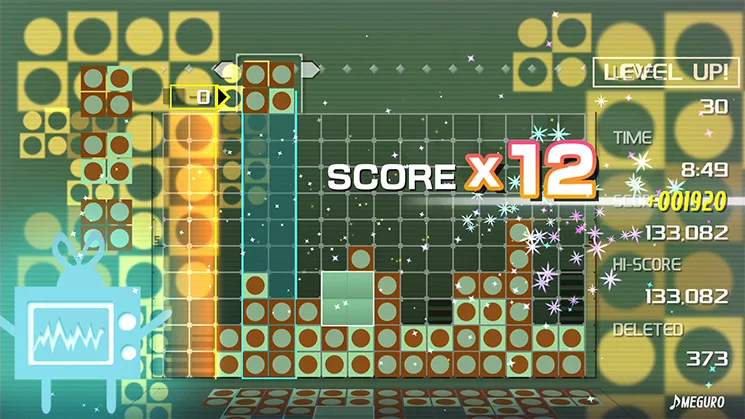
Every block that descends in Lumines Remastered is a 2x2 square. This square is comprised of four individual smaller blocks, or "miniblocks." These miniblocks will always be one of two colors, determined by the current "skin" or theme of the stage you are playing. For example, in the "Beyond the Future" skin, you might see bright blue and vibrant orange miniblocks. In "Shinin'," you might encounter stark black and white.
- Composition: Each 2x2 block can have various configurations of these two colors. It could be all one color, three of one color and one of the other, or two of each color (arranged diagonally or in a 2x2 split).
- Rotation: You can rotate these 2x2 blocks using the designated rotation buttons (typically the shoulder buttons or face buttons, depending on your control scheme). This allows you to change the arrangement of the colored miniblocks within the 2x2 square, which is vital for setting up clears.
- Placement: Blocks fall from the top of the screen. Your goal is to strategically place them to form 2x2 squares of a single color.
Forming Clearable Blocks: The Single-Color Square
The primary objective in Lumines Remastered is to create 2x2 squares composed entirely of a single color. These are your "clearable blocks."
- How to Form: You achieve this by dropping 2x2 blocks and rotating them, or by letting existing single-color miniblocks on the playfield combine. For instance, if you have two blue miniblocks adjacent to each other, and you drop a 2x2 block that places two more blue miniblocks next to them to form a 2x2 blue square, that square becomes clearable.
- The "Clear Line" Mechanism: Once a single-color 2x2 square is formed, it doesn't immediately disappear. Instead, it becomes "marked" for removal. A "timeline" (also known as the "sweep line" or "scan line") moves horizontally across the screen from left to right, periodically. When this timeline passes over any marked 2x2 single-color squares, those squares are cleared from the playfield.
- Chain Reactions: This is where the true strategy comes in. When blocks are cleared, any blocks above them fall down. This can often lead to new single-color 2x2 squares forming automatically, which are then also marked for clearing by the timeline. This creates satisfying and high-scoring chain reactions.
Understanding the Timeline's Impact
The timeline is the heart of Lumines Remastered's unique gameplay. Its speed and frequency are dictated by the current "skin" and its associated music track. Faster music often means a faster timeline, requiring quicker decision-making.
- Strategic Delay: Because blocks aren't cleared instantly, you can strategically build up multiple single-color squares across the playfield before the timeline sweeps through. This allows for massive chain reactions and higher scores.
- Managing the Stack: Pay close attention to the timeline's position. If it's about to sweep, you might prioritize completing a clearable square immediately. If it's just passed, you have more time to set up complex arrangements.
- Combo Potential: Clearing multiple 2x2 squares simultaneously with a single sweep of the timeline contributes to your combo multiplier, significantly boosting your score. Aim to set up large, interconnected clearable areas.
Advanced Block Manipulation Tips
- "Garbage" Management: Sometimes, you'll end up with isolated miniblocks of a color that are difficult to clear. These are often referred to as "garbage." Try to incorporate these into future 2x2 squares, even if it means temporarily making your playfield look a bit messy. Don't let them build up too high, as they can lead to a game over.
- Vertical Stacking: While the goal is 2x2 squares, remember that blocks fall. You can stack single-color miniblocks vertically, knowing that a future block drop might complete a 2x2 square when they settle.
- Anticipation: Always be thinking several blocks ahead. What colors are coming next? How can you rotate the current block to best set up future clears?
- Edge Play: Don't neglect the edges of the playfield. Often, a single miniblock on the far left or right can be the key to completing a large clear.
By internalizing these principles of block types and their interaction with the timeline, you'll transform from a casual player into a true Lumines Remastered master, capable of clearing stages with dazzling efficiency and racking up astronomical scores!