
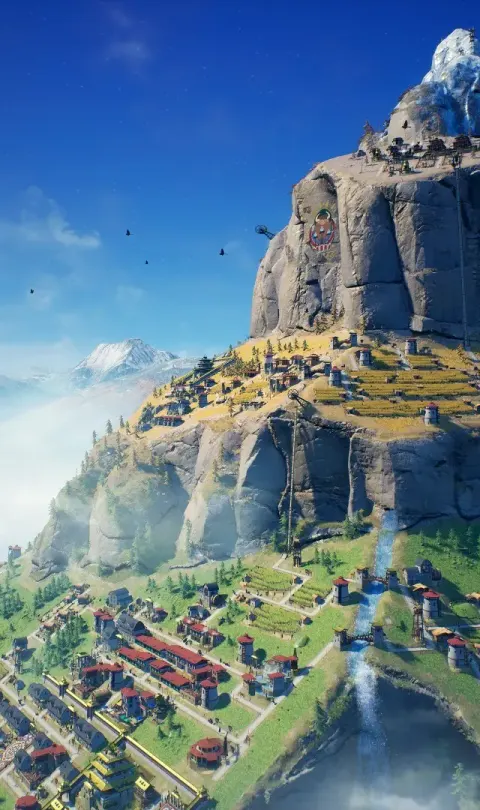
Advance your settlement in Laysara: Summit Kingdom by understanding and optimizing the production of crucial intermediate goods.
As your settlement in Laysara: Summit Kingdom grows, the reliance on basic resources will evolve into a need for more complex intermediate goods. These items are the crucial link between raw materials and the finished products that drive your economy and satisfy your citizens' needs. Mastering the production of these intermediate goods requires careful planning of specialized workshops, efficient worker allocation, and a keen understanding of the production chains involved. The game's environment plays a significant role, as certain vegetation zones or the discovery of resources on distant mountain slopes might be prerequisites for producing specific intermediate items, adding a layer of strategic depth to your expansion efforts.
The development of intermediate goods is a hallmark of a maturing economy in Laysara: Summit Kingdom. It sifies a move beyond basic survival towards a more sophisticated and self-sufficient civilization. invest in new technologies and buildings to unlock the recipes and production capabilities for these items. The strategic placement of these production facilities, considering proximity to both raw material sources and the locations where these intermediate goods will be utilized, is paramount. Furthermore, the potential for trading between cities, as hinted at in the Sandbox mode, suggests that You can specialize in certain intermediate goods and exchange them for other necessities, further enhancing their kingdom's economic resilience and growth potential.
Lumber and Processed Wood Products
Following the initial harvesting of timber, the next stage in the wood production chain involves creating lumber and other processed wood products. Lumber mills are essential for converting raw timber into usable planks and beams, which are then used in a wide variety of construction projects, from residential buildings to more advanced structures. Beyond basic lumber, players may unlock the ability to craft more specialized wooden items, such as furniture, tools, or even components for more complex machinery. The availability of specific types of wood, potentially found in unique vegetation zones or on distant mountain slopes, could influence the properties or efficiency of these processed wood products. For example, a rare, dense wood might be ideal for crafting durable tools or sturdy furniture, while a lighter wood could be better suited for decorative elements.
Cut Stone and Masonry Goods
Once stone is quarried, it undergoes processing to become cut stone and other masonry goods. This typically involves stonemason workshops where raw stone is shaped into blocks, bricks, or other architectural elements. These processed stone materials are crucial for constructing more robust buildings, fortifications, and infrastructure that can withstand the harsh mountain environment. The quality and type of stone available, potentially influenced by the geological makeup of different vegetation zones or distant mountain slopes, could affect the durability or aesthetic appeal of the resulting masonry goods. Players might also discover recipes for specialized masonry items, such as decorative tiles or reinforced stone components, that require specific types of processed stone and skilled labor to produce, adding another layer to their production chains.
Textiles and Clothing Production
The production of textiles and clothing is a vital intermediate step in ensuring the well-being and comfort of your citizens in Laysara: Summit Kingdom. This process typically begins with the acquisition of raw fibers, such as wool from yaks or other animal products, or plant-based fibers from specific crops. These raw fibers are then processed into yarn and subsequently woven into textiles. Specialized workshops, such as weavers and tailors, are required to transform these textiles into garments. The availability of suitable grazing land for animals or fertile soil for fiber-producing crops, potentially influenced by vegetation zones, will dictate the efficiency of this production chain. Expanding to distant mountain slopes might reveal unique fiber sources or introduce challenges in managing livestock in harsh environments, requiring players to adapt their strategies for textile and clothing production.
100% Human-Written. AI Fact-Checked. Community Verified. Learn how AntMag verifies content