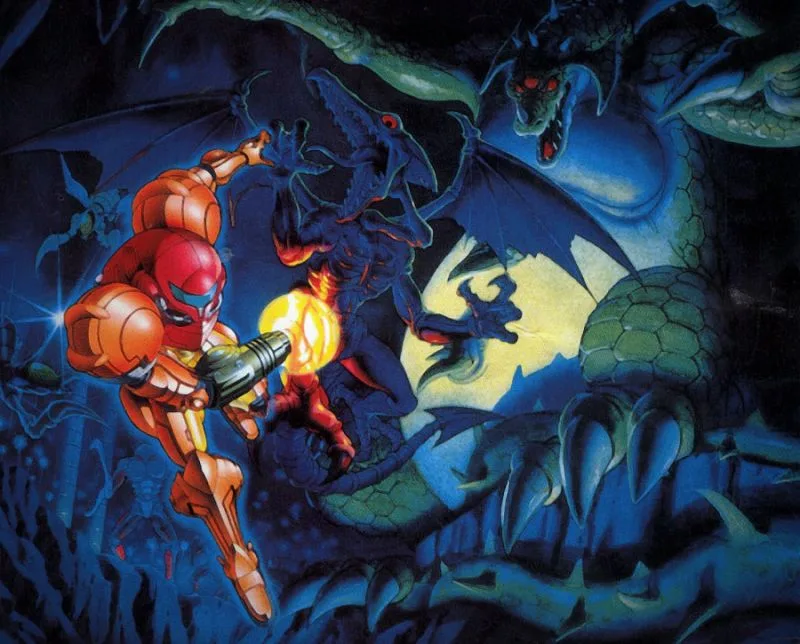
Learn essential Super Metroid movement techniques like Arm Pumping, Wall Jumping, Damage Boosting, and more to speedrun the game and access new areas.
At the core of Super Metroid speedrunning is fast and accurate movement. Many things in the game are acquired out of order and require some advanced movement tech to get. This section will cover the basics of movement and the tricks used in a speedrun. For a very detailed video on movement, consult ShinyZeni's Movement Tutorial.
GENERAL MOVEMENT
Samus is controlled with the directional pad buttons. She walks very slow but can accelerate to a modest clip with the Run button held down. While running, you only need to hold the button until Samus reaches max speed, after which point you can release the button. While running, Samus' jump speed and distance are heavily influenced by her speed when she left the ground, so running is the preferred speed of travel whenever possible. Until you have the Gravity Suit, your movement is heavily restricted in water and you have little control over jumping (although this can be influenced positively if doing certain tricks, like a Gravity Jump or Maridia movement in a reverse boss order run). Basically if you are not airborne, you should be running at all times. Abuse of the run button is key to certain tricks like short charging the Speed Booster.
ARM PUMPING
Probably the single most important piece of tech you can learn for speedrunning this game is the Arm Pump and a variation of it, called the Zohdin Pump. How Arm Pumping works is that every time you press L or R, it advances Samus' position forward one pixel. Therefore by repeatedly alternating L and R presses while running, Samus will move faster across a horizontal surface than she would just running normally. The idea is that you're moving from L to neutral to R to advance a total of 3 pixels when ordinarily you'd just advance one. This works on flat or angled surfaces, but can cause slowdown if you Arm Pump and fall off a ledge since you will lose that extra forward momentum. Once this is mastered, this should become the default form of generalized movement for getting through rooms where Samus needs to stay grounded. A variation on this called Zohdin Pumping is described below.
ZOHDIN PUMPING
This variation on Arm Pumping requires that you press L like normal, but your R presses use a raking motion with your fingernails as if you were strumming guitar strings. This allows for more R presses than normal without the overlaps that occur with normal Arm Pumping. It is useful mostly in straightaway hallways or areas where you don't need to worry about being able to press any of the face buttons.
STOP ON A DIME
This trick employs using the Angle Up or Angle Down buttons to immediately stop any forward momentum. You can use it to quickly land (like with a Ledge Grab) or quickly mount elevator platforms without having to wait for Samus to slow down and stop.
WALL JUMP
The designers gave Samus a new form of movement in this game that allows you to scale to higher heights by bouncing off of a wall. Even though this version is not very intuitive, it is probably the best version of wall jumping in the series next to the kind in Metroid Zero Mission. To perform a wall jump, spin jump towards a wall and press the opposite directional button as you brush against it; if done correctly you'll see Samus' sprite change to one that looks like she's crouching on the wall. When this happens, press jump again to bounce off in the other direction. You can bounce back and forth between walls to scale vertical areas, or chain them together on the same wall as described below. You'll be taught this move casually from the Brinstar Etecoons.
SINGLE WALL JUMP
This variation of the wall jump involves leaping up a single wall. As you spin jump at a wall and brush against it, tap the opposite directional button and jump again, but curve the jump back towards the starting wall. This requires a lot of back and forth pressing of the directional buttons but can become much faster than regular wall jumping and leads to many sequence breaking opportunities.
QUICK DROP
This trick abuses how stacks of crumble blocks or quicksand works. By repeatedly alternating your left and right movement so that you're constantly in a turnaround animation, Samus will plummet at near terminal velocity through them.
DAMAGE BOOST
Damage boosting is a form of movement that allows you to take advantage of the knockback from an enemy or damage source and turn that into momentum. While taking damage, press Jump and the opposite directional button from where Samus is facing, so if you’re facing left when you take the hit, press right and Jump to be thrown a sizeable distance. Once the damage boost has been initiated, hold the direction you’re traveling in for a little bump in momentum and distance. This technique is used to cross many areas, like getting through Hellway as an example. What you damage boost off of requires different kinds of timing; if you’re using spikes you have 10 frames to initiate the damage boost, while enemies themselves only give you 5 frames, so you will need to plan your button presses accordingly.
KAGO'ING
Kago’ing is a trick named after the Craterian Kagos since it is the enemy this trick was first utilized on. This trick involves performing an uninterruptable animation (like an Arm Pump or a turnaround) to pass through enemies and objects without experiencing knockback when taking damage or using a damage boost. This is the basis for the Z
100% Human-Written. AI Fact-Checked. Community Verified. Learn how AntMag verifies content