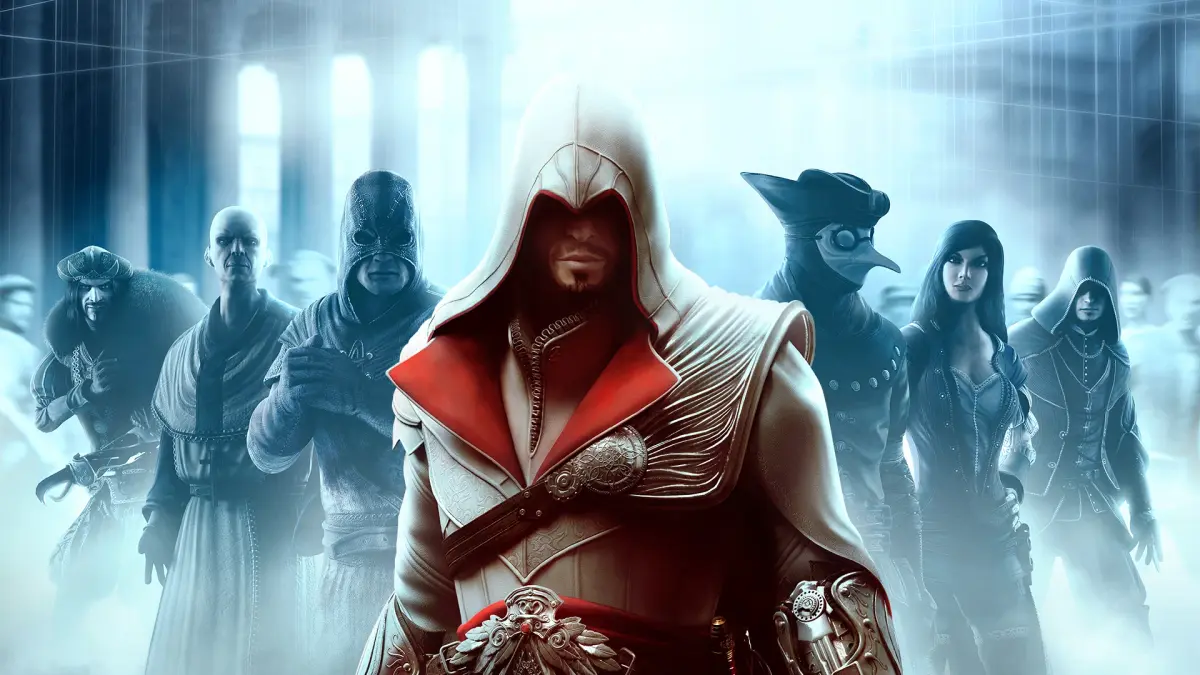
Unravel the mysteries of the Giant Mural in Assassin's Creed Brotherhood, from Chinese and Arabic translations to the symbolism of the Butterfly Effect and the Mandelbrot set.
Hey there! So, you've stumbled upon the Giant Mural in your bedroom and you're probably wondering what all those symbols and writings mean, right? Don't worry, we'll break it down. There are some Omega symbols, which usually mean the end of something, but no Alpha, which is kind of fitting for the game's themes.
What's with the Chinese and Arabic?
Honestly, the Chinese and Arabic text on the mural is pretty cryptic. While I can't give you a direct translation, some folks online have dug into it. The Arabic translates to "Al Zalzala," meaning "the shake" or "earthquake." This is a pretty clear nod to Armageddon, the end of the world, and it ties into the satellite launch date mentioned in the game. There's also Hebrew on there, translating to "Olam Habah," meaning "The World to Come." This likely refers to the afterlife, but in the context of the game, it probably signifies the world after the satellite is launched and the Templars are in control.
What's the big butterfly in the middle?
That big butterfly you see is actually symbolism for the Lorenz Attractor, which is a concept from chaos theory called "The Butterfly Effect." Basically, it means a tiny action can have huge, unpredictable consequences later on. Think of it like the flapping of a butterfly's wings in Brazil potentially causing a tornado in Texas – it sounds wild, but it's about how small changes can snowball into massive events.
This is super relevant to Assassin's Creed Brotherhood because of the Animus. You're going back in time and making changes, and those small alterations could drastically alter the future. It's like in Back to the Future, where Marty's actions in the past completely changed his present. The Animus, and the information it holds, could be key to the Templars' plan with the satellite. It even hints at the possibility of actual time travel, where a seemingly minor interaction, like shaking a young Dr. Vidic's hand, could have massive repercussions.
We see this concept in other games and movies too. In Red Alert, Einstein went back in time to prevent WWII, but ended up creating an even worse future where Stalin rose to power. And in a Futurama episode, Fry accidentally became his own grandfather, which prevented a brainspawn invasion. The point is, small changes in the past can lead to huge, sometimes terrifying, changes in the future. This ties into the Philadelphia Project in the game – a small change in the past could have a big impact on the present. It makes you wonder if a big change in the past could have an even bigger effect on the future, or maybe even come back to haunt the Templars.
What about Zm = Zn^z+C?
You might have seen a formula like that, but it's actually a bit off. The real equation is for the Mandelbrot set: Zn+1=(Zn^2)+C. The 'm' is just a stand-in for 'n+1'. If you look up the Mandelbrot set online, you'll see a picture that looks incredibly familiar to something in the game.
Who is Emperor Jiajing?
Emperor Jiajing was the 11th Emperor of China during the Ming Dynasty, ruling from 1521 to 1567. He wasn't exactly a saint; he's known for building the Temple of the Sun in Beijing. According to Subject Sixteen, Jiajing had a sin – he was greedy, collecting rare materials from all over the world. It's possible one of these rare materials he hoarded is an artifact the Templars are after.
Who is Quetzcoaltz?
No one really knows for sure who Quetzcoaltz is in the context of the game, but it's a pretty interesting name!
100% Human-Written. AI Fact-Checked. Community Verified. Learn how AntMag verifies content