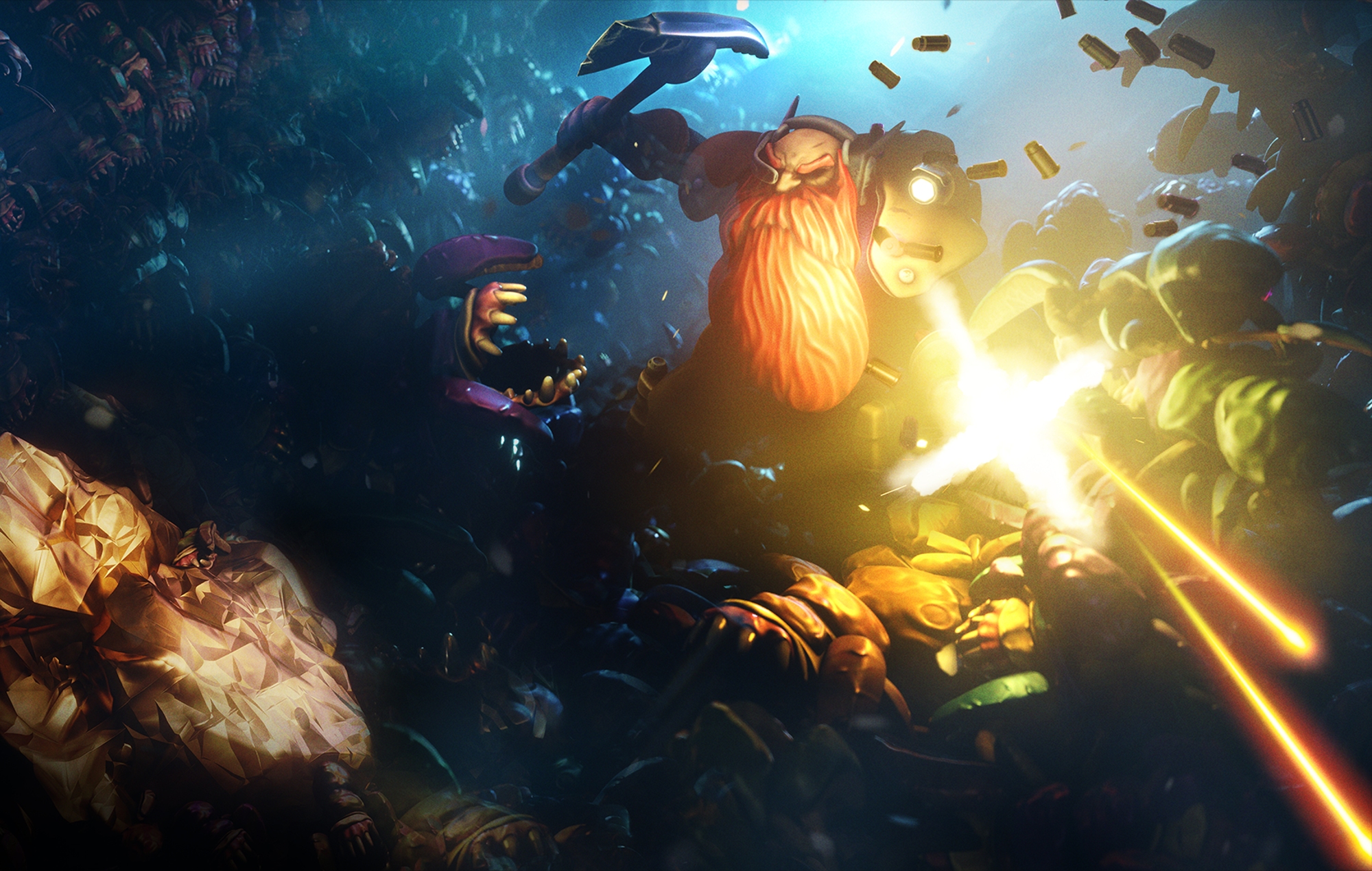
Explore the Royal Naboo in Deep Rock Galactic: Rogue Core, detailing their civilization, team, and fortress bonuses, and their rich history.
Civilization Bonus: Nova collection is 10% faster. Holocron gives more Nova.
Team Bonus: Air Cruiser speed is increased by 10%.
Fortress Bonus: Increased attack against Mechs and Heavy Weapons.
Heralded as one of the galaxy's most enlightened human cultures, the Naboo built their great civilization from humble beginnings. Over the centuries, the Naboo have evolved from simple colonists to artists, scholars, and inventors.
The Naboo's history begins about 3,950 BBY, on the planet Grizmallt, with the rise of Queen Elsinoré den Tasia. To begin her reign, Tasia introduced a new age of exploration and colonization. Under her rule, Grizmallt spent the next several decades launching hundreds of expeditions into the wilds of space. Most of these missions failed, the colony ships destroyed or lost as they searched for habitable worlds far beyond the known hyperlanes. In the final days of her life, Queen Tasia personally sponsored the last such expedition. With the blessing of a famous Jedi Master, the colony ship Beneficent Tasia and its support starships, Constant and Mother Vima, left Grizmallt in search of fortune and glory. The expedition targeted the galaxy's dangerous southern quadrant, then home to a handful of settlements. On Grizmallt, Queen Tasia's dying wish was that this last expedition would find a home deep within undiscovered space. Shortly after she perished, however, the Beneficent Tasia also went silent.
The inhabitants of Grizmallt assumed that the Beneficent Tasia had been lost, but the starship did, in fact, survive the many hazards of unknown space. Although severely damaged and unable to contact Grizmallt, the expedition eventually reached Naboo's orbit. As if guided by Tasia's last wish, the settlers discovered that Naboo was a pastoral, peaceful world rich in natural resources and quite capable of supporting human life. In approximately 3,900 BBY, the Grizmallt colonists officially landed on Naboo.
Within weeks of their arrival, the settlers encountered the Gungans, the planet's native sentient species. Although immediately distrustful of one another, neither species attacked the other, and the humans were allowed to establish their first settlement without incident. Over the next several decades, the settlers slowly spread across the planet's largest landmass, building cities and villages to support their growing numbers. The human colonists kept to the grassy plains and ocean coastlines, only occasionally treading into Gungan territory. Despite this, tension between the humans (who had now taken to calling themselves the Naboo after their new homeworld) and the Gungans remained strong.
Life on Naboo did not prove particularly difficult and the colonists soon found that they had a great deal of time for the arts and sciences. They established an electoral monarchy, built beautiful cities such as Theed, and maintained a peaceful culture that advocates education, the arts, ecology, and scientific achievement. The planet is a respected member of the Republic and its leaders are viewed as well-educated and socially adept.
The Naboo are rigid pacifists. As a result, conflicts between Naboo communities and with the Gungans are non-existent. And, while the Naboo research and invent a wide range of new technology, this rarely extends into weapons of war. The Naboo recognize the need to defend themselves, but most combat vehicles and weapons have been imported from other systems; the Naboo then modify this equipment to suit their needs and protect the environment.
Unfortunately, although generally well-educated, the Naboo are somewhat naive and consider their comfortable way of life as a birthright. In addition, many Naboo once viewed the planet's other sentient species, the Gungans, with some suspicion and prejudice. Specifically, the Naboo believed that the Gungans are barbaric and less intelligent because they maintain a warlike culture. Fortunately, most of these prejudices dissolved when Queen Amidala and Boss Nass brought the two species together during the Battle of Naboo.
While the Naboo were not nearly as active in the Republic as other systems, they did maintain a presence in the Senate before the rise of the Empire. In 52 BBY, the Naboo elected Senator Palpatine to the Galactic Senate; in time, he would become Supreme Chancellor and one of the most powerful men in the galaxy.
Naboo and its populace were thrust into the galactic consciousness in 32 BBY when war erupted with the Trade Federation. Angry over the Republic's new policy to tax the Free Trade Routes, the Trade Federation singled out peaceful Naboo, Palpatine's homeworld, for a devastating blockade. Under the leadership of Nute Gunray and Rune Haako, the Trade Federation held Naboo captive, finally launching a full-scale invasion of the planet. The Naboo were ill-equipped to defend themselves against such an attack, although several resistance groups did emerge to fight the Trade Federation forces.
Despite the efforts of the Royal Security Forces, the Trade Federation easily captured the capital city of Theed. However, Gunray could not imprison Queen Amidala, who was rescued by Jedi and taken to Coruscant. Appearing before the Galactic Senate, Amidala called a Vote of "No Confidence" in Supreme Chancellor Finis Valorum; soon after, Valorum was deposed and Palpatine was elected in his place.
Amidala returned to Naboo with a powerful entourage that included the Jedi Qui-Gon Jinn and Obi-Wan Kenobi; a former slave named Anakin Skywalker; Jar Jar Binks, a Gungan outcast; the Queen's loyal handmaidens; and Captain Panaka, Amidala's faithful and courageous personal bodyguard. With Jar Jar's help, Amidala found the Gungans and forged a peace with their ruler Boss Nass. Under Nass' leadership, the Gungan Grand Army marched against the Trade Federation while the Queen's Royal Security Forces launched a raid on Theed. Amidala herself captured Nute Gunray, while the Space Fig
100% Human-Written. AI Fact-Checked. Community Verified. Learn how AntMag verifies content