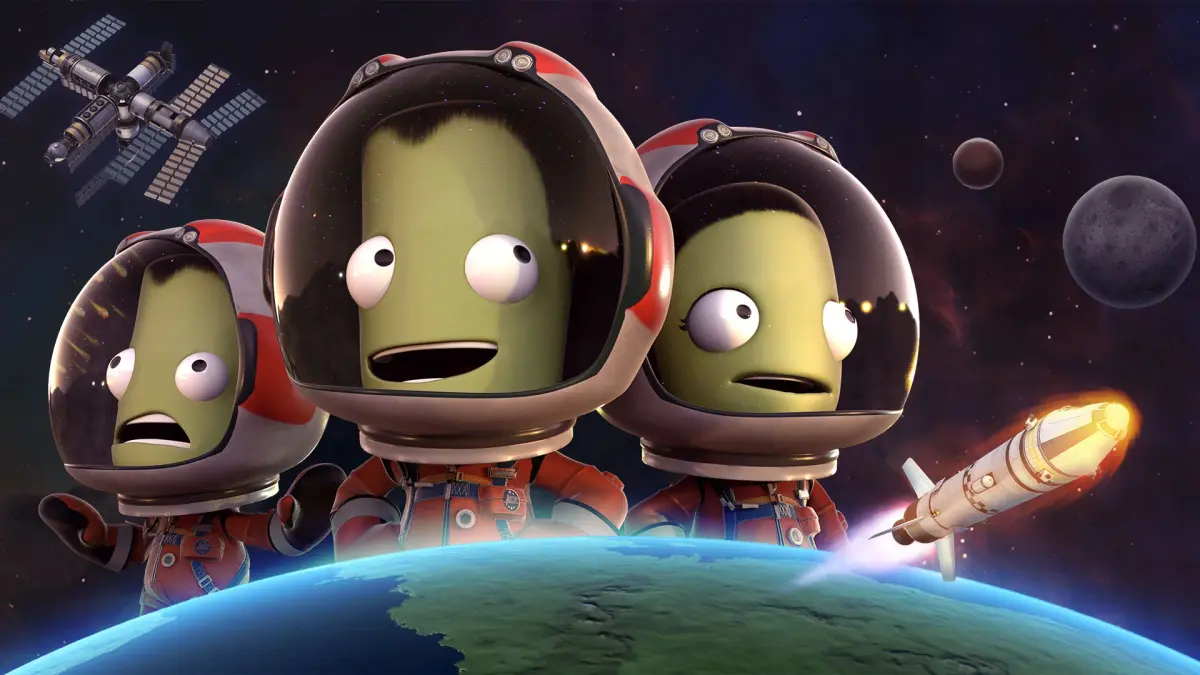
Complete Phase 3 of your Jool expedition in Kerbal Space Program by landing on Bop and Pol, collecting science, and returning to Kerbin via aerobraking.
Phase 3: Joolian Moon Landings (Bop, Pol) & Kerbin Return
Welcome, intrepid Kerbonaut, to the penultimate stage of your grand Joolian expedition! Having conquered the challenging surfaces of Laythe, Vall, and Tylo, you now turn your attention to the smaller, more forgiving celestial bodies of Bop and Pol. This phase focuses on efficient landings, comprehensive science collection, and the monumental journey back to Kerbin with your invaluable data.
Crucial Clarification: For the sake of clarity and consistency within this comprehensive guide, please note that "Moon Landings" in Phase 2 referred specifically to Kerbin's natural satellites (Mun and Minmus). This current phase, "Joolian Moon Landings," is dedicated to the moons orbiting the gas giant Jool. This distinction is vital for understanding the progression of your space program.
I. Lander Design & Preparation for Bop and Pol
Unlike the high-gravity challenges of Tylo or the atmospheric complexities of Laythe, Bop and Pol offer a welcome respite with their extremely low gravitational pulls. This translates to significantly less demanding lander designs and fuel requirements. However, precision and careful planning remain paramount.
A. Bop/Pol Lander Specifications:
- Minimal Thrust-to-Weight Ratio (TWR): Due to their low gravity, a TWR barely above 1.0 on the surface is sufficient. Over-engineering with powerful engines will only add unnecessary mass. Aim for a TWR of 1.5-2.0 for comfortable maneuvering.
- High Efficiency Engines: Small, high-ISP (Specific Impulse) vacuum-optimized engines like the 'Spark' (LV-0909) or 'Terrier' (LV-909) are ideal.
- Lightweight Structure: Utilize small fuel tanks and structural components. Every kilogram saved is a kilogram less to accelerate.
- Landing Gear: Basic landing legs are perfectly adequate. Consider a wide stance for stability on potentially uneven terrain.
- Science Instruments: Equip your lander with a full suite of science instruments for maximum data return.
B. Recommended Science Instruments for Bop & Pol:
- Mystery Goo™ Containment Unit: Essential for surface and orbital observations.
- PresMat Barometer: While these moons lack significant atmospheres, it can still register trace readings.
- 2HOT Thermometer: For temperature readings on the surface and in orbit.
- Double-C Seismic Accelerometer: Crucial for seismic data.
- Gravioli Detector: To measure gravitational anomalies.
- Atmospheric Fluid Spectro-Variometer: Even trace atmospheric elements can be detected.
- Surface Scanning Module: For resource prospecting (optional, but good for future missions).
- EVA Report & Surface Sample: Always perform these on the surface for maximum science.
II. Landing on Bop
Bop is Jool's outermost and most eccentric moon. It's known for its low gravity and often irregular, potato-like shape. It's also famous for the Kraken Easter egg!
A. Transfer & Orbital Insertion:
- ΔV from Jool Orbit: Approximately 100-200 m/s for a transfer burn from a low Jool orbit to an intercept with Bop.
- Orbital Insertion: A small burn of around 50-100 m/s will be needed to circularize into a low Bop orbit (e.g., 10-20 km).
B. Landing Strategy:
- Descent: Due to Bop's extremely low gravity (0.06 G), your descent will be very slow. Use minimal thrust to control your vertical velocity.
- Target Landing Zone: Look for flat areas to ensure a stable landing. Bop's surface can be quite bumpy.
- Final Approach: Aim for a vertical velocity of 0.5-1.0 m/s for a soft touchdown. Over-thrusting can easily send you back into orbit.
- Science Collection: Once landed, perform all surface science experiments, EVA report, and collect a surface sample.
III. Landing on Pol
Pol is another low-gravity, irregularly shaped moon, characterized by its distinctive green-yellow coloration. It's even smaller than Bop, making it an excellent target for low-ΔV operations.
A. Transfer & Orbital Insertion:
- ΔV from Jool Orbit: Similar to Bop, expect around 100-200 m/s for the transfer.
- Orbital Insertion: A very small burn of 30-70 m/s will suffice for a low Pol orbit.
B. Landing Strategy:
- Descent: Pol's gravity is even lower than Bop's (0.03 G). This means an even slower descent and extreme care with throttle control.
- Target Landing Zone: Pol's surface is often described as "spiky." Look for the relatively flatter, smoother patches.
- Final Approach: Aim for a vertical velocity of 0.2-0.5 m/s. It's easy to bounce or accidentally re-orbit.
- Science Collection: As with Bop, perform all available surface science experiments, EVA report, and collect a surface sample.
IV. The Long Journey Home: Return to Kerbin
With all Joolian moon science collected, the final, and arguably most challenging, phase of your mission begins: the return to Kerbin. This requires a significant ΔV burn to escape Jool's Sphere of Influence (SOI) and a precise aerobraking maneuver at Kerbin.
A. Escape from Jool's SOI:
- ΔV Requirement: This is the largest burn of the return trip. From a low Jool orbit (or after rendezvousing with your main transfer vehicle), you'll need approximately 1,800 - 2,200 m/s to achieve an escape trajectory that intercepts Kerbin.
- Maneuver Planning: Plan your escape burn carefully. Aim for a prograde burn when your craft is at apoapsis in Jool's system, or when aligned for a gravity assist from Tylo or Laythe if you have the fuel and patience.
- Kerbin Intercept: Once on an escape trajectory, fine-tune your burn to achieve a Kerbin intercept. This may require small mid-course corrections (10-50 m/s).
B. Kerbin Aerobraking & Capture:
Aerobraking at Kerbin is a highly efficient, but equally dangerous, method of shedding velocity. Precision is key to avoid burning up or skipping out of the atmosphere.
- Target Periapsis: For a safe and effective aerobrake from a Jool return trajectory, aim for a Kerbin periapsis between 30,000 m and 35,000 m (30 km - 35 km).
- Entry Angle: A shallow entry (higher periapsis) risks skipping out of the atmosphere. A steep entry (lower periapsis) risks overheating and destruction.
- Heat Shield: Ensure your command module is equipped with a sufficiently sized heat shield (e.g., 2.5m for a 2.5m craft). Orient your craft heat-shield-first during atmospheric entry.
- Monitoring: Closely monitor your craft's temperature and G-forces. If temperatures rise too quickly, you may need to adjust your periapsis for subsequent passes (though from Jool, a single pass is usually desired).
- Multiple Passes (Optional): If your initial aerobrake is too high, you might perform multiple passes through the upper atmosphere to gradually reduce speed. This is safer but takes more time.
- Orbital Capture: After shedding enough velocity, your craft will be captured into Kerbin orbit. A small final burn might be needed to circularize or adjust your orbit for re-entry.
C. Final Re-entry & Landing:
- De-orbit Burn: Perform a retrograde burn to lower your periapsis into the denser atmosphere (e.g., below 25 km).
- Parachutes: Deploy parachutes at appropriate altitudes to slow your descent. For Kerbin, drogue chutes typically deploy at high altitude, followed by main chutes at lower altitude (e.g., 1000m).
- Safe Landing: Aim for a splashdown in the ocean or a flat landmass for recovery.
Congratulations, Kerbonaut! You have not only landed on every moon of Jool but also returned home with a treasure trove of scientific data. The Jool-5 challenge is a true test of planning, patience, and piloting skill, and your success marks you as a master of Kerbal Space Program!
100% Human-Written. AI Fact-Checked. Community Verified. Learn how AntMag verifies content