
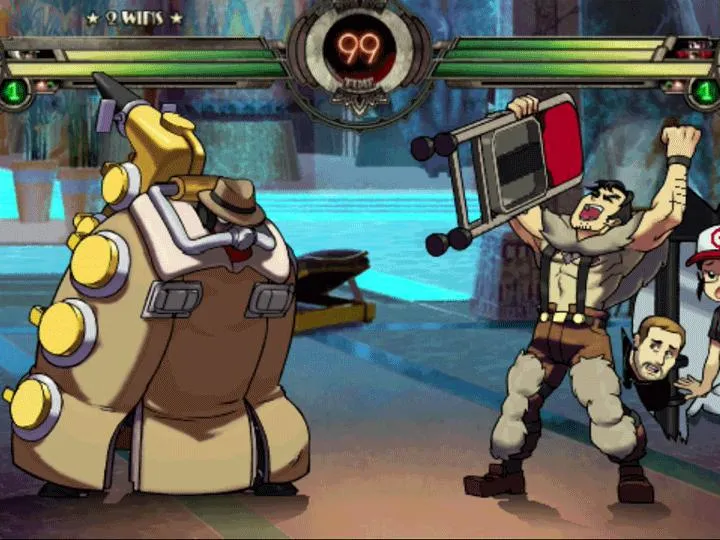
Master Skullgirls 2nd Encore combos and blockstrings for competitive play. Learn combo theory and build your own attack sequences with specific examples.
Mastering combos and blockstrings is fundamental to competitive play in Skullgirls 2nd Encore. This section will break down the core concepts, provide actionable steps for building your own sequences, and offer specific examples to get you started. Remember, practice in the Training Room is key!
Understanding Combo Theory
A combo is a sequence of attacks that, once the first hit connects, the opponent cannot block or escape until the sequence ends or is dropped. Skullgirls features a robust combo system with several key mechanics:
- Gatling System: This allows you to cancel normal attacks into other normal attacks, typically from light to medium to heavy (e.g., LP > MP > HP). You can also cancel standing normals into crouching normals, and vice-versa, as long as the strength progression is maintained or the new normal is of a higher strength.
- Special Cancel: Most normal attacks can be canceled into a character's special moves (e.g., Peacock's MP > QCF+LK (Bang!)). This is crucial for extending combos and adding damage.
- Super Cancel: Special moves and some normal attacks can be canceled into a character's Blockbuster (Super) attacks. This is often used for high-damage finishers or to extend otherwise un-extensible combos.
- Launcher/Air Combo: Many characters have a specific normal attack (often HK or HP) that launches the opponent into the air, allowing for air combos. After a launcher, you can typically perform a series of air normals and air specials.
- Wall Bounce/Ground Bounce: Certain attacks will cause the opponent to bounce off the wall or ground, allowing for further combo extensions. For example, Valentine's QCB+HK (Scalpel) can cause a wall bounce.
- Drama (Damage Dampening): As a combo progresses, the damage output of subsequent hits is reduced. This prevents infinite combos and encourages variety. The Drama meter is visible in the Training Room.
- Undizzy: This is Skullgirls' unique combo-breaking mechanic. As a combo progresses, the opponent's Undizzy meter fills. If it fills completely, they become "dizzy" and can perform a Burst to escape the combo. Smart combo design involves managing Undizzy.
Building Basic Combos (Ground to Air)
A common combo structure in Skullgirls is a "ground-to-air" sequence. Here's a general template:
- Opener: Start with a fast, low-commitment normal attack (e.g., LP, LK) or a quick special move to confirm a hit.
- Gatling Chain: Follow up with a series of normal attacks, progressing from light to medium to heavy (e.g., LP > MP > HP).
- Launcher: Use a normal attack that launches the opponent into the air (e.g., c.HK for many characters).
- Jump Cancel: Immediately after the launcher, jump towards the opponent.
- Air Normals: Perform a series of air normal attacks (e.g., j.LK > j.MK > j.HP).
- Air Special/Super: End the air combo with an air special move or an air Blockbuster for extra damage or to bring the opponent back to the ground.
- Landing/OTG (Off The Ground): If the opponent lands, some characters can follow up with an OTG attack (e.g., a specific special move or a d.HP for some characters) to extend the combo further.
Example: Filia's Basic Ground-to-Air Combo
Let's use Filia as an example. Go to the Training Room and set the dummy to "Block After First Hit" to practice confirmation.
- Opener: c.LK (Crouching Light Kick)
- Gatling: c.LK > c.MP (Crouching Medium Punch)
- Launcher: c.MP > c.HK (Crouching Heavy Kick)
- Jump Cancel: Immediately after c.HK, press Up-Forward to jump.
- Air Normals: j.LK (Jumping Light Kick) > j.MP (Jumping Medium Punch) > j.HP (Jumping Heavy Punch)
- Air Special: j.HP > QCB+LK (Air Hairball)
- Landing: After Air Hairball, Filia lands. You can often follow with a quick c.LP or c.LK for a small additional hit, or a Blockbuster like QCF+HP+HK (Fenrir Drive) for a finisher.
Full Sequence: c.LK > c.MP > c.HK > j.LK > j.MP > j.HP > QCB+LK (Air Hairball)
Advanced Combo Techniques
- Assist Calls: Integrate your assist characters into your combos for extensions, extra damage, or to manage Undizzy. For example, calling a Big Band assist during an air combo can allow you to land and continue the combo on the ground.
- DHC (Delayed Hyper Combo): Cancel a Blockbuster into another character's Blockbuster for massive damage and character tag-ins. This is a primary way to spend meter for high-damage finishes.
- Alpha Counter: While blocking, press Forward + Assist 1 or Assist 2 to perform a counter-attack with your assist character. This costs 1 meter and can be a strong defensive option.
- Burst Baiting: Smart players will intentionally drop a combo or use a less damaging sequence to bait an opponent's Burst, then punish it.
- Meter Management: Be mindful of your meter. Do you need to save it for a Burst, a DHC, or a powerful Blockbuster finisher?
Blockstrings: Applying Pressure
A blockstring is a sequence of attacks that, when blocked, leaves the attacker safe or at an advantage, allowing them to continue pressure. The goal is to create a series of attacks that are difficult to interrupt and force the opponent to guess their next move.
Key Elements of a Good Blockstring:
- Tightness: The gaps between attacks should be small enough that the opponent cannot interrupt with a fast normal or special.
- Mix-ups: Incorporate high/low and left/right mix-ups to open up the opponent's guard.
- Pushback: Manage the pushback from blocked attacks. Too much pushback can end your pressure prematurely.
- Special Cancels: Use special moves to extend blockstrings, create frame traps, or transition into a mix-up.
- Assist Calls: Assists are invaluable in blockstrings. They can cover gaps, create cross-ups, or provide additional hits for mix-ups.
- Ending Safely: A good blockstring should end with an attack that is safe on block (e.g., a special move that leaves you at -4 or better on block) or allows you to escape.
Example: Peacock's Basic Blockstring
Peacock excels at zoning and pressure. Here's a simple blockstring to start with:
- Opener: s.LP (Standing Light Punch)
- Gatling: s.LP > s.MP (Standing Medium Punch)
- Special Cancel: s.MP > QCF+LK (Bang!) - This is safe on block and creates some distance.
- Follow-up: After Bang!, you can immediately throw out a QCB+HP (Lonesome Lenny) to set up a trap, or dash forward and attempt a throw.
Full Sequence: s.LP > s.MP > QCF+LK (Bang!) > (Optional) QCB+HP (Lonesome Lenny)
Practice Tips in the Training Room
The Training Room is your best friend for combo and blockstring development. Utilize these settings:
- Dummy Settings:
- Guard: "Guard All" for blockstrings, "Block After First Hit" for combo confirmation.
- Reversal Action: Set to "Jump" or "Blockbuster" to test if your sequences are truly tight or if you can bait a reversal.
- Undizzy: Monitor the dummy's Undizzy meter to understand how your combos affect it.
- Reset Position: Set to "Same" or "Corner" for consistent practice.
- Input Display: Always have the input display on to ensure you're performing the correct inputs.
- Frame Data: While not directly in-game, understanding frame data (available on external wikis) can significantly improve your blockstring design.
Experiment with different character combinations and assist calls. The possibilities for creative combos and blockstrings in Skullgirls are vast!
100% Human-Written. AI Fact-Checked. Community Verified. Learn how AntMag verifies content