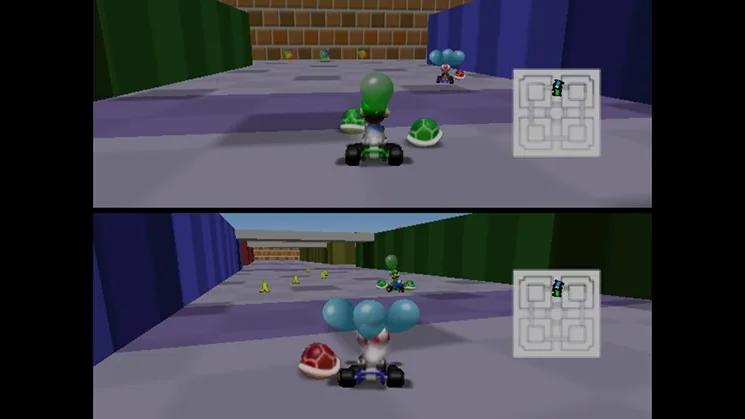
Learn about Mario, the iconic plumber from Mario Kart 64, and his extensive history in video games, starting from Donkey Kong.
Mario is the central figure of the Mario Kart 64 game. His history in video games is extensive, appearing in more titles than any other character. His first appearance was in the game Donkey Kong, where he was known as Jumpman, a carpenter trying to rescue his girlfriend, the Lady, from Donkey Kong. In this early arcade game, his appearance was dictated by primitive graphics: a cap because hair was difficult to animate, overalls for arm movement, sideburns to distinguish ears, a mustache to cover (press the cover button to crouch behind walls or objects) his mouth, and red overalls for ease of generation. His name, Jumpman, reflected his ability to leap over barrels and hazards thrown by Donkey Kong.
For the sequel, Donkey Kong Jr., Jumpman was renamed Mario Segali, after the landlord of the Nintendo of America building. In Donkey Kong Jr., Mario was depicted as a cruel character wielding a whip, but he was absent from the third Donkey Kong installment. He then starred in Mario Bros., where his profession shifted to plumbing due to his ability to travel in pipes. Alongside his brother Luigi, Mario cleared Brooklyn sewers using his signature jumping skills.
Mario's career advanced to the NES with Super Mario Bros., an instant classic where he defeated King Koopa, Bowser, and rescued Princess Peach Toadstool, establishing a trend for future games. His popularity surged, leading to a trilogy, with Super Mario Bros. 3 being his most popular NES adventure, despite introducing few new elements to the series.
The American Super Mario Bros. 2 was a unique case. Nintendo adapted the Japanese-only game Doki Doki Panic, replacing its main characters with Mario, Luigi, Peach, and Toad, and rebranding it as Super Mario Bros. 2 for the US market. The original game involved an Arabian family rescuing children from a storybook. While most enemies were retained with a name change from Mamu to Wart, the ending was altered, suggesting the entire adventure was a dream, hinting at a subconscious ego beneath Mario's humble plumber exterior, or perhaps excessive mushroom consumption.
With Yoshi as his companion, Mario appeared in Super Mario World. This was followed by Super Mario World 2: Yoshi's Island, which explored the origins of the plumber. In this game, a Magikoopa foresaw Mario's future trouble for Bowser, leading the Koopa Troop to intercept the stork delivering Mario and Luigi. While Luigi and the stork were captured, Mario escaped to find Yoshi, who served as Baby Mario's ride until Yoshi defeated Baby Bowser and freed the stork.
Super Mario World 2 contradicted earlier established facts by placing Mario and Luigi in the Mushroom Kingdom with parents, and portraying them as twins. However, previous and future games consistently clarify that Mario is older than Luigi. Nintendo has acknowledged these discrepancies, stating they aim for a grand linking storyline for the Mario series but admit it can limit creativity.
Mario gained a voice in Super Mario World 2 with a shriek, but it was in Super Mario 64 that he began to vocalize more extensively. Voiced by Charles Martinet, Mario's dialogue included stereotypical Italian phrases like "Mama mia!" and various "Yahoo!" sounds. Super Mario 64 marked Mario's first major 3D adventure, where he ventured alone to rescue Princess Peach Toadstool from Bowser, who had seized control of the Mushroom Castle using the Power Stars. In this game, Mario could collect up to 120 Power Stars to defeat Bowser. The game concluded with Mario eating cake with Princess Peach. Luigi, Wario, and Yoshi were playable characters in the Nintendo DS port, Super Mario 64 DS.
Mario's involvement in RPGs continued on the N64 in 2001. A rift between Square-Enix and Nintendo, stemming from Square's releases on the Playstation, impacted Mario's previous RPG ventures.
- Mario's early design was heavily influenced by the limitations of arcade graphics.
- The name change from Jumpman to Mario was inspired by a real person.
- Super Mario Bros. 2 in the US was a reskin of a Japanese game called Doki Doki Panic.
- Super Mario World 2: Yoshi's Island offers insights into Mario and Luigi's origins.
- Mario's voice actor, Charles Martinet, is responsible for many of Mario's iconic vocalizations.
100% Human-Written. AI Fact-Checked. Community Verified. Learn how AntMag verifies content