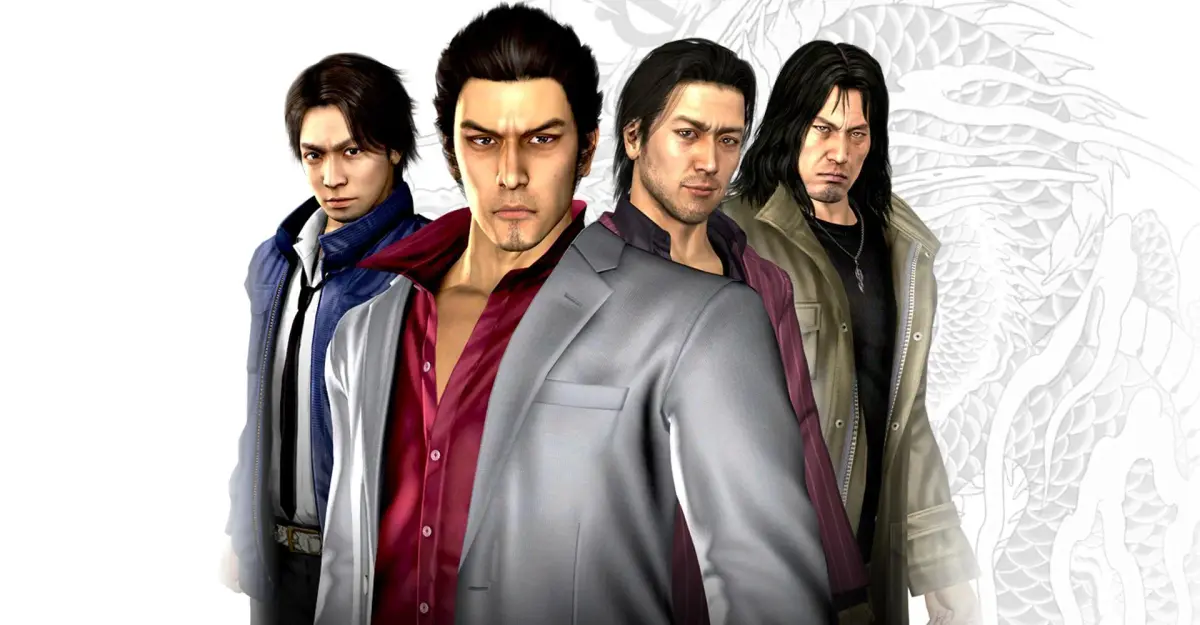
Understand the unique Japanese terms and yakuza hierarchy used in Yakuza 4 Remastered. Learn about 'Aniki', 'Bento', 'Captain', 'Chairman', 'Chinpira', 'Gokudo', and honorifics like '-chan' and '-kun'.
Here I provide some terms that you'll read in the subtitles and also might pick up in the actual language, further explaining how some of those terms are translated to subtitle.
- "Aniki"
- Literally "big brother". Younger brothers tend to refer to older brothers with this term in Japanese, and in the yakuza world, someone you refer to as "aniki" is your direct superior on the streets and generally someone you aspire to be. Kido, for example, refers to Arai as his aniki.
- Bento
- In short, a boxed lunch. Bento are typically prepared in rectangle containers, usually with a base of rice or noodles, then adding meat, veggies, and so forth. One can buy bento from a convenience store, or in the case of schoolkids, their parents could prepare one for them.
- Captain
- In Japanese, this is the "wakagashira": the second in command for any family. Being the captain of a family is tantamount to being a heartbeat away from running it. The captain-ship of the Dojima Family was an issue in Yakuza 0. Shintaro Kazama served as the captain of the Dojima Family. It's possible to be a patriarch of one's own family and still be the captain of another more esteemed family, as in the case of Kazama, who was also the patriarch of his own family. In this game, Arai, for example, is the captain of Kanemura Enterprises.
- Chairman
- The boss of bosses of a yakuza association, similar to a "godfather". The Chairman is arbiter for the families in a yakuza association, ultimately deciding what is best for the group. It's a position of considerable power but also considerable responsibility. When directly referring to a chairman, it's typical to refer to them by their number of succession. In the case of Kazuma Kiryu, he may sometimes be addressed as "yon-daime", literally "the fourth", since he was the Fourth Chairman of the Tojo Clan, even if he did step down after a day. The current chairman is the Sixth Chairman, Daigo Dojima.
- "Chinpira"
- While this isn't really used much in subtitle or brought up because of localization, I figured it important to mention this term, which refers to both low-level members of the yakuza as well as typical street punks. "Chinpira" are basically considered as well below the executive level of the yakuza. They either dress in track pants and sweats or flashy clothes. Kiryu is notable in that regardless of his place in the series, he routinely dresses as a "chinpira" with the somewhat flashy suit.
- Expulsion vs. Exile/Banishment
- It's important to note that in the very first game, Kiryu receives a notice that he's been "expelled" from the Tojo Clan. This is known as "hamonjo" and is meant to state that the recipient is no longer tied to the organization and is now for all intents a civilian. The thing about hamonjo is that is possible to reverse it. Kiryu expected to be completely banished from the life, what's known as "zetsuenjo", an irreversible expulsion that would mean that even associating with members of the yakuza would result in severe hostilities. Kiryu also receives hamonjo in Yakuza 0, which is why he was able to return following the game's events.
- Family
- In the case of the yakuza, a family ("-kai", or "-gumi") is quite simply an organization with a patriarch at its head. The family could be focused around one specific business, or could have whole neighborhoods in their racket. The family could be small and of low influence, or it could stretch back towards the beginning of the organization and have great power. More prominent families, like the Kazama Family, the Dojima Family, or the Shimano Family, had a seat at Tojo HQ where they would convene with the chairman to discuss policy and tactics. Smaller families can sometimes go about their business without any great amount of notice, as long as they know their place and don't make waves.
- "Gokudo"
- Literally meaning "the ultimate path", but also commonly meaning just "gangsters", members of the yakuza will typically refer to themselves as this. Commonly, when the subtitles say "yakuza", you'll instead hear "gokudo". When the characters say this word, they typically mean that their perspective of their organization is favorable or honorable.
- Honorifics
- Honorifics exist on a much greater hierarchy in polite Japanese society than Western society's "Mister" or "Mrs." Almost everyone is addressed with some sort of honorific attached to their name. Furthermore, in the case of this game series at least, men tend to be referred to by their family name (Kiryu, Akiyama, Saejima), whereas women tend to be referred to by their given name (Haruka, Hana, Yasuko). If someone refers to a character without an honorific, they're either very close with that character or being very rude on purpose. Here's a list of common honorifics you'll find in this game, although plenty more exist:
- -chan
- An honorific typically used as a diminutive. Most often you'll find this used by adults when addressing children. One might think it could mean "My dear" or "Little". As children get older, boys usually are addressed as "-kun", but girls tend to hold onto being addressed as "-chan" into their adulthood. In this game, Akiyama refers to Hana as "Hana-chan", largely because she works for him. He refers to Kido as "Kido-chan" as a bit of a commentary on his youth and inexperience in the yakuza.
- -han
- Equivalent to "-san", but for the Kansai regional dialect. Some characters that speak in a Kansai accent use this honorific.
- -kun
- An honorific also typically used as a diminutive or for people familiar with each other, and also for senior members addressing younger members. It's also used among boys to refer to each other.
- -niisan
- An honorific addressing someone as their older brother. Typically used among families. In the case of this game, Kiryu refers to Majima as "Majima-niisan" or "Majima-no-niisan" due to the fact that, despite all of his antics, Kiryu still fo
100% Human-Written. AI Fact-Checked. Community Verified. Learn how AntMag verifies content