
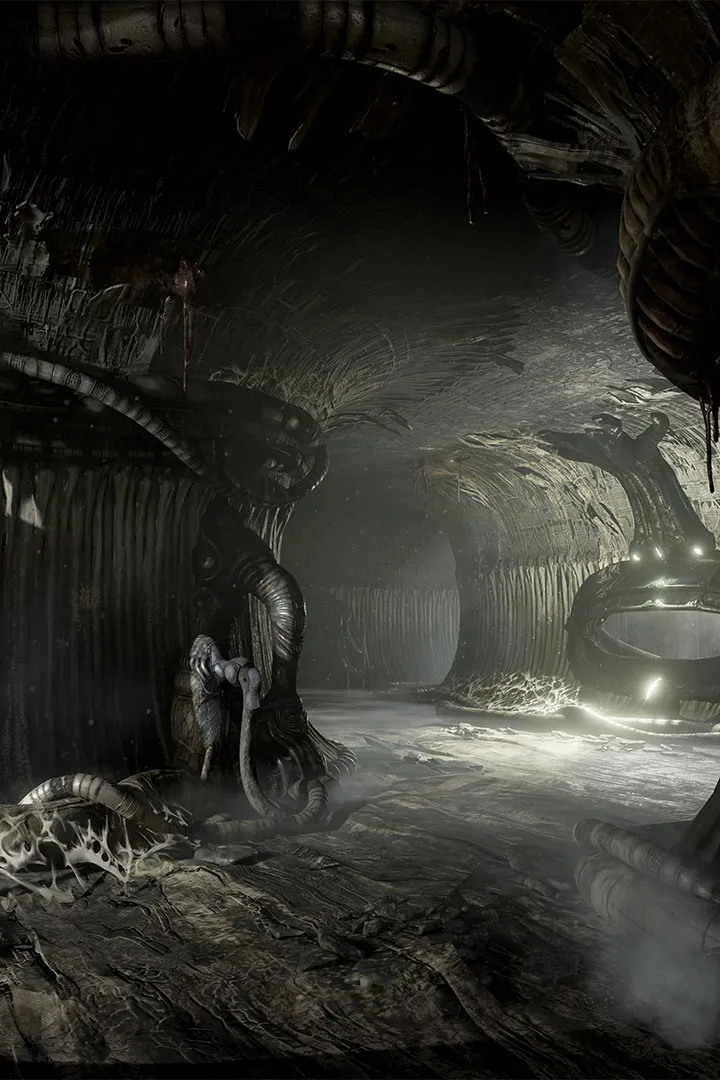
Analyze the perpetual cycle of life, death, and rebirth within Scorn. Understand how evolution and decay shape the game's unique and disturbing atmosphere.
Scorn presents a world where the cycle of life and death is not a biological imperative but a mechanical, grotesque process. The very machinery you interact with seems to embody this, with organic and industrial elements fused in disturbing ways. The act of creation and destruction is intertwined, and You character's journey often involves manipulating these processes. You might find yourself activating dormant mechanisms that lead to the birth of new, albeit monstrous, entities, or conversely, dismantling existing structures to acquire vital components. This constant flux, this perpetual re-purposing of organic matter and mechanical parts, forms the core of the world's unsettling existence. The puzzles themselves often reflect this, requiring you to understand how to initiate a sequence of events that leads to a specific outcome, whether it's the growth of a new appendage for a machine or the activation of a transport system. The environment itself is a testament to this, with discarded husks and nascent forms coexisting. The very act of survival often hinges on understanding and manipulating these cycles, turning what appears to be decay into a means of progression. For instance, the Egg Chamber puzzle in Act 3 requires you to understand the reproductive cycle of certain creatures to proceed, demonstrating how life, in its most alien forms, is a key to unlocking the path forward. The pervasive theme suggests that even in this desolate landscape, life finds a way, albeit a profoundly disturbing one, and death is merely a transition, a source of raw material for what comes next.
The Mechanical Metamorphosis
The world of Scorn is a constant state of becoming and unbecoming. You character, a silent observer and active participant, witnesses and influences this transformation. The tools and devices encountered are not merely static objects but active agents in this cycle. The Grasping Hand tool, for example, is used to manipulate organic and mechanical components, often in ways that mimic biological processes like digestion or gestation. Understanding how these tools interact with the environment is crucial. You might need to use the Grasping Hand to extract a vital organ from one creature to implant it into another, thereby initiating a new cycle of life or functionality. This isn't about healing or restoration in a conventional sense, but about the brutal, efficient re-purposing of biological material for mechanical ends. The puzzles often demand a deep understanding of these interconnected systems, forcing players to think in terms of cause and effect within this unique biomechanical ecosystem. The visual language of Scorn reinforces this, with pulsating organic matter integrated into rigid, metallic structures, blurring the lines between the living and the inanimate. This constant interplay between creation and destruction, life and death, is the fundamental engine of Scorn's narrative and gameplay.
100% Human-Written. AI Fact-Checked. Community Verified. Learn how AntMag verifies content