
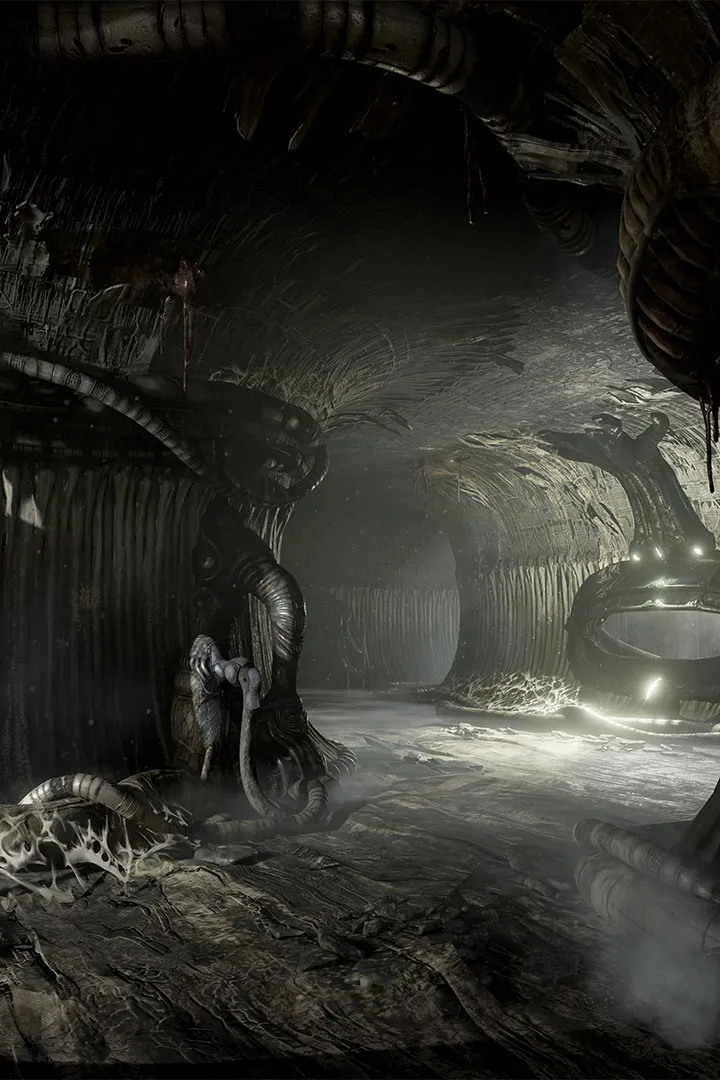
Understand the complex Organic Structures in Scorn. Learn how these alien constructions function and how to interact with them to overcome obstacles.
Scorn's world is a testament to the unsettling visions of H.R. Giger, and a significant portion of its environment is composed of what can only be described as organic structures. These are not mere decorations; they are integral to the game's mechanics, puzzles, and overall narrative. Understanding how these organic elements function is crucial for progression. They often serve as conduits, interfaces, or even living components of the biomechanical machinery. For instance, in Act 2, you might encounter vast desert landscapes dotted with pulsating organic growths that are part of larger, interconnected systems. These structures can act as pathways, power sources, or even as components within the puzzles you need to solve. The game encourages a hands-on approach, meaning you'll often need to interact directly with these organic elements, pushing, pulling, or manipulating them to achieve a desired outcome. The visual des of these structures is deliberately grotesque and alien, designed to evoke a sense of discomfort and wonder simultaneously. They are a constant reminder of the game's unique aesthetic and its deep dive into biomechanical horror.
The organic structures in Scorn often behave in ways that are both alien and, in a disturbing sense, logical within the context of the game's world. They can be sensitive to touch, react to pressure, or even exhibit ss of life, such as pulsing or shifting. For example, some organic mechanisms might require you to insert a specific tool or even a part of another organic structure to activate them. The game doesn't provide explicit tutorials for these interactions; instead, it relies on visual cues and player experimentation. Observing how these structures respond to your actions is key. A slight tremor, a change in color, or a subtle movement can indicate that you are on the right track. In Act 5, for instance, you might find yourself needing to navigate through a series of organic tunnels, where the path forward is dictated by the growth patterns and reactions of the surrounding organic matter. It's important to remember that these structures are not always passive; some may react defensively or even aggressively if mishandled, though the source material does not detail specific enemy types directly emerging from these structures. The challenge lies in deciphering their intended purpose and interacting with them in a way that als with that purpose.
The integration of organic and mechanical elements is a hallmark of Scorn's des. You will frequently see flesh-like tissues fused with metal and stone, creating a disturbing symbiosis. These hybrid structures are often the focus of the game's puzzles. For example, a puzzle might involve redirecting a flow of organic fluid through a series of pulsating veins and arteries to power a dormant machine. The solutions are rarely straightforward and often require a deep understanding of the interconnectedness of these systems. Details for specific organic mechanisms and their precise functions are still being verified, but the general principle is to approach them with curiosity and a willingness to experiment. Don't be afraid to try different interactions. The game rewards players who are observant and willing to learn the unique "language" of its biomechanical world. The organic structures are not just scenery; they are the very essence of Scorn's gameplay and narrative, offering a unique and deeply unsettling interactive experience.
[/NODE_1] [NODE_2]The Sificance of the Humanoid Figures
The humanoid figures encountered in Scorn are central to its unsettling narrative and its H.R. Giger-inspired aesthetic. These beings are not mere inhabitants of the world; they are integral to its disturbing cycle of life, decay, and biomechanical integration. Their very existence and their interactions with the environment offer profound insights into the game's themes of suffering, creation, and the blurring lines between organic and artificial life. As you venture through the desolate landscapes, from the vast desert of Act 2 to the intricate machinery of Act 5, you will witness these figures in various states of being. Some may appear to be struggling, others may be engaged in laborious tasks, and many will be found in states of decay or transformation. The game does not provide explicit dialogue or exposition regarding their origins or their societal structure, forcing players to infer their roles and their sificance through observation and environmental context. Their des is a direct reflection of the biomechanical horror that permeates the world, suggesting a deep and often painful connection to the machinery they inhabit.
The puzzles and encounters in Scorn are often directly tied to the plight or the actions of these humanoid figures. You might find yourself needing to operate machinery that directly impacts them, or perhaps you will be tasked with guiding them through perilous environments. For instance, a puzzle in Act 5 might involve manipulating a series of organic mechanisms to aid a struggling humanoid figure, or conversely, to facilitate its demise. The game's approach to these figures is unflinching, presenting their existence in a raw and often brutal manner. It is crucial to observe their reactions and their physical states, as these often provide clues to the solutions of the puzzles or the strategies needed for certain encounters. The source material does not specify any particular named humanoid characters, but their collective presence and individual circumstances paint a grim picture of existence within this biomechanical world. Understanding their role is not just about progressing through the game; it's about comprehending the deeper, disturbing message that Scorn seeks to convey about existence and the consequences of unchecked technological and biological fusion.
The sificance of these humanoid figures extends beyond their immediate role in puzzles and encounters. They are the embodiment of the game's core themes. Their forms, often contorted and fused with machinery, speak to a loss of individuality and a subjugation to the biomechanical forces that govern their world. The game challenges players to confront these unsettling images and to consider the implications of such an existence. While specific details regarding their societal hierarchy or their ultimate purpose are still being verified, it is clear that they are not simply passive pawns. They are beings with a history, with struggles, and with a place within the disturbing ecosystem of Scorn. The act of interacting with them, whether it's to help or to hinder, is a direct engagement with the game's narrative and its exploration of what it means to be alive in a world that seems to have forgotten the meaning of humanity. Their presence is a constant, unsettling reminder of the game's unique and disturbing vision.
100% Human-Written. AI Fact-Checked. Community Verified. Learn how AntMag verifies content