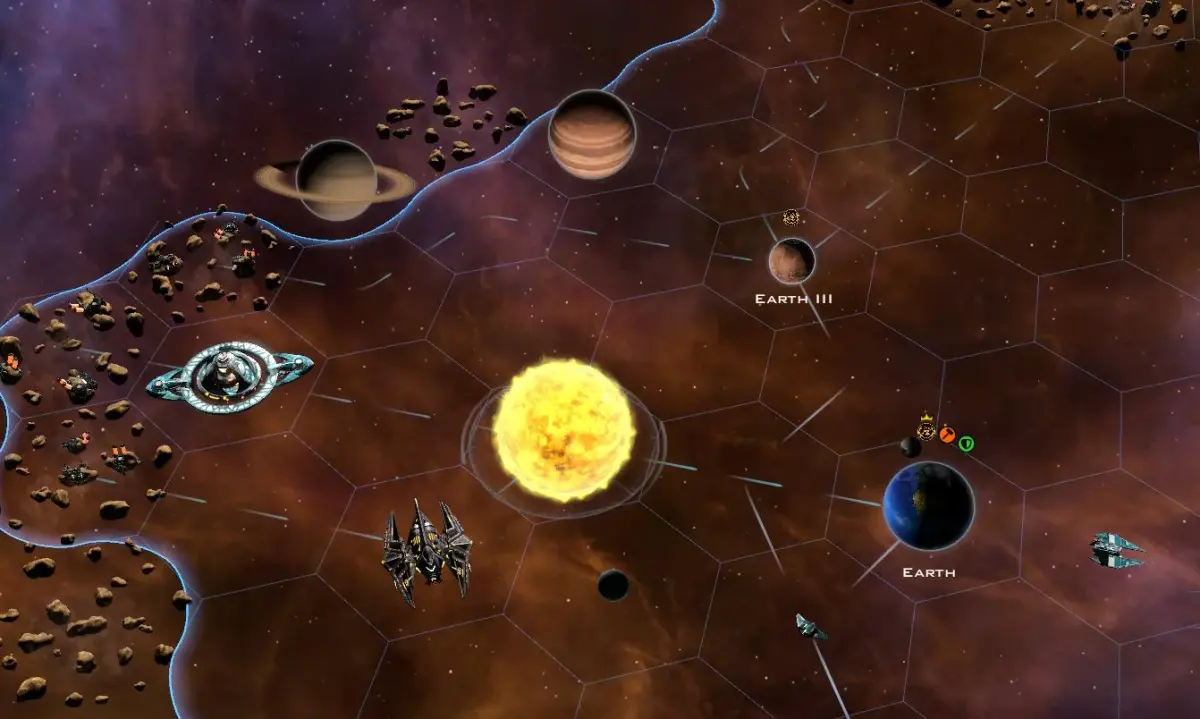
Galactic Civilizations II is a deep, turn-based space 4X strategy game where you'll forge an interstellar empire. You'll manage everything from colony expansion and ship design to diplomacy and fleet combat, all in your quest for galactic dominion. It's a game for anyone who loves grand strategy and wants to build a civilization from a single planet to a galaxy-spanning superpower.
This guide, based on the 'Paths to Victory' strategy guide, dives into the core mechanics of conquering the galaxy. We'll cover everything from initial setup and mastering fleet combat to economic management and faction-specific strategies. Whether you're struggling with early-game expansion or aiming for ultimate victory, this guide offers insights to help you forge a mighty empire.
Part 1
New to Galactic Civilizations II? This guide walks you through setting up your first Sandbox game, understanding galaxy size, tech rates, and starting your empire.
Alright, so you've got Galactic Civilizations II and you're ready to dive in! This game is seriously one of the best 4X strategy games out there, especially if you're into sci-fi or turn-based strategy. Think of this guide as your buddy showing you the ropes. We'll get you started with the basics so you can begin building your own galactic empire today. As we go, I'll be adding more strategies and insights from other players too.
First things first, when you fire up the game, you'll see a few main choices. You can jump into a New Game (often called Sandbox Mode), start a Campaign to follow the story, or try a Metaverse game. Metaverse is basically Sandbox but without mods, and it lets you upload your score to compare with others online. For now, let's stick with a new game in Sandbox Mode.
Once you click 'New Game,' you'll be looking at the universe setup. This is where you decide how big your playground is. The galaxy size ranges from Tiny (just 3x3 sectors) all the way up to Gigantic (16x16). If you want a game that wraps up in a few hours, aim for anything smaller than Medium. Bigger maps can take multiple sessions, so I usually go for Huge – it gives you space to breathe early on but doesn't drag on for days.
You can also pick a Scenario, which changes the victory conditions and game rules. For your first game, just leave it on Normal so all victory conditions are active.
Down at the bottom, you'll see boxes that tweak the universe's makeup. These settings let you adjust the game's difficulty, separate from the AI's intelligence. The easiest way to start is by setting everything to Abundant. Lowering any of these options will reduce how many of those things appear in the game.
Star density controls how far apart your star systems are. You can have them clustered tightly or spread way out across the map. The Technology rate adjusts how much all your research costs, basically controlling how fast you unlock new goodies. If you want to zip through the tech tree, crank this up!
Part 2
Learn how to begin your empire in Galactic Civilizations II. This guide covers your first turn, from technology research and planetary management to exploration and colonization.
New in version 1.1
The game now includes options to turn off tech trading, to turn off minor races, and to turn on blind exploration which only reveals an empire's influence coverage on the mini map if you've explored that region of space. Also the game now allows you to set the above galaxy options to random so you won't know what you are playing on until the game actually starts.
The next screen allows you to choose one of the predefined races or create your own. When you are first starting out I suggest using one of the predefined races. As you become proficient at the game a custom race will allow you to tailor the game more to your preferred style of play.
The next screen shows you an overview of your selected race's abilities, political party, color scheme and core ship design, and starting techs. For now click Next. I'll describe this in a later section.
This last screen allows you to set the number of opponents and the overall difficulty of the game. There are twelve different difficulty settings ranging from Cakewalk - Suicidal. For your first game I would suggest 2-4 opponents and Easy difficulty. As you get proficient with the game concepts start to move up the difficulty scale and or increase the number of opponents you play against. This game does a very good job of allowing the player to tailor the experience to his/her own skill levels. I break down the difficulty settings later in the FAQ.
New in version 1.1
The game now gives you the option to randomly select your opponents and to randomize their intelligence setting. So for instance you can tell the game to give you 5 opponents from the list that are all set to a base of Normal but are randomized internally. This affects the AI by slightly altering what internal algorithms it has access to. This is one of those under the hood sorts of things but it does add a bit of mystery to the AI personalities.
Section 1.2 - Your First Turn
After dismissing the opening dialog box the game takes you to the technology screen. This screen is divided into three sections in the default mode. In the upper left area you see a list of all the available techs you can currently research along with the time in turns it will take in parenthesis. To the right of that selection list is a description of your currently selected tech along with the abilities, improvements, and future unlocks the tech gives you. The lower section of the screen is a fully expanded list of all the techs in the game.
Depending on the starting techs of your race the first couple of selections will change. However for the most part your best first tech is going to be either New Propulsion Techniques or Universal Translator. As with a lot of things in this type of game make your choice based on what will benefit your empire the most. If you are in a remote area of the map you may want to get better engines for your colony ships. If there are AIs nearby you may want to get Universal Translator so you can speak with them sooner.
After choosing your starting tech to research the next screen takes you to the Planetary Management screen of your home world. Here you can see all the buildings on the planet along with any special tiles. Unless your home world starts out with some bonus tiles that would lend it well to either manufacturing or research I'd suggest that you start out with a balanced set of buildings. I typically build the following on my home world:
2 x Basic Factory
2 x Xeno Lab
1 x Basic Farm
1 x Marketplace
1 x Entertainment Center
1 x Embassy (once unlocked)
Also with 5000bc in the bank your first turn you may want to purchase your first factory just to give your home world a good start at producing more buildings and colony ships.
After clicking Done on the planetary screen you finally see the main game screen. Take a moment to familiarize yourself with the controls for moving the map around as well as zooming in and out. Of note is once you zoom out past a certain point the game switches from the 3D world to a 2D Strategic View. In the Strategic View you see icons to represent your ships and planets. This can give you quick information about the items shown without having to hover the mouse over them. Get used to switching into and out of strategic view. You won't regret it.
Ok so now you see two ships. One is your flag ship and the other is your first colony ship. If you are playing as any race other then the Terrans you start out with a tech called Stellar Cartography. This allows you to see all the stars and planets on the minimap right from the start. If you don't see any anomalies right away then send your flag ship off towards any cluster of stars nearby. Along the way monitor the space that is uncovered looking for said anomalies and also floating space resources.
Send your colony ship off in the general direction of the star clusters also. Do not waste your first ship on the Planet Quality (PQ) 4 planet in your starting system. There is plenty of time for that one later. Right now you are looking for at least a PQ8 or above so that you can get another planet similar to your home world up and running. To colonize a planet you find simply select the colony ship and then right click on the planet.
Before you click the Turn button select your home world and purchase a new colony ship. That's all for your first turn. Your empire building days have begun.
Section 1.3 - Expanding Your Empire
Time for turn two through oh I don't know several hundred maybe. There are many effective ways for expanding your influence over the galaxy. Depending on your personal style of play some may appeal to you more then others. For the purpose of this guide I'm going to talk in broad generalities here and go into more specifics in the section about strategies.
Your first fifty to a hundred turns (depending on the map size you chose) are going to be what I c
Part 3
Master the Colonizing Phase in Galactic Civilizations II by maintaining steady expansion. Learn how to achieve Cultural, Diplomatic, Technology, or Conquest victories.
- 1Maintain a steady rate of expansion; do not expand too fast.
- 2Avoid rushing buildings beyond the first factory on your first few new colonies.
- 3Use your starting 5000bc bank to stay afloat during the initial red economic period.
- 4Consider using a few planets to build colony ships in addition to your home world, especially after the v1.1 update changed population growth mechanics.
- 5If you find anomalies that provide money, rush build beneficial structures like colony ships for PQ18 planets or constructors for research resources.
- 6Aim for your first few colonies to produce a constructor every twenty turns and your home world to produce a colony ship every fifteen turns.
- 7Keep citizens happy; if your approval rating falls below 70% due to high taxes, you have expanded too fast. Aim for 49% taxes with 78% approval to be in good shape.
- 8Avoid spreading your influence too thin with gaps between star systems.
- 9Fill in your sphere of influence with lesser PQ planets after establishing your first four or five colonies.
- 10Leave clusters of strong planets for the AI to settle, increasing your chances of taking them over later via influence.
- 11Prevent the AI from splitting your empire by colonizing planets in a way that could cause you to lose influence on outlying systems.
- 12Choose research options that benefit your empire's immediate needs when the research flag appears.
- 13Once the Colonizing Phase ends, you enter the mid-game phase, which is the longest part of the game.
- 14Contact major and minor races and start trading technology and setting up trade routes to expand your economy.
- 15Be prepared for potential wars, especially if you play as a warmonger.
Winning The Game:
There are four ways to win Galactic Civilizations II in normal settings:
- Cultural Victory: Control 75% of map assets and have 75% of the map under your sphere of influence. You cannot be at war.
- Diplomatic Victory: Form an alliance with all remaining major races. This often involves allying with some and eliminating others.
- Technology Victory: Research the "Technology Victory" technology at the end of the blue tech tree.
- Conquest Victory: Eliminate all other races.
Campaign Note: The campaign in Galactic Civilizations II is considered restrictive by some players due to limitations on research and objectives, and the lack of carry-over between scenarios. It is generally not recommended for new players seeking to enjoy the core 4X TBS experience.
Technology Tree Overview: Galactic Civilizations II features a large technology tree with over 200 technologies split into eight categories. Information is sourced from the TechTree.xml file. Technologies are grouped by color and listed in order of requirements, with opinions on their importance provided.
- The v1.1 update toned down the colony rush due to changes in population growth mechanics; reducing a planet's population too much will significantly slow its recovery.
- Tempering your colony expansion with the new population growth mechanics is vital.
- Don't hesitate to use anomalies that provide money to rush build beneficial structures.
- Prioritize keeping citizens happy to maximize tax revenue and population growth.
- Avoid letting the AI split your empire by strategically colonizing to maintain a cohesive sphere of influence.
- Adapt your research path based on your empire's immediate needs rather than following a fixed ideal path.
- The mid-game phase is the longest; ensure your early game efforts set you up for success in trade, diplomacy, and potential conflict.
Part 4
Explore Galactic Civilizations II Communications Branch technologies for diplomacy, trade, and influence, including costs and requirements like Universal Translator.
- 1Xeno Communications: Costs 30 RP. Provides +5 to diplomacy. This is typically the starting technology.
- 2Universal Translator: Costs 25 RP. Requires Xeno Communications. Provides +5 to diplomacy. Unlocks Embassy (PI) and Foreign Relations Center (SB). This is usually the second tech researched and is required to communicate with all other races.
- 3Interstellar Governments: Costs 200 RP. Requires Universal Translator. Provides +5 to diplomacy. Essential for advancing your empire's form of government, with higher tiers offering bonuses to Manufacturing Points (MP), Super Projects (SP), and Research Points (RP), but requiring closer attention to approval rating and potentially overriding war decisions.
- 4Alliances: Costs 300 RP. Requires Interstellar Governments. Provides +10 to diplomacy. A must-have for a Diplomatic Victory. Alliances can be offered once a relationship status of *Close* is achieved with another AI, even if they haven't researched this tech.
- 5Interstellar Republic: Costs 800 RP. Requires Alliances. Provides +10 to diplomacy and +5 to influence. Offers a bonus of +25 to SP, MP, and RP. Researching a higher form of government triggers an election; losing it due to low approval can result in negative bonuses.
- 6Star Democracy: Costs 1500 RP. Requires Interstellar Republic. . Offers a bonus of +50 to SP, MP, and RP. Requires a higher approval rating than Interstellar Republic. Unlocks Political Captial (SP).
- 7Star Federation: Costs 5000 RP. Requires Star Democracy. . Offers a bonus of +75 to SP, MP, and RP. Requires an even higher approval rating. Unlocks Galctic Monument (GA).
- 8Diplomatic Relations: Costs 100 RP. Requires Universal Translator. Provides +10 to diplomacy. Unlocks Diplomatic Translators (TG) and Interstellar Embassy (SB). Improving diplomacy can help secure better trade deals.
- 9Advanced Diplomacy: Costs 400 RP. Requires Diplomatic Relations. Provides +10 to diplomacy. Unlocks Cultural Exchange Center (PI) and Galactic Forum (SB). Prioritize this tech if aiming for a cultural win.
- 10Expert Diplomacy: Costs 500 RP. Requires Advanced Diplomacy. Provides +10 to diplomacy. Unlocks Galactic Showcase (GA) and Supreme Forum (SB).
- 11Majesty: Costs 1000 RP. Requires Expert Diplomacy. Provides +10 to diplomacy.
- 12Total Majesty: Costs 1500 RP. Requires Majesty. Provides +20 to diplomacy. Unlocks Spin Control Center (SP).
- 13Trade: Costs 200 RP. Requires Diplomatic Relations. Provides +10 to diplomacy, +3 to trade routes, and +10 to trade. Unlocks Economic Capital (SP), Restaurant of Eternity (GA), and Trading Post (SB). This tech enables the construction of freighters, which are essential for establishing trade routes from their construction planet.
- 14Advanced Trade: Costs 400 RP. Requires Trade. Provides +3 to trade routes and +10 to trade. Unlocks Galactic Stock Exchange (GA) and Galactic Mall (SB).
- 15Neutral Shipping: Costs 400 RP. Requires Trade. . This tech is only available for Neutral alignments.
- 16Master Trade: Costs 1200 RP. Requires Advanced Trade. . Unlocks Galactic Privateer (GA), Galactic Bazaar (GA), Advanced Trading Post (SB), and Trade Center (SB). Galactic Privateer aids in protecting trade routes during warfare, while Galactic Bazaar is useful for economies reliant on trading techs and trade goods.
- 17Xeno Entertainment: Costs 300 RP. Requires Universal Translator. Provides +10 to morale. A good early-game tech to address approval difficulties. Unlocks Multimedia Center (PI).
- 18Xeno Business: Costs 400 RP. Requires Xeno Entertainment. Provides +5 to influence. Unlocks Interstellar Consortium (SB).
- 19Cultural Domination: Costs 800 RP. Requires Xeno Business. Provides +5 to influence. Unlocks Re-education Center (SP) and Franchise Center (SB).
- 20Historical Assimilation: Costs 1000 RP. Requires Cultural Domination. Provides +5 to influence. Unlocks Franchise Headquarters (SB).
- 21Xeno Cultural Trends: Costs 1000 RP. Requires Historical Assimilation. Provides +5 to influence.
- Intermix Communications Branch technologies with planetary building to allow planets time to construct improvements.
- Prioritize Universal Translator as the second research to enable communication with all other races.
- For a Diplomatic Victory, Alliances is a critical technology.
- If facing trade deal difficulties, improving diplomacy via Diplomatic Relations can be beneficial.
- If aiming for a cultural win, Advanced Diplomacy should be researched as soon as possible.
- For war-like or evil empires, Galactic Privateer (unlocked by Master Trade) helps secure trade routes.
- Galactic Bazaar (unlocked by Master Trade) is useful for economies that rely on trading technologies and trade goods.
- Xeno Entertainment is a good early-game choice if approval ratings are becoming an issue.
Similar guides you might like




100% Human-Written. AI Fact-Checked. Community Verified. Learn how AntMag verifies content