Discover how to unite the 17 countries of Ransei and encounter legendary Pokémon in Pokémon Conquest. Learn about gameplay mechanics and character links.
The setting is a land at war called Ransei which resembles Japan during the Warring States period. In this world there are seventeen countries ruled by mystical castles. The protagonist can conquer them to unite the castles. If he/she is successful, a mysterious legendary Pokémon is said to appear.
The main goal of this game is to gradually capture every castle and unite the country under the protagonist's control. Methods of accomplishing this varies between two main phases: the unification stage and the battle stages.
Unification stages borrows elements from the turn-based strategy system found in the Nobunaga's Ambition series. The player commands a plot of land on a stylized map of Japan and can plan their party's movements until there are no more active generals under their command. Each character is limited to one action per turn which equates to one month's time in the game. A maximum of six characters can be stationed within one castle. If the player has gathered a large army and has conquered multiple castles, they can transport their troops or even leave their actions to the game's AI using a short list of commands. The protagonist and those within his/her castle will always require manual attention.
Characters can gradually build their compatibility, or a "Link", with a Pokémon of their choice to change their strengths in battle. They can do this by visiting outlets in a castle town or by fighting wild Pokémon at castles within their territory. Wild Pokémon can be tamed during battle in a mini-game like sequence, allowing the character the option to switch between multiple Pokémon/obtain multiple Links. A character's compatibility rating with wild Pokémon is shown as either bronze, silver, or gold medals; an X means that a Link is not possible. Each character has a "Best Link Pokémon", or a Pokémon which can obtain 100% linkage, which may or may not be their default.
Evolution stages for Pokémon are still in this title; the manner of Evolutionary Stones for certain Pokémon also carries over in this game. Similarly, characters can also change their appearance based on whether they have reached a high Link percentage with their Pokémon partner. In the protagonist's case, he/she has three different forms within the game based on their strength level. Warlords have two or three ranks, one in which they are starting out and another or two when they have evolved. The form that the player first sees varies on the individual.
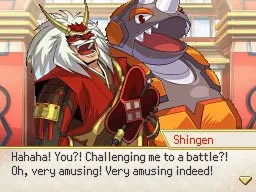
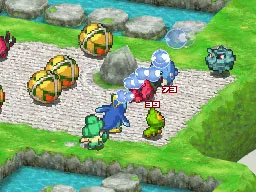
When an opposing party challenges the protagonist (or vice versa), a battle begins on the castle's specialized battlefield. The battle screen takes place on a 2D square grid with characters ordering their Pokémon to fight against one another. A maximum of six generals/Pokémon can fight for each side within a single battle. Characters can perform strategies or skills, called "Warrior Skill", to help their Pokémon in the field. These abilities can be used once per battle. Their equipment, which can be found on the field or by purchasing at shops, may offer supplementary assistance.
Pokémon special abilities and elemental weaknesses found within the main series remain the same (e.g.: Fire strong against Ice, Flying immune to Ground, and so on). Special abilities can be used in a variety of ways to obtain a new advantage in the field. Group attacks require planning to use since they can harm both ally and enemy units. Stage gimmicks, treasures, and other bonuses may also be used to raise the chances of winning battles.
A Pokémon's performance in battle is also determined by their Energy level, or their willpower to fight. This is determined by the colored arrows next to their icon in the planning screen; bright red-orange means they are at they're best while dark blue means they're tired. If their energy is low, it can be raised by letting the Pokémon rest from battle or by letting them eat ponigiri.
100% Human-Written. AI Fact-Checked. Community Verified. Learn how AntMag verifies content