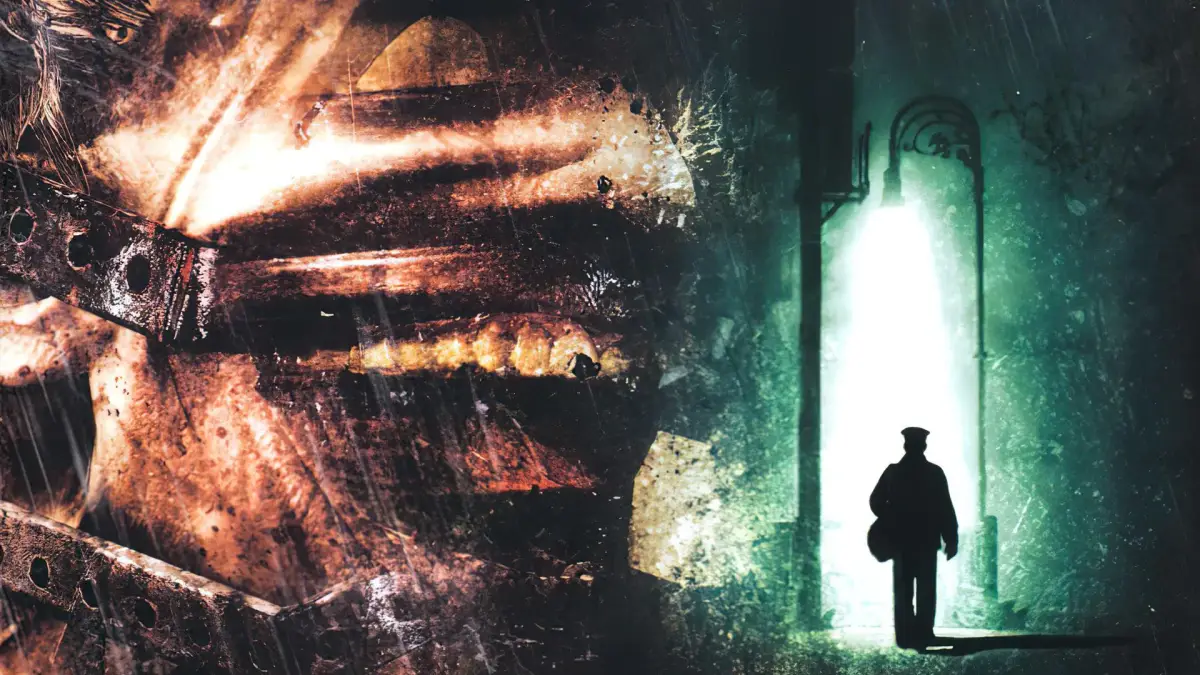
Explore Bat's Lament Falls, the Devil's Train, and the Cave of Tears in Silent Hill: Downpour. Learn about the Weeping Bats and the mine's history.
Bat's Lament Falls
Bat's Lament Falls is the tallest waterfall in Devil's Pit. It is named after the Weeping Bat, a rare species indigenous to the area that lives its entire life in Diyu's Tusk Cave at the bottom of the Pit. The Weeping Bats secrete a fluid from their eyes to deter parasites, which led natives to believe they were weeping due to their imprisonment. While unpredictably aggressive towards other creatures in Devil's Pit, especially their offspring, no attacks on humans have ever been reported.
Elevator Machinery & Water Chute
When the Gillespie Coal & Iron company established the Devil's Pit Mine in 1816, they initially used man and animal power to haul materials. As the mine expanded, they harnessed the power of the underground river and Devil's Falls to operate machinery like waterwheels for hoisting ore. By the mid-19th century, Devil's Pit utilized sophisticated hydroelectric power. The waterwheels, cogs, gears, and troughs of the Water Chute served as the engineer's control hub, redirecting water flow to power the main elevator, a flood control pump, and an early electrical generator. This system was restored by the Silent Hill Preservation Society.
Train Tour of the Mines
In the early years, mine carts were used for transporting materials, running on steel tracks and initially powered by animals or humans, later by engines. Due to the steep inclines and declines, the tracks had hazardous turns. Miners were warned to avoid riding the carts, as the estimated death rate was 40%.
Devil's Falls
Devil's Falls is the second-highest continually flowing single-drop waterfall in North America, plunging 1,419 feet to the subterranean river below. During spring runoff, it flows at 300 cubic feet per second (2,400 gallons per second). The falls feed an underground river system flowing through over 20 miles of limestone cavern before emptying into Toluca Lake. The Gillespie Coal & Iron Company utilized its power for various mining systems.
Entry to Cave of Tears
Originally called Diyu's Tusk Cavern, this dark cavern contains the largest stalagmite in North Eastern America. Discovered by Chinese immigrant miners in 1863, they believed the stalagmite resembled a tusk from Diyu, the realm of the dead in Chinese mythology. It is also the lifelong home of the Weeping Bat, leading locals to refer to it as the Cave of Tears.
The Devil's Train
Jokingly called the Devil's Train by former miners, this mine train is now a visitor ride with audio commentary offering an educational tour of Devil's Pit and historical re-enactments. Be advised that the tour uses strobe lighting, and passengers sensitive to such effects should take care. Keep hands inside the cart at all times due to low ceilings and narrow passageways. Flash photography is discouraged to avoid disturbing native fauna.
- Pay attention to the audio commentary on The Devil's Train for historical details.
- Be aware of the strobe lighting effects during The Devil's Train tour if you are sensitive.
- Ensure your hands remain inside the mine cart during The Devil's Train tour.
- Avoid using flash photography on The Devil's Train to respect the native fauna.
100% Human-Written. AI Fact-Checked. Community Verified. Learn how AntMag verifies content