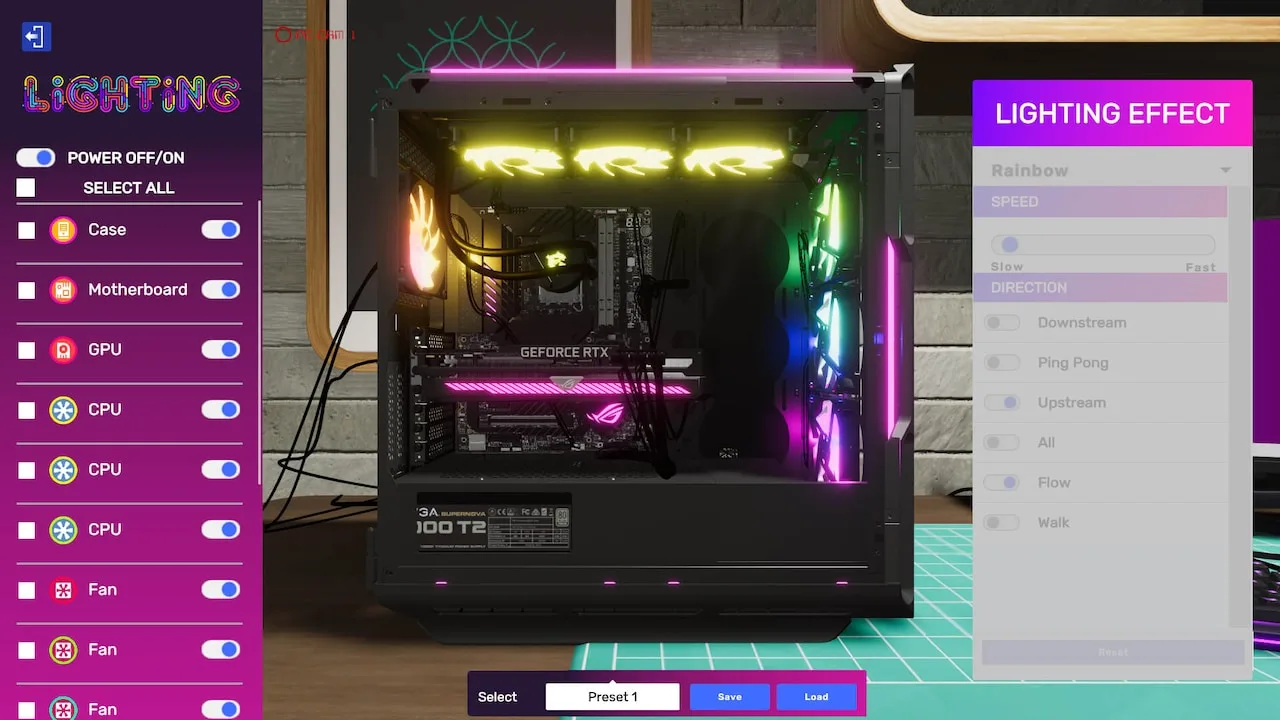
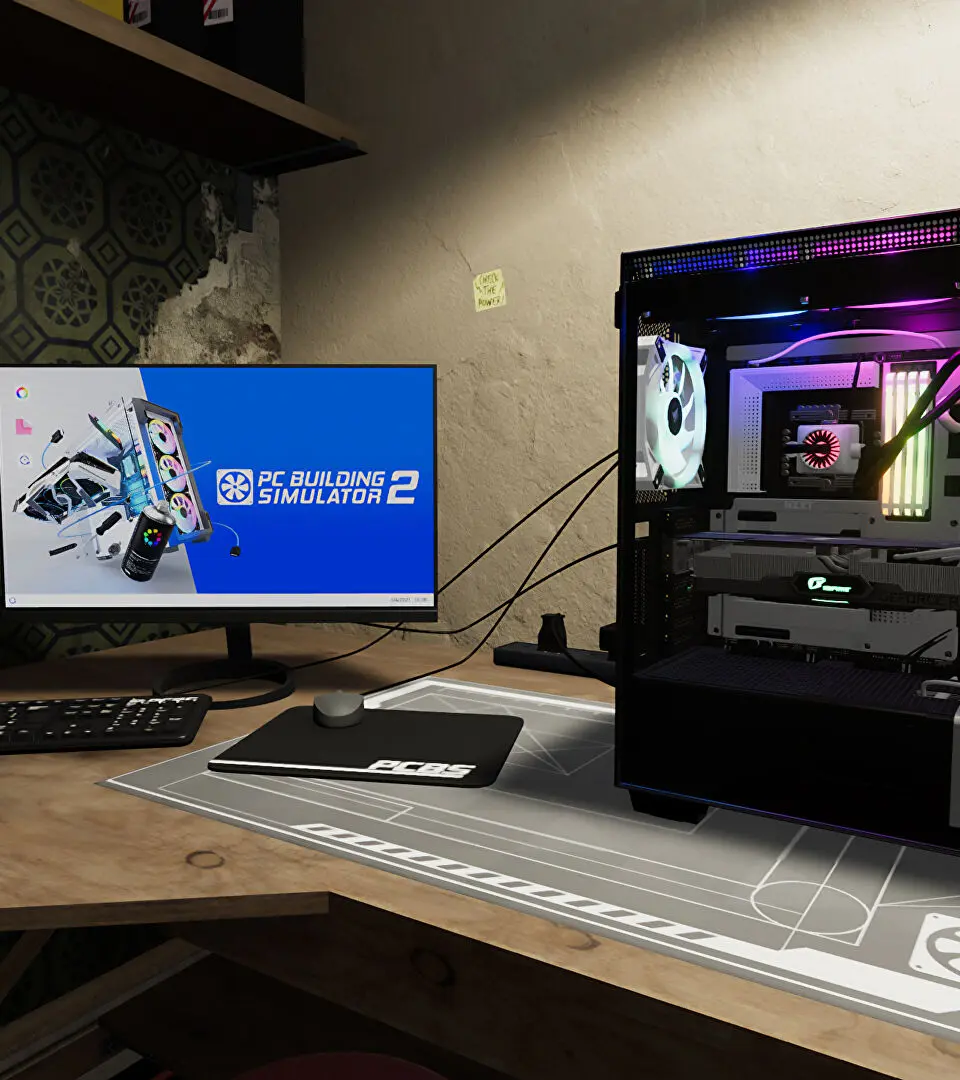
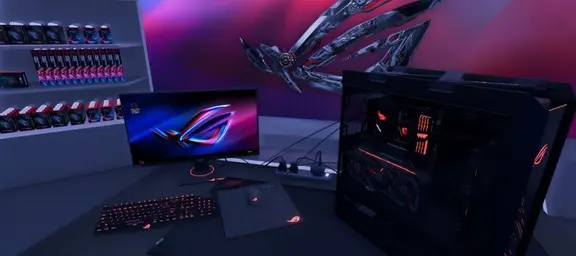
Welcome to PC Building Simulator 2! In this comprehensive RPG, you'll dive into the intricate world of PC hardware, from your very first component installation to mastering complex custom liquid cooling loops. You'll navigate the challenges of component selection, tackle a variety of client jobs, and optimize your workshop to become the ultimate PC technician.
This guide is here to help you conquer the game's trickier tasks. We'll walk you through jobs like 'Dusty Dilemma,' where you'll need the Air Compressor to clean out dust and replace faulty fans, and 'Overheating Issues,' which requires using the Thermal Camera to diagnose problems like insufficient thermal paste or poor airflow. Get ready to master maintenance, diagnostics, and component upgrades to achieve PC building perfection.
Overview
Navigate PC Building Simulator 2 with this overview. Learn core mechanics, essential components, and the different play modes for virtual PC construction.
Overview
Navigate PC Building Simulator 2 with this overview. Learn core mechanics, essential components, and the different play modes for virtual PC construction.
Job: 'Virus Attack!'
Learn how to diagnose and fix PC overheating issues in PC Building Simulator 2. This guide covers using the Thermal Camera, replacing thermal paste, and upgrading cooling solutions.
- 1Accept the 'Overheating Issues' job from Jessica.
- 2Use the Thermal Camera tool to identify components or areas experiencing excessive heat.
- 3Common causes include dried-out thermal paste, poor case airflow, or an inadequate CPU cooler.
- 4If thermal paste is the issue, carefully remove the CPU cooler, clean the old paste from both the CPU and cooler, apply new paste, and reattach the cooler.
- 5If airflow is poor, consider adding more case fans or ensuring existing fans are correctly oriented.
- 6If the CPU cooler is insufficient, replace it with a more powerful one (e.g., an AIO liquid cooler).
- 7After making changes, use the OCCT software (accessible via the tablet's 'Apps' tab) to stress test the CPU and GPU.
- 8Monitor temperatures during the stress test to ensure they remain within acceptable limits.
- 9Deliver the PC once stable temperatures are confirmed.
- Always check the thermal paste condition during CPU cooler removal, even if it's not the primary suspected cause.
- Ensure all case fans are installed and oriented correctly for optimal airflow (intake and exhaust).
- Higher-end CPUs and GPUs generate more heat, requiring more robust cooling solutions.
- Don't forget to reconnect all necessary power cables after removing/replacing components.
Game Settings & Optimization
Optimize your experience in PC Building Simulator 2 by adjusting game settings. Balance visual fidelity and performance for smooth PC building gameplay.
Welcome, aspiring PC builders! While your in-game workshop might be a haven of high-performance components, ensuring your actual game runs smoothly is just as crucial for an optimal experience. This section will guide you through the various settings in PC Building Simulator 2, helping you fine-tune your game for the best balance of visual fidelity and performance.
Accessing Game Settings
To access the game settings, follow these simple steps:
- From the main menu, click on the "Options" button.
- Alternatively, if you are already in your workshop, press the "Escape" key to bring up the in-game menu, then select "Options".
Within the Options menu, you'll find several categories to adjust. We'll break down the most impactful ones below.
Graphics Settings: Visuals vs. Performance
The Graphics settings are where you'll make the most significant impact on your game's performance. Finding the sweet spot depends on your real-world PC's capabilities.
Resolution & Display Mode
- Resolution: This determines the clarity of the image. For the sharpest visuals, set this to your monitor's native resolution. If you're experiencing performance issues, try reducing it.
- Display Mode:
- Fullscreen: Generally offers the best performance as it gives the game exclusive control over your display.
- Borderless Window: Allows for easy alt-tabbing but might slightly reduce performance compared to Fullscreen.
- Windowed: Runs the game in a resizable window. Typically the lowest performance option.
Quality Presets & Individual Settings
PC Building Simulator 2 offers several pre-defined quality presets, but for true optimization, diving into individual settings is key.
- Overall Quality: This slider offers a quick way to adjust multiple settings simultaneously (Low, Medium, High, Ultra). Start here if you're unsure, then fine-tune.
- Texture Quality: Affects the detail of surfaces.
- Impact: High VRAM usage.
- Strategy: If your GPU has 8GB+ VRAM, set to Ultra. For 4-6GB, High is usually safe. Below 4GB, consider Medium.
- Shadow Quality: Determines the sharpness and complexity of shadows.
- Impact: Significant CPU and GPU load.
- Strategy: This is often one of the first settings to reduce for performance gains. Lowering from Ultra to High or even Medium can yield noticeable FPS improvements with minimal visual degradation.
- Anti-Aliasing (AA): Smooths jagged edges on objects.
- Impact: Moderate GPU load.
- Strategy: Options like FXAA are less demanding than MSAA. If performance is a concern, try FXAA or turn it off entirely.
- Post Processing: Includes effects like bloom, depth of field, and motion blur.
- Impact: Moderate GPU load.
- Strategy: Depth of Field and Motion Blur can be toggled off for performance and often preferred by players for a clearer view of components.
- Ambient Occlusion: Adds realistic shading to areas where objects meet or are close together.
- Impact: Moderate GPU load.
- Strategy: Can make a scene look richer, but disabling it can free up some GPU resources.
- Reflections: Controls the quality and presence of reflections on shiny surfaces.
- Impact: High GPU load, especially with real-time reflections.
- Strategy: Reducing this or switching to screen-space reflections (if available) can significantly boost FPS.
Audio Settings: Immersion & Clarity
While not directly impacting performance, proper audio settings enhance your workshop experience.
- Master Volume: Controls the overall game sound.
- Music Volume: Adjusts the in-game soundtrack.
- SFX Volume: Controls sound effects like component installation, fan noises, and tool sounds.
- Voice Volume: If any narrative or tutorial voices are present, this controls their level.
- Audio Output Device: Ensure this is set to your preferred speakers or headphones.
Gameplay Settings: Quality of Life
These settings primarily focus on user experience and interface elements.
- Mouse Sensitivity: Adjust to your comfort for navigating the workshop and menus.
- Invert Mouse Y-Axis: For players who prefer inverted vertical camera controls.
- UI Scale: Adjusts the size of the user interface elements. Useful for different monitor resolutions or personal preference.
- Show FPS Counter: A highly recommended option! Enabling this will display your current frames per second, allowing you to immediately see the impact of any graphics setting changes you make. This is crucial for effective optimization.
- Tutorial Hints: Toggle these on or off depending on your experience level with the game.
Key Bindings: Customizing Your Workflow
The Key Bindings menu allows you to reassign actions to different keys, tailoring the controls to your personal preference. This can significantly speed up your workflow in the workshop.
- Interaction Key: Default is 'E'. Consider binding this to a more accessible mouse button if you frequently interact with components.
- Rotate Component: Default is 'R'. Essential for fitting parts correctly.
- Open Tablet: Default is 'Tab'. Quick access to emails, shop, and objectives.
- Toggle Tools: Default is '1', '2', '3', etc. for different tools.
Strategy: Experiment with different keybinds, especially for frequently used actions, to find a setup that feels intuitive and efficient for your building style.
Optimization Strategy: A Step-by-Step Approach
Follow this method for effective game optimization:
- Start with a Baseline: Begin with the "High" or "Medium" overall quality preset.
- Enable FPS Counter: Go to Gameplay settings and enable "Show FPS Counter."
- Test in a Busy Scene: Load into your workshop or a client PC with many components. Observe your FPS.
- Adjust One Setting at a Time:
- If your FPS is too low (e.g., below 30-40 FPS), start by lowering Shadow Quality.
- Next, try reducing Reflections or Ambient Occlusion.
- If still struggling, reduce Texture Quality (ensure you have enough VRAM first).
- Finally, consider lowering Anti-Aliasing or Post Processing effects.
- Increase for Visuals: If your FPS is consistently high (e.g., above 60 FPS), try increasing settings like Texture Quality or Shadow Quality one step at a time until you find the balance between visuals and your desired frame rate.
- Restart if Necessary: Some graphics changes (especially resolution or display mode) may require a game restart to take full effect.
By systematically adjusting these settings, you can ensure PC Building Simulator 2 runs as smoothly and beautifully as possible on your system, allowing you to focus on the intricate art of PC assembly.
Getting Started
Master PC Building Simulator 2's career mode with our guide. Learn essential early jobs, upgrades, and client management to become a top PC builder.
Getting Started
Master PC Building Simulator 2's career mode with our guide. Learn essential early jobs, upgrades, and client management to become a top PC builder.
Similar guides you might like





100% Human-Written. AI Fact-Checked. Community Verified. Learn how AntMag verifies content