
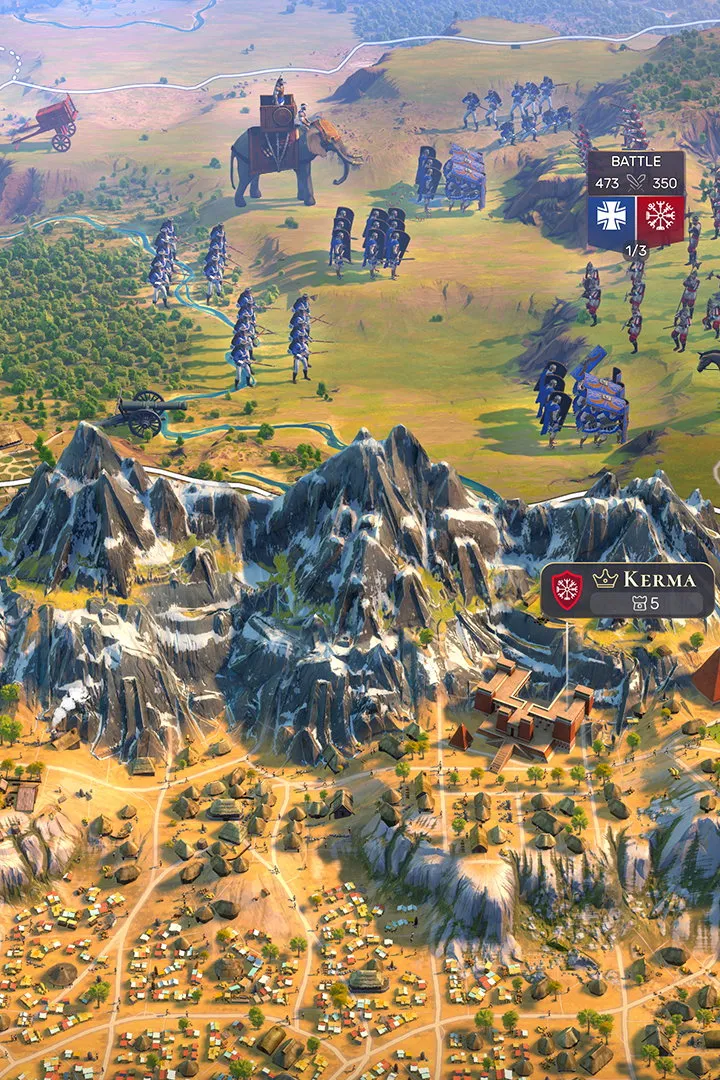
Master Humankind city placement by choosing the optimal first settlement location for early game advantages and ensuring territorial expansion.
The placement of your very first city in Humankind is arguably one of the most critical decisions you will make in the early game, with ramifications that can echo throughout your entire playthrough. A well-placed first city can provide a strong foundation for growth, resource generation, and territorial expansion, while a poorly chosen location can lead to early struggles and a significant disadvantage. The game's mechanics heavily favor cities situated near abundant resources and strategic terrain features. Therefore, before committing to settling, it is essential to thoroughly scout the surrounding area and evaluate potential sites based on several factors. This includes proximity to food sources for population growth, production resources for building infrastructure and units, and access to water, which often provides bonuses. Furthermore, considering defensive positions and potential expansion routes for future cities is also vital. The goal is to find a location that offers the best balance of immediate benefits and long-term potential, setting your civilization on a path to prosperity and dominance from the very outset.
When scouting for your first city location, remember that Humankind rewards thoughtful planning. The game presents a dynamic map where resources are unevenly distributed, and understanding these distributions is key to maximizing your early game advantage. A city placed on a river, for instance, often receives a stability bonus and can facilitate early trade routes. Proximity to luxury resources can provide significant economic boosts once researched. Even the terrain type surrounding a potential city site can influence its development; plains and grasslands are generally more fertile, while hills can offer defensive advantages. It's also important to consider the proximity of other potential city sites. You don't want to establish your first city so close to where you plan your second that their influence zones overlap inefficiently, leading to wasted territory. The initial scouting phase, using your starting scout and warrior units, should be dedicated to gathering as much information as possible about the immediate vicinity to make an informed decision about where to plant your civilization's first permanent settlement. This careful consideration will pay dividends as your civilization grows and expands.
Evaluating Resource Abundance
The most crucial factor in determining your first city's location is the abundance and variety of resources nearby. Prioritize sites that offer a strong combination of food and production. Food is essential for population growth, allowing you to field more units and construct buildings faster. Production, generated from tiles like forests and hills, is necessary for building everything from units to districts. Look for tiles with high base yields, indicated by numbers on the tile itself. For example, a tile with a food yield of 3 and a production yield of 2 is significantly better than one with 1 food and 1 production. Also, scout for luxury resources like horses, marble, or gold. While these may not provide immediate boosts to food or production, they offer significant stability or economic advantages once researched and exploited, which can be crucial for early game success. The game mechanics allow you to ass population to work specific tiles, so having several high-yield tiles surrounding your city will maximize your output.
Proximity to Water and Terrain Advantages
Water sources, such as rivers and coastlines, often provide significant bonuses to cities. Cities built on rivers, for instance, typically receive a stability bonus and can support more population. Coastal cities can facilitate early naval exploration and trade. Therefore, if a prime resource location is also adjacent to a river, it becomes an even more attractive site for your first city. Terrain also plays a role. Hills can provide defensive bonuses to units stationed in or near them, making a city on a hill more defensible. Plains and grasslands are generally more fertile and better for food production. Conversely, settling in barren or mountainous terrain without significant resource compensation can severely hamper your city's growth. Consider the terrain's impact on both your city's immediate output and its long-term strategic value. A balanced approach, considering both resource abundance and terrain advantages, will lead to a more robust and resilient first city.
Strategic Considerations and Expansion Routes
Beyond immediate resource needs, think about the long-term strategic implications of your first city's placement. Is the location defensible? Are there natural choke points that can be easily controlled with a few units? Conversely, does the location offer clear expansion routes for future cities? You don't want to settle in a position where your expansion is immediately blocked by mountains, oceans, or rival civilizations. Consider the proximity of potential barbarian encampments; settling too close might lead to constant harassment. Ideally, your first city should be placed in a location that allows you to expand into new territories and secure additional resources without immediately running into significant obstacles. The game encourages a network of cities, so your first settlement should be a cornerstone of that future network, providing a strong base from which to launch further expansion and exploration.
The Role of Outposts in City Placement
It's important to note the interplay between outposts and city placement. Often, you will have established one or more outposts before deciding on your first city location. If an outpost has secured a particularly valuable resource or a strategically important tile, this can heavily influence your decision on where to build your first city. The game allows you to convert an outpost into a city. This means you can use outposts to scout and claim territory, and then upgrade the most promising outpost into your first settlement. This provides flexibility, allowing you to test the waters and gather information before committing to a permanent city. However, remember that outposts have limited functionality compared to cities. While they can gather resources and exert influence, they cannot build districts or support a large population. Therefore, the decision to upgrade an outpost into a city should be based on its long-term potential and the strategic advantages it offers.
100% Human-Written. AI Fact-Checked. Community Verified. Learn how AntMag verifies content