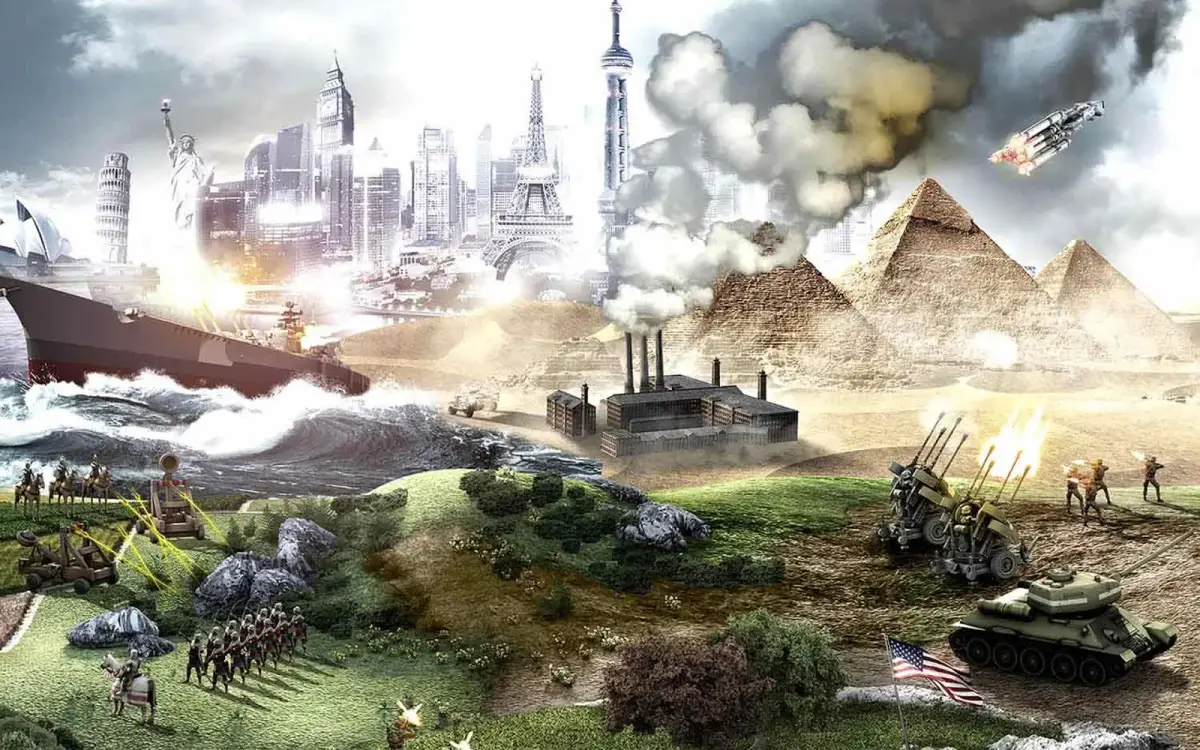
Part 12 of the Civilization V walkthrough: Analyze Montezuma's naval, air, growth, and civilization scales, and understand China's unique units and civilization power.
The lack of defense will help you significantly; you will be able to easily take over his lands once you defeat his standing army.
Naval Scales
- Naval - 3/10
- Naval Reconnaissance - 3/10
- Naval Growth - 4/10
- Naval Tile Improvement - 4/10
Montezuma will, by large, neglect his naval units significantly. He will be more likely to use them as a support role at most, but more likely, the extent of his naval prowess will be to ship units across the sea to set your cities on fire.
Air Scale
- Air Power - 4/10
Air power isn't something that is on Montezuma's mind; he isn't there to use air units as an offensive strategy, rather, as best, support. And that's a good thing, bombers aren't the best thing you want to face when they decide to rain death on your cities.
Growth Scales
- Expansion - 8/10
- Growth - 5/10
- Tile Improvement - 5/10
- Infrastructure - 5/10
- Production - 5/10
- Gold - 5/10
- Science - 4/10
- Culture - 5/10
The only thing that stands out, above average, is that Montezuma expands and he will expand aggressively. This is why he is one of the most hated enemy leaders to face; he will expand and declare war to gain land, and he does not build an economy to match that expansion. It is nice to note that he isn't that tech inclined though, so whilst you will be using riflemen, he will still be stuck using Jaguar Warriors.
Civilisation Scales
- Happiness - 6/10
- Great People - 5/10
- Wonder - 6/10
- Diplomacy - 5/10
- Spaceship - 7/10
For someone who doesn't like to tech up, he will go for the spaceship victory, more often than not, although it will take him a fairly long time to get there. This is quite good, although his armies marching into your land isn't that good.
[3.03] China
Leader - Wu Zetian
Unique Unit 1 - Chu-Ko-Nu, replaces Crossbowman
Unique Unit 2 - None
Unique Building - Paper Maker, replaces Library
Civilization Power
ART OF WAR
- Great General effective and spawn rate increased
~ History
Summarizing the rich history of China in several paragraphs is a daunting task indeed. China is a civilization spanning some six thousand years and comprising a large fraction of humanity. There is evidence of man's prehistoric ancestors living in China some two million years ago, and modern man has lived in the area for at least 18,000 years, possibly much longer.
Geographically, China can be divided into three main areas: the mountainous highlands of the west, the rugged south, and the eastern lowlands bordering the Yellow and East China Seas. Bisected by a number of major rivers, the incredibly fertile lowlands have been the center of power in China, and whoever controls that area controls Western Asia.
The Xia Dynasty is the earliest known centralized political entity in China. While the specific dates of the dynasty remain open to debate, many reputable scholars agree that the Xia existed from around 2000 BC to 1600 BC. The Xia did not control all of China; their power was largely centered in northern China, the area which would eventually become known as Manchuria. The Xia were eventually overtaken by the Shang, who lasted from around the 18th to the 12th century BC. The Shang were in turn ousted by the Zhou, who held power until around the 9th century BC. From the 9th century to the 2nd China suffered through the unending agony of near-constant civil war during the so-called Spring and Autumn period, which in turn was followed by the Warring States period. Eventually, in the second century BC, the Qin Dynasty conquered its rivals and established the first truly unified Chinese state. Their successors, the Han, introduced the office of the Emperor, the single leader who would rule all of China.
Over the succeeding centuries China would be ruled by the Tang and the Song dynasties. In 1271 AD the country would be conquered by the Mongol leader Kublai Khan, who would begin his own dynasty, known as the Yuan. A century later, the Yuan would be overthrown and the Ming dynasty would gain power, lasting until the 16th century AD. The Qing replaced the Ming, ruling until 1912 AD, when the Republic of China was established. The Republic lasted some fifty years, until it was overtaken by the People's Republic of China in 1949. As of this writing, the People's Republic remains China's current ruler.
A creative and innovative people, China has given the world some of the most important inventions in history, including paper, gunpowder, the compass, and movable type. (This section is mandatory whenever Chinese history is discussed, in case you were wondering. It's a law.)
Throughout much of its history China has remained an insular and isolated civilization, largely ignoring - and ignored by - the rest of the world. This was not difficult, as for many centuries China long held a distinct technological and military edge over any and all external foes. And any threats it could not defeat militarily (such as the Mongols, who conquered China in 1271), it simply absorbed into its own dominant culture.
This changed during the 18th and 19th centuries. By this period, the European powers and Japan had achieved a significant technological advantage over the Chinese. This edge, combined with vastly superior naval forces, better armaments, superior communications and advanced military tactics, allowed the foreign powers to dominate much of the rich Chinese coastal cities, where they could engage in extremely profitable business (including the infamous opium trade). The weak and corrupt Chinese central government was unable to oust the hated foreigners, who remained until most were driven out by the Japanese during and following World War II.
Emerging triumphant over the Nationalists shortly after World War II, the Co
100% Human-Written. AI Fact-Checked. Community Verified. Learn how AntMag verifies content