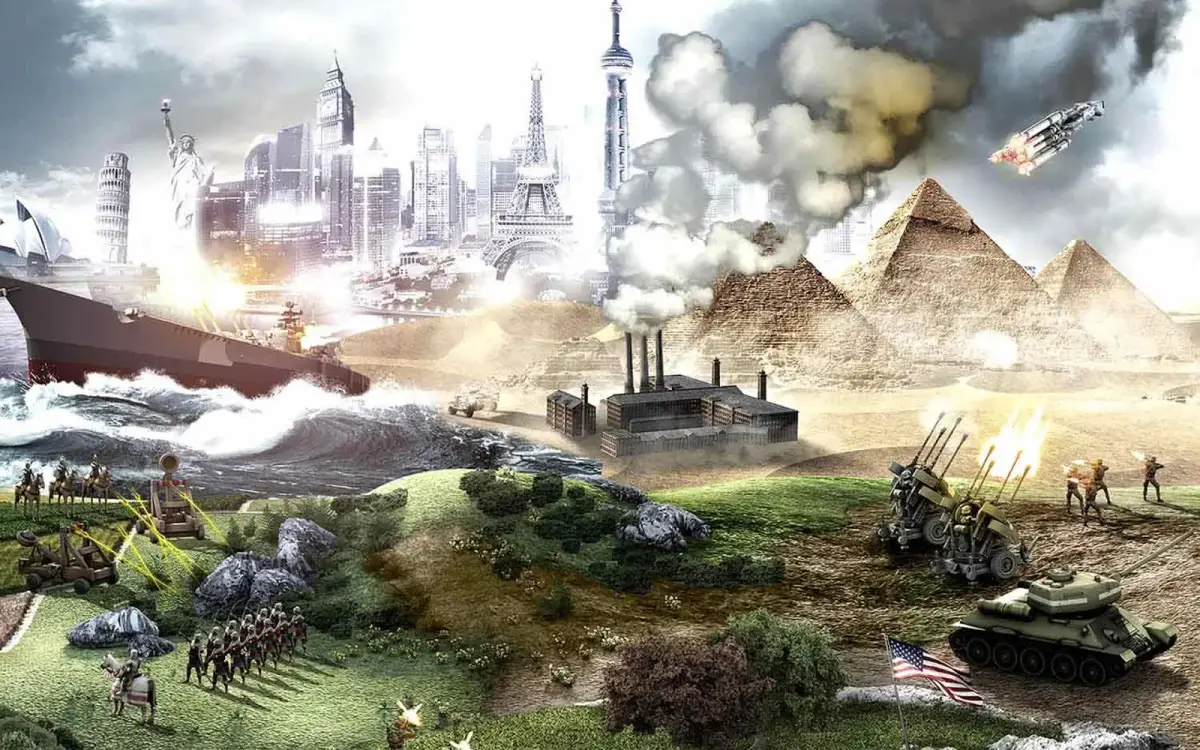
Learn about the US involvement in World War I, the Great Depression, and the lead-up to World War II in Civilization V.
The Spanish-American War resulted in the Philippines, Guam, and Puerto Rico becoming US territories, and Cuba gaining independence. Despite growing industrial power, American military strength was not on par with global powers, relying on the Atlantic and Pacific oceans for protection, guarded by the British Navy.
As Europe moved towards World War I, the US declared neutrality, influenced by its diverse immigrant population. However, American neutrality favored Britain and France due to British naval dominance. Germany's unrestricted submarine warfare, including the sinking of the Lusitania in 1917, led to the US declaration of war.
The American Expeditionary Force (AEF) grew to over 1,000,000 men in Europe by 1918, significantly impacting the battlefield and enemy morale, contributing to the war's end that year. The AEF suffered approximately 50,000 deaths and 300,000 injuries during its combat in France.
Following World War I, President Woodrow Wilson's efforts for a League of Nations were overshadowed by European nations seeking heavy penalties for the losers, leading to American public opinion turning against further European military involvement.
The Great Depression, triggered by the 1929 US stock market crash, caused widespread bank collapses, 25% unemployment in the US, and a 60% drop in crop prices. The US economy began a slow revival in the mid-thirties, fully recovering only with the onset of World War II.
During the Great Depression, fascism rose globally, with leaders like Mussolini, Franco, and Hitler gaining power. Democracies, weakened by World War I and the Depression and wary of Communism, watched as Germany rearmed and expanded. The invasion of Poland by Germany and the Soviet Union in 1939 prompted France and the United Kingdom to declare war on Germany.
The United States remained officially neutral through 1940 and 1941, despite Germany's conquests. American neutrality continued to favor the British. President Franklin Roosevelt accelerated US military buildup and sought public support for intervention. In the Pacific, a US oil embargo on Japan created severe economic and military pressure, leading to Japan's attack on Pearl Harbor on December 7, 1941. While battleships were damaged, aircraft carriers were unharmed, proving crucial for the Pacific war.
Germany's subsequent declaration of war on the United States allowed for significant American intervention in Europe. World War II presented a massive challenge for the US, which was underprepared in manpower, arms, ships, and tanks. The government had to balance military needs with industrial production for itself and its allies, while managing a difficult alliance with the United Kingdom and the Soviet Union, former adversaries of Communism.
- Pay attention to the impact of naval power on trade routes, especially during periods of neutrality.
- The influx of troops can dramatically shift the tide of war, as seen with the AEF.
- Economic conditions like the Great Depression can significantly influence political doctrines and international relations.
- Strategic decisions, such as oil embargoes and surprise attacks like Pearl Harbor, have profound consequences.
- The importance of maintaining a strong industrial base alongside military might is critical for prolonged conflicts.
100% Human-Written. AI Fact-Checked. Community Verified. Learn how AntMag verifies content