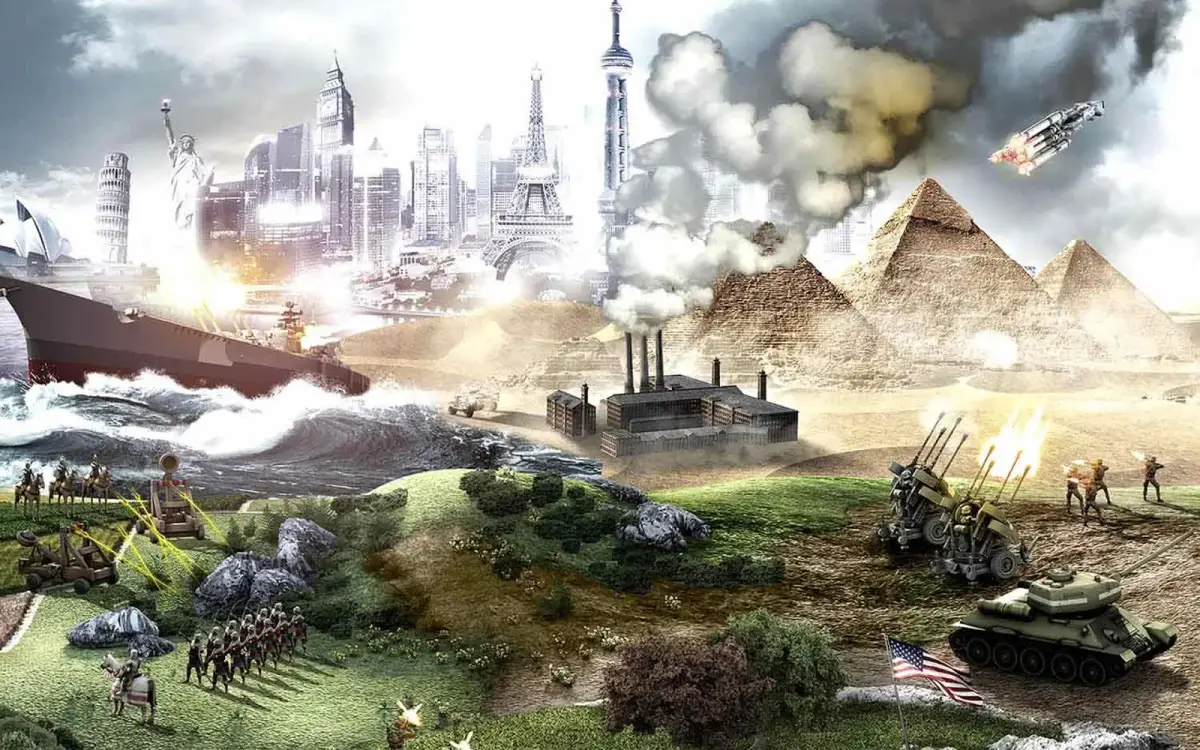
Explore the history and structure of Greek city-states (poleis) in Civilization V, from Sparta's militarism to Athens' democracy, and their conflicts.
The term 'polis' refers to a city-state, a sovereign political organization answerable only to its citizens. This term also describes a group of allied smaller towns without a dominant central city, similar to Sparta's organization. Both forms emerged in the 8th century BC. Some historians suggest major cities grew around religious temples, while others believe the Greeks adopted this organization from the Phoenicians.
Despite a shared language, history, and nationality, Greek city-states frequently bickered and waged war against each other. They would occasionally unite against a common enemy, but these alliances dissolved once the immediate threat passed.
The four dominant Greek city-states were Corinth, Thebes, Sparta, and Athens. Sparta and Athens eventually became the most powerful, and their struggle for supremacy profoundly impacted the Greek world.
Sparta, located in a harsh, poor region of central southern Greece, went to war with Messenia in the 8th Century BC. Victorious, Sparta conquered Messenia and enslaved its people, the 'Helots.' The Helots' resentment led to several revolutions, prompting Sparta to adopt a highly militarized society. Spartan males entered military service at a very young age, becoming disciplined, fearless, and renowned foot soldiers.
Athens, situated in the fertile and wealthy region of Attica in south-eastern Greece, contrasted sharply with Sparta, being a mighty sea power. Athenians celebrated arts, culture, and learning over the austere military life of the Spartans. It's noted that Athenians also utilized slaves and were not averse to conquering rivals for plunder.
In the late 6th century BC, Athens was ruled by the tyrant Peisistratos and his sons. An Athenian aristocrat enlisted Spartan King Cleomenes I to overthrow the tyrants. After succeeding, Cleomenes installed a puppet ruler. The Athenians expelled the puppet and established a new government where all citizens (excluding women and slaves) shared power equally, creating the world's first democracy. The Spartans attacked to restore their puppet, but the Athenians fiercely defended their city, forcing the Spartans to withdraw. This event marked the beginning of a centuries-long rivalry.
The period known as 'Classical Greece' spans from the Athenian overthrow of their last tyrant to the death of Alexander the Great. This era witnessed a flourishing of art, architecture, literature, science, and political thought—a renaissance of human culture and knowledge. Many prominent figures from this time, such as Leonidas I, Pericles, Herodotus, Socrates, Plato, Aristotle, Euripides, Sophocles, Aristophanes, and Hippocrates, are still remembered today.
This extraordinary era was also marked by intense warfare. It is debated whether this golden age thrived in spite of, or because of, the constant conflict.
In the early 5th century BC, Greek cities on the Anatolian coast (Ionia) were under Persian control. In 499 BC, these Greek cities revolted, receiving aid from some mainland Greek cities, but were ultimately unable to withstand the Persian response and were reconquered.
Seven years later, in 492 BC, the Persians launched a massive retaliatory invasion of Greece with a large army and a supporting naval force. The army advanced through Thrace and Macedonia but retreated to Asia Minor due to the general's injury.
In 490 BC, the Persian fleet landed a substantial force (estimated between 20,000 to 100,000 soldiers) in Attica. They were met by a smaller force of approximately 9,000 Athenians and 1,000 Plataeans, who decisively defeated the Persian army. This victory granted the Greeks about ten years of peace.
In 480 BC, Persian King Xerxes I led another massive invasion with around 300,000 troops. The overwhelming Persian force quickly subdued central Greek cities and advanced towards Athens. A much smaller contingent of Spartan and other Greek troops met them at Thermopylae. The defenders fought valiantly to the last man, allowing Athenians to evacuate their city. Though displaced, the Athenians used their powerful navy to destroy Persian ships, cutting off supplies to the Persian army in Athens. Within a year, a large Spartan army attacked the Persian occupiers, leading to their defeat and near destruction.
By 478 BC, the Athenians had returned to their devastated city and began reconstruction. They formed an alliance known as the 'Delian League' with other Greek city-states.
100% Human-Written. AI Fact-Checked. Community Verified. Learn how AntMag verifies content