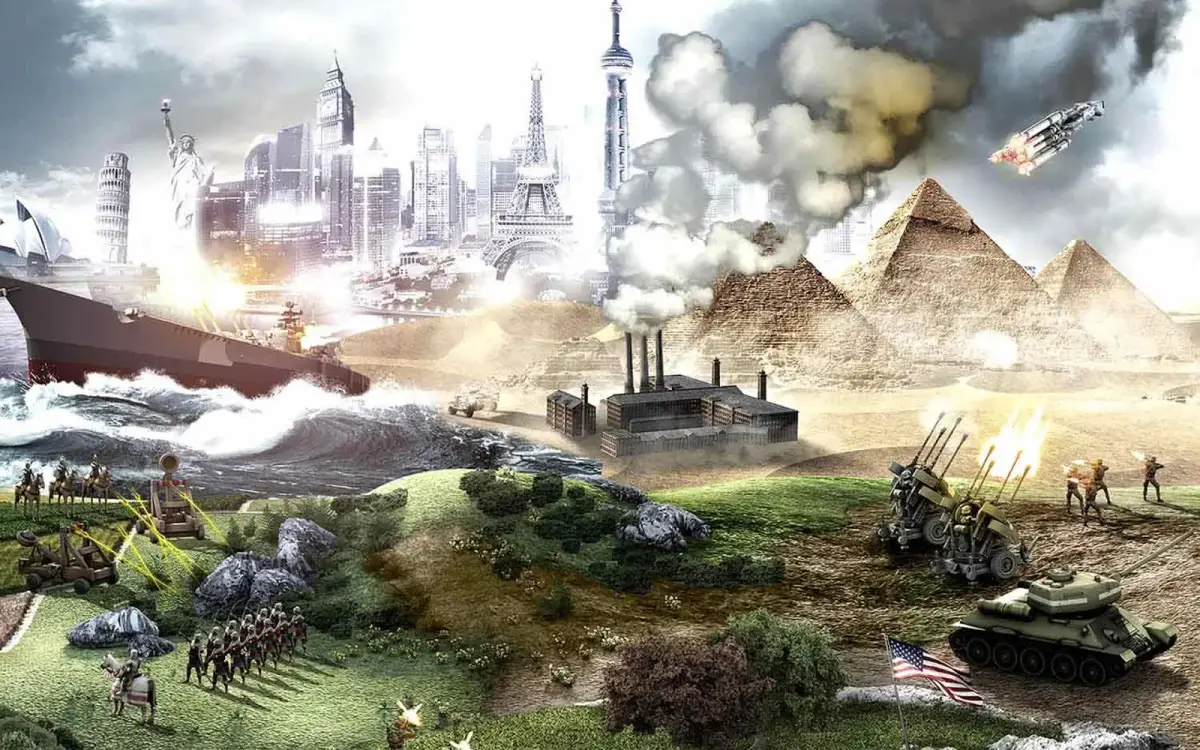
Explore the major changes in Civilization V, including unique units/buildings, the removal of religion, revamped civics, tech trading, and the end of unit stacking. Learn about Wealth, Culture, Happiness, and Great People.
This section details key changes and mechanics introduced in Civilization V, focusing on unique civilization features, the removal of religion, the overhaul of civics, alterations to technology trading, the elimination of unit stacking, and the core concepts of Wealth, Culture, Happiness, and Great People.
Unique Civilization Features: Civilizations now feature unique elements, such as one unique building and one unique unit, or two unique units. For example, the Americans have the Minuteman and B17, while the Chinese have the Chu-No-Ku unit and the Paper Maker building.
Religion: The religion system from Civilization IV has been removed due to ineffective implementation.
Civics: Civics have been completely redone. Players now choose social policies accumulated through culture points, rather than government systems.
Technology: While the tech tree remains, tech trading has changed. It now involves research pacts and joint ventures, costing money, instead of direct trading.
Stacks: Unit stacking is no longer possible. A single hex tile can only hold one civilian unit and one military unit.
Wealth, Culture and Happiness
These three elements are crucial for managing your empire:
Happiness
Happiness is now a global metric, affecting empire growth and imposing combat penalties on armies if the empire is unhappy. Factors increasing unhappiness include population, the number of cities, and annexed cities. Happiness can be improved through Wonders, buildings, luxury resources, and natural wonders.
Culture
Culture serves two primary purposes: expanding city borders and acquiring new social policies. Culture is generated by the starting city's palace, culture-producing buildings, Wonders, social policies, specialists, Great Artists (via Landmarks), and partnered city-states. Culture points are tallied and spent on social policies.
Wealth
Wealth, or gold, is generated from cities, Great Merchants, trade routes, conquering enemies, and city-states. Gold is spent on city maintenance (buildings, roads/railroads), military unit upkeep, buying tiles, buildings, and unit upgrades. Trade routes can be established between connected cities, with coastal cities with harbors forming instant trade routes with other coastal cities under the same control if connected to the capital.
Great People
Great People are influential figures in various fields. There are five types: Great Artists (e.g., Mozart, Beethoven, Shakespeare), Great Generals (e.g., Robert E. Lee, Lord Nelson, Rommel), and Great Engineers (who influence the world with their buildings).
100% Human-Written. AI Fact-Checked. Community Verified. Learn how AntMag verifies content