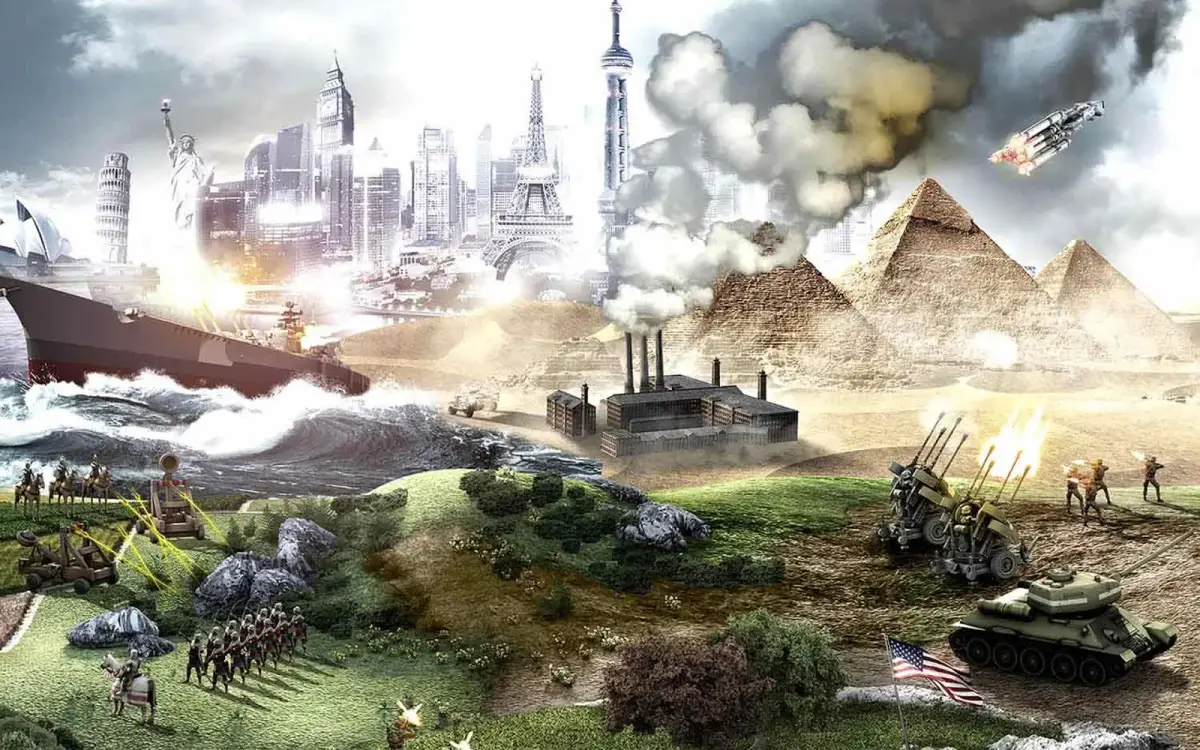
Learn about Mohandas Gandhi, his Satyagraha tactics, and his role in India's independence in Civilization V.
History:
Mohandas Gandhi was an Indian patriot who led India's nonviolent independence movement against British Imperial rule in the early to mid-twentieth century. He pioneered "satyagraha," or resistance to tyranny through mass civil disobedience, a tactic used to great effect against the British Raj.
Mohandas Gandhi was born in an India under British rule. The son of the Prime Minister of the small state of Porbandar, in his youth Gandhi displayed none of the brilliance that would mark him as an adult; in fact the young man was a mediocre student and quite shy. He entered into an arranged marriage at the age of 13, the usual custom of the period. Apparently he did not enjoy the experience, later calling the practice "the cruel custom of child marriage."
Upon graduating from high school, Gandhi decided to follow his father into state service. To this end he decided he would go to England to study. His father having just died, Gandhi's mother did not want him to go, allowing him only after he had promised to abstain from wine, women, and meat. His caste looked upon traveling over the ocean as unclean; when he persisted they declared him an "outcast."
When World War I broke out, the Indian National Congress enthusiastically backed the British war effort. Gandhi himself toured Indian villages urging men to join the British army. The support was given on the assumption that Britain would repay Indian loyalty with political concessions, if not dominion status or even independence. In the event the British did not move quickly enough to satisfy Indian expectations, and Indian resentment grew.
In 1921, Mahatma Gandhi (1869 - 1948) assumed leadership of the Indian National Congress. He implemented a policy of "satyagraha," resistance through non-violent civil disobedience. He led mass rallies, marches and protests, including the famous "Salt March" in 1930, in which he and thousands of followers marched to the sea to make salt in protest of the British tax on that vital mineral. He was imprisoned on a number of occasions, including a two-year stint in 1942 during which his wife died and he contracted malaria. He was eventually released because the British feared he would die in prison.
Despite his enormous popularity in India and around the world, Gandhi was unable to bridge the growing differences between Indian Hindus and Muslims. Even as he was bringing independence to his country, religious strife was tearing it apart.
Weakened by two World Wars and unable to find an answer to Gandhi's satyagraha tactics, in 1947 the British Parliament passed the Indian Independence Act. The Act recognized two countries: Hindu India and Muslim Pakistan. Pakistan was divided into two sections, one on the east and the other on the west, separated by 1000 miles by the much larger India between them. Something like 15 million people were displaced during the disintegration of India: Hindus fled from the newly-created Pakistan into Hindu India, and Muslims fled India into Muslim Pakistan. Perhaps one million people died during the upheaval.
Civilization V Abilities:
India is a powerful nation with one of the best powers in the game, the ability to double the unhappiness from cities, from 2 to 4, to halving the unhappiness from cities due to population, which is especially useful later on in the game, where population spirals beyond 10. This is quite a useful perk, but it has really bad effects early on in the game, so it is hard to balance it out.
Civilization V Units & Buildings:
The War Elephant is a nice mounted unit, that does not require horses in order to produce, which is evidence since I see an elephant and not a horse underneath the rider, but is significantly stronger than the unit it will replace. The Mughal Fort provides additional culture on top of the defensive bonuses for the city, as well as gold after you have learn the Flight technology, which is a nice touch as well, to counter the maintenance cost.
100% Human-Written. AI Fact-Checked. Community Verified. Learn how AntMag verifies content