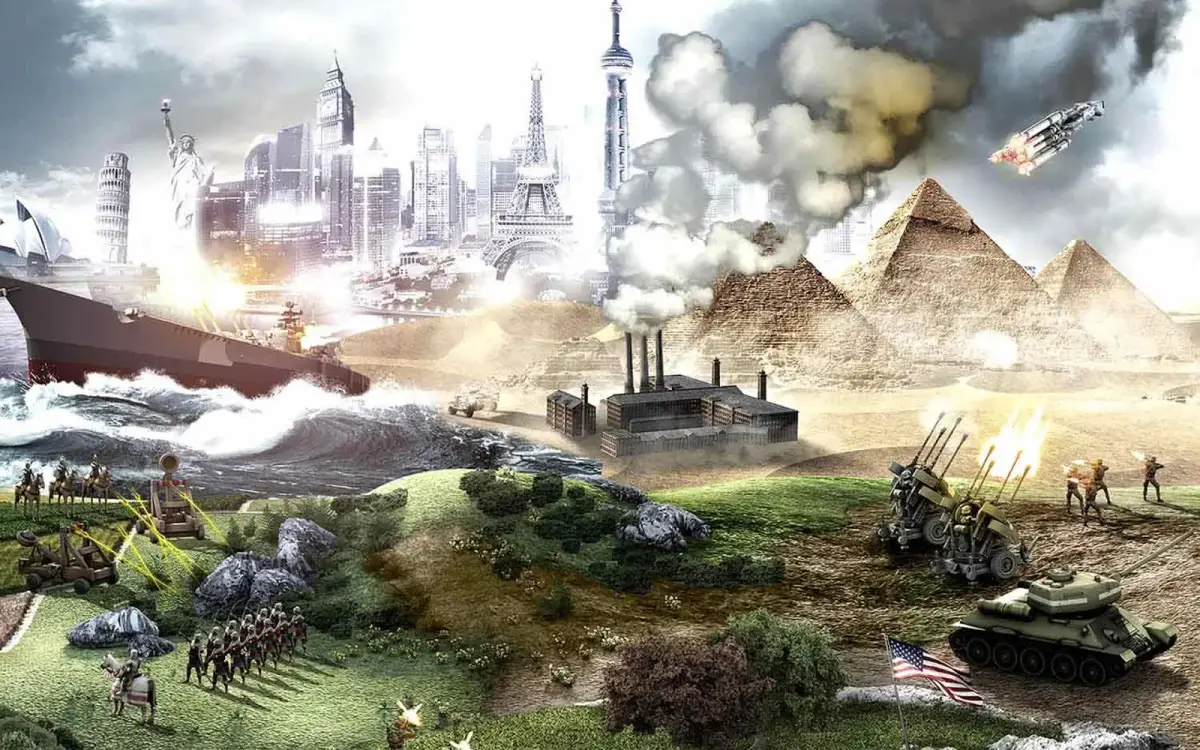
Learn about the end of World War II, the Cold War, and the events of September 11, 2001 in Civilization V.
As the US entered World War II, it found itself on the defensive. The Japanese Navy advanced across the Pacific, while German U-boats threatened Great Britain. However, the American industrial base rapidly produced warships, planes, and tanks. By 1942, the US was on the offensive in North Africa and the Pacific. By 1944, Allied troops were in France, leading to Germany's collapse in May 1945. Japan surrendered after the US dropped atomic bombs on Hiroshima and Nagasaki.
The US learned crucial lessons: global involvement is necessary for security, and it's better to rebuild defeated enemies than to harshly punish them. The US spent billions rebuilding Europe and Japan, excluding the USSR.
At the end of World War II, the US emerged as the world's most powerful nation, with an intact industrial base and a battle-tested military. The Soviet Union, however, possessed the strongest army in Europe. Latent hostilities between the US and the Soviet Union escalated due to fears of International Communism and Soviet desires for security against foreign invasion.
For fifty years, the US and the Soviet Union engaged in an arms race, subverted foreign governments, and fought proxy wars. The US fought International Communism in Korea (a tie) and Vietnam (a loss). The Soviet Union gained control of Eastern Europe but suffered a significant loss in Afghanistan. By the late 1980s, internal flaws and excessive military spending bankrupted the USSR, leading to its dissolution in the 1990s and the end of the Cold War.
The Cold War, while costly, drove technological innovation, including communications satellites and space exploration, culminating in the moon landing.
The end of the Cold War brought a brief period of peace to the United States. However, on September 11, 2001, terrorists hijacked four jet planes, crashing two into the World Trade Towers and one into the Pentagon. A fourth attack was thwarted by passengers. The attacks were traced to al-Qaeda, an extremist group based in Afghanistan.
The US responded by invading Afghanistan to remove its fundamentalist leaders and, controversially, invaded Iraq, the home of Saddam Hussein. Currently, the US is working to repair its international image, build alliances against terrorism, and withdraw from Iraq. Afghanistan remains a difficult challenge, and victory in either conflict is uncertain. The US now shares superpower status with China and is struggling with economic recovery and internal issues related to slavery and racism.
100% Human-Written. AI Fact-Checked. Community Verified. Learn how AntMag verifies content