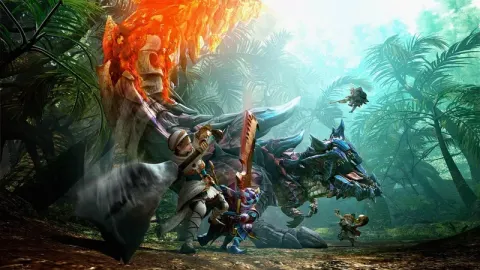
Understand true damage, sharpness multipliers, elemental damage, and status effects in Monster Hunter Generations. Learn how weapon stats truly work.
Walkthrough
- 1Understand that the displayed raw power of a weapon is its true damage potential, not a conceptual representation.
- 2Recognize that raw power is increased or decreased by the weapon's sharpness (Blademaster weapons only).
- 3Consult the sharpness table for raw and elemental damage multipliers: Red (50%/25%), Orange (75%/50%), Yellow (100%/75%), Green (105%/100%), Blue (120%/106%), White (132%/112%), Purple (145%/120%).
- 4Note that purple sharpness is unobtainable in Monster Hunter Generations; white is the highest achievable level.
- 5Understand that staying at Green sharpness or above buffs or does not change damage, and these multipliers are applied before monster defenses.
- 6Consider that armor skills like Sharpness+1 and Sharpness+2 are highly valued for their damage-increasing effects.
- 7Be aware that elemental damage is also shown in its true form, with numbers that matter despite appearing small.
- 8Understand that elemental damage is affected by sharpness and monster resistances, with different parts having varying percentage values that determine how much true damage is applied.
- 9Recognize that some monsters are immune or highly resistant to certain elements, making elemental choice important (e.g., avoid fire against Rathalos).
- 10Note that weapons with higher motion values (e.g., Great Sword) are less dependent on effective elemental damage compared to weapons with smaller motion values (e.g., Dual Blades).
- 11Understand that status effects (Poison, Sleep, Paralysis, KO, Blast) function independently of monster parts, with each monster having different thresholds for affliction.
- 12Be aware that some monsters are immune or highly tolerant to certain statuses, while others are weak (e.g., Duramboros is weak to poison).
- 13Know that after a status is inflicted once, it takes more hits to inflict it again, and tolerance can increase significantly.
- 14Understand that the status value on a weapon has a 1/3 chance of affecting a monster's threshold with each hit that deals status damage.
- 15Recognize that fast-attacking weapons (e.g., Dual Blades, Sword and Shield) are more effective at applying status effects due to their higher frequency of hits and thus more chances to trigger the 1/3 chance.
- 16Understand that Monster Hunter Generations displays true raw weapon power, unlike previous games where numbers were inflated for conceptual clarity, which can be confusing for beginners.
Tips
- Staying at Green sharpness or higher significantly buffs your damage potential.
- Armor skills like Sharpness+1 and Sharpness+2 are crucial for maximizing damage output.
- Choose elemental damage types that monsters are weak to; avoid using elements they resist.
- Weapons with high raw damage (like Great Swords) rely less on elemental damage than fast-attacking weapons (like Dual Blades).
- Fast-attacking weapons are excellent for applying status effects due to their rapid hit rates.
- Pay attention to monster tolerances for status effects, as some are more susceptible than others.
100% Human-Written. AI Fact-Checked. Community Verified. Learn how AntMag verifies content