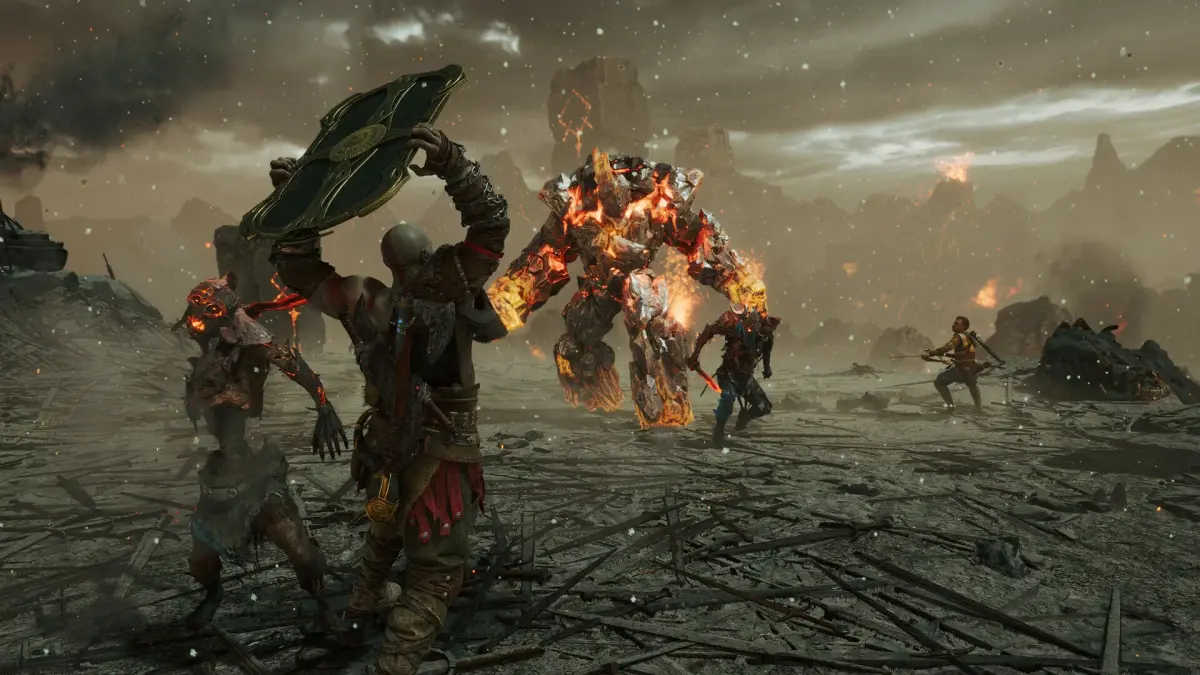
Choosing between the Dauntless Shield and Stone Wall Shield in God of War Ragnarök? Learn their pros, cons, and upgrade paths to find the best fit for your playstyle.
Alright, so you've just finished up with The Huntress and met up with Sindri again. Soon after, you'll find yourself at his place in the Realm Between Realms, where Brok will also show up. Kratos's shield got pretty banged up fighting Thor, so Brok offers you a choice between two new shields to use for now: the Dauntless Shield and the Stone Wall Shield. Honestly, you could stick with one of these for the whole game if you really like it. The big question is, which one should you pick? Let's break down the good and bad of each.
Dauntless Shield
The Dauntless Shield is all about taking risks for big rewards. Its special move is called Shield Bash, which you can activate by double-tapping [Circle/B]. This move does a good chunk of stun damage to enemies. What's cool is that if you nail a regular parry right before using Shield Bash, it gets stronger. Nail a perfect parry, and it gets even stronger!
Basically, if you like to play aggressively, this shield is for you. It's not really the type of shield you can just hold up to block everything; most enemies will power through a standard block. Instead, it's built for those perfect parries – tapping [Circle/B] just as an enemy's attack is about to land. If you get the timing right, the enemy gets pushed back a bit, giving you a window to attack. A perfectly timed parry also adds some stun damage, which is super helpful for building up to a Stun Grab with [Triangle/Y].
So, if you're confident in your parrying skills, the Dauntless Shield is a solid choice for boosting your stun damage. Just remember, you can't just hold [Circle/B] to block most attacks like you can with the Stone Wall Shield, even against regular enemies.
Stone Wall Shield
The Stone Wall Shield is more of your classic, defensive option. Its special move is Shield Slam, activated by double-tapping [Circle/B]. This slams the shield down, knocking enemies back. You can only use this after you've blocked enough attacks (usually 2 or 3) to fully charge the shield by absorbing the hits.
This shield lets you hold down [Circle/B] to block multiple attacks, which is way more forgiving if you're struggling with parry timings. It's generally a better bet when you're facing tough single enemies or groups where unexpected attacks can easily throw off your timing. Keep in mind, you still can't block attacks that have a red ring around them, but everything else is fair game.
Just a heads-up, there's a limit to how many times you can block consecutively. If you keep blocking without using Shield Slam to release that absorbed energy, an enemy will eventually break through your guard. You should still mix in your own attacks and not rely solely on defense.
Shield Upgrades
Beyond how you play with them, think about how these shields improve as you upgrade. Both shields increase their Defence stat at the same pace, starting at 10 and going up to 130. But from upgrade level 3 onwards, they get an extra perk.
- Dauntless Shield: You can eventually boost your Cooldown stat up to 26, meaning you can use your special attacks more often.
- Stone Wall Shield: You can increase Vitality to level 26. This not only bumps up your maximum health but also improves your stun resistance.
A Bit of Lore: The Guardian Shield
You might be wondering why Kratos makes a point about his old shield, the Guardian Shield. It was actually a gift from his wife, Laufey (also known as Faye), given to him on their anniversary. Even though Kratos is all about stoicism, he's definitely got a sentimental side!
100% Human-Written. AI Fact-Checked. Community Verified. Learn how AntMag verifies content