Learn the basics of your adventure in Alola, including character movement, Pokémon basics, turn-based battles, managing your party's HP and PP, and saving your game.
You’re a seemingly average child who’s just become a Pokémon trainer. Despite being new to the Alola region, it’s not long before you’re thrust on an exciting and Pokémon-filled adventure. Your powers are myriad, including the ability to travel endlessly without need of rest, or food… or sleep. Nevermind your bag that can fit anything and everything inside.
To move your character around, you use the left Circle Pad (located above the D-pad). You can run by holding the B button. If you spot anything or anybody of interest, press the A button to interact. This will enable you to talk to people, read messages, pick up items, or just poke something. Whatever the case, don’t be shy with that A button.
Pokémon are your partners in crime… wait, that sounds wrong. No, they’re your partners in bringing justice to the world. Or something like that. Anyway, Pokémon–those amiable pocket monsters–are extremely important. Without them, you can’t get far in the Pokémon world. Heck, you’d probably struggle to make it beyond the front door.
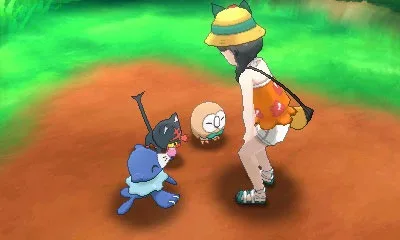
At the very beginning, you’ll be given one of three starter Pokémon to accompany you. From there, it’s your responsibility to capture new Pokémon and raise your Pokémon party. With Pokémon by your side, you can fight off the aggressive Pokémon found in the wild and battle other Pokémon trainers to earn valuable experience.
Your adventure takes place in the bountiful Alola region, which consists of four natural islands and fifth, artificial island. Alola is a large place, with a wide variety of locations–from populated towns to peaceful pathways or dwelling places for exotic Pokémon. Whilst the places you visit can differ a lot in appearance, they generally fall into two types:
Battles are turn-based in Pokémon, so you can afford to take your time.
For the most part, Pokémon battles occur between two Pokémon–yours versus the wild Pokémon or the opposing trainer’s Pokémon. During battles, trainers pick moves for their Pokémon to execute, while wild Pokémon use a random move. The battle is won if you defeat all of the opponent’s Pokémon or if you KO or capture the wild Pokémon.
Winning battles grants Experience Points for your participating Pokémon, which eventually allows them to Level Up and become stronger. If you defeat a trainer, you’ll also earn Poké Dollars (money) that you can spend in shops or elsewhere. Capturing Pokémon helps expand your team options and fill up the pages in your Pokédex.
During each Pokémon battle, your Pokémon’s HP and PP may deplete. HP (Hit Points) are your Pokémon’s health–once their HP drops to 0, your Pokémon will faint and be unable to participate in battle. If all Pokémon are knocked out, you’ll automatically run back to the Pokémon Center you last visited, dropping some of your money in the process.
PP (Power Points) are the number of times a Pokémon can use a particular move. Each move has its own maximum PP value; typically the stronger the move, the less PP it has. Once a move’s PP reaches 0, the Pokémon will be unable to use the move. HP and PP can be restored by visiting a Pokémon Center or by using items such as Potions or Ether.
Last–but definitely not least–don’t forget to save your game via the X button menu, especially before or after you’ve completed something important or if you need to take a lengthy break from the game. The last thing you want is losing all your hard-earned progress for the day! This is especially important in an age where auto-saving is very common.
100% Human-Written. AI Fact-Checked. Community Verified. Learn how AntMag verifies content